So excited to share our latest preprint, introducing a powerful genealogical compression algorithm for biobank-scale genetic data
With Amber Shen, Xinran Wang, and Nick Mancuso @nmancuso_
https://t.co/LpDTWzn7Z3
🚀 New article — not April Fools:
How to Optimize Your Rust Program for Slowness
Write tiny programs that run longer than the universe — using loops, Turing machines, and hand-written tetration.
📝 https://t.co/6lmVv2GgBq
#RustLang#TuringMachines#BusyBeaver#Programming
🚨New preprint! The orange-bellied parrot is predicted to go extinct by 2038 due to devastating genetic diversity loss. We tracked >200 years of genomic erosion. Here’s what we found and what it means for conservation. 🧬🦜 #ConservationGenomics https://t.co/Usp1hEKdqR
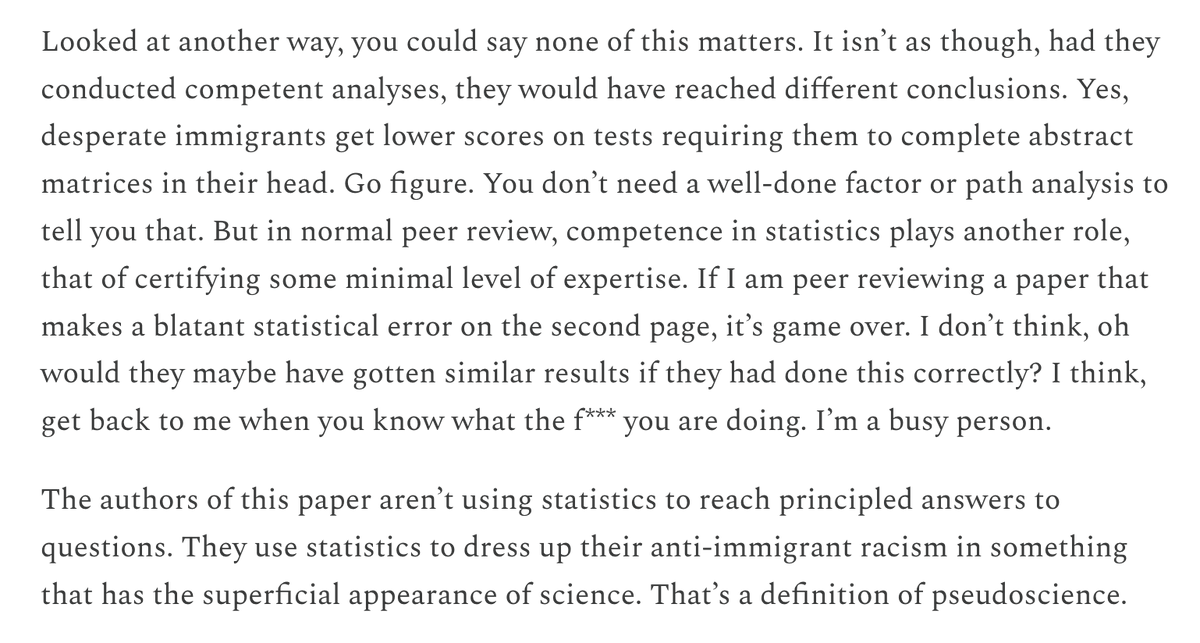
More on this embarrassing pseudoscience from Eric Turkheimer, who (with Paige Harden) argues the paper should never have even passed peer-review: "get back to me when you know what the f*** you are doing"
https://t.co/hJRxlqkugD
The Li + Durbin 2011 paper showing that you can infer an entire population history from just a single genome is still one of the most mind-blowing results in genetics I have ever seen.
https://t.co/5yFPxNc8Pu
Congrats to my friend and colleague Guosong Hong for his stunning and original discovery, published today in Science, on clearing tissues *in living animals* with a common food dye!
The dye is tartrazine, used in Doritos!
https://t.co/fqVivyH0kI
Last week The Atlantic featured an article on the rising popularity of race/IQ science on the right (https://t.co/6A2yiv3MMh). The obvious point that "intelligence is not like height" sparked an unusual amount of whinging. I wrote about how this is now more true than ever. 🧵
I wrote about some recent studies identifying widespread gene-environment interactions (GxE) acting on common traits, but through an unexpected mechanism. A few highlights 🧵:
#OnThisDay in 1858, a seminal journal article comprised of papers by Alfred Russel Wallace FRS and Charles Darwin FRS on the theory of evolution by natural selection was published by the @LinneanSociety, the first public announcement of the theory. https://t.co/xCid7qBpO5
I just finished my master's degree in Bioinformatics at Aarhus University. These last two years have been beautiful personally, but also very professionally rewarding so if you are interested bioinformatics projects I have been involved in, please take a look at my github page!
I wrote about the menagerie of twin heritability models and the wide range of estimates they are reporting. Another front in the missing heritability debate that has been simmering since the 1970's and now rekindled by newer data.
These "how are Sardinians living so long" takes are still popping up. My favorite hypothesis: They lie about (or don't know) how old they are. Few of the 100+ folks have birth cerificates. Same phenomenon in elsewhere: offical birth certs appear -> supercents decline.
@thesteinegger Risk mitigation: I should make minimap2 closed sourced and set up a web service such that each user is only allowed to align 10 reads per day, because minimap2 is used for studying in viral/bacterial strains that in theory can be misused for wrong purposes.
Our genome assembly broke @ncbi! We recently submitted the genome of the endangered White Bark Pine, which has 4 scaffolds that are longer than > 2,147,483,647 bp, which is the largest integer for a 32-bit int (2^31 - 1). So we have to break them and re-submit
much more memory efficient! In fact, my laptop doesn't have enough memory to build the database for the entire datatset with the base R function, and runs perfectly fine with the Rust+R version in ~ 4 seconds (2/n)
https://t.co/0xyIlUz9zq
I *don't* promise anything, but I may try following @PatSchlossin in the yt serie and implement things after him in Rust (but wrap it in an R package using rextendr) as I was looking for an excuse to try!
Up to last video, not bad at all!
https://t.co/mDreRTIf30
I updated the repo. So far, I find cool how to use generics+traits to decouple the Rust code from how R encodes its data structures.
And it is reasonably fast! About 12x faster than base R in a subset of the RDP data when computing conditional probabilities and ... (1/n)