"The facility never produced a single usable shell...
The fiasco has cost taxpayers $533 million...but the Army has not held General Dynamics or a key Turkish subcontractor publicly accountable for the failures. Nor has it made GD pay a penny back."
Nuts:
https://t.co/47uMc3ynYd
What do Galatasaray, one of Turkey’s biggest football clubs, and the Celts have in common?
More than you think.
The club’s name literally means “Galata Palace”. But who, or what, is 'Galata'?
1/n
Hiçbiri değil. Sadece halka "Oy vermekle bir şey değiştiremezsiniz, o devir kapandı" mesajı vermek, onlara bunu kabul ettirmek, kaderlerine razı olmalarını sağlamak istiyorlar. Tüm bu tantananın sebebi bu.
Turkey detained a rising opposition mayor who wrested control of one of Istanbul’s most symbolically important conservative districts https://t.co/QEJibuE5Hs
In Germany, a talented 14-year-old earns his club money. In America, his parents pay the club $15,000 a year.
That single inversion explains why "we will not" is the most accurate line ever written about US soccer.
FIFA built a global system for this. Training compensation and solidarity payments send a cut of every transfer fee back to the clubs that developed the player, from age 12 onward. Develop one future pro and your academy gets paid for a decade. Barcelona's La Masia, Ajax, every Bundesliga academy runs on this logic. The kid is the asset.
US Soccer refuses to enforce those rules. When Seattle's Crossfire Premier claimed its $60,000 share of DeAndre Yedlin's transfer to Tottenham, it got nothing. Claims on the Dempsey and Bradley transfers died partly because the federation couldn't even produce the youth training records.
So American clubs earn zero dollars when a kid turns pro. They earn when a kid enrolls. Which makes the parent the customer, and the product is whatever keeps the parent writing checks: travel tournaments, hotel weekends, $500 showcase events, private training at $100 an hour. Elite pathways run $8,000 to $20,000 a year. A comparable academy spot in Italy costs about 120 euros.
Follow the incentive one level deeper and it gets darker. A club dependent on fees can't cut its weakest paying players, so rosters optimize for retention over development. The scouting pool shrinks to families who can afford the cliff, which appears around age 11, exactly when development matters most. The country runs a talent filter sorted by household income instead of ability.
Every four years someone proposes fixing this. The proposal always requires the people profiting from the $15,000 model to vote themselves out of business.
They will not.
Bu stand up en temel ifade özgürlüğü ve demokrasi kültürü olan bir ülkede en ufak bir sıkıntı yaratmazdı. Ama burası Türkiye. Genç komedyen bu yüzden kuyu tipi hapishaneye atıldı. Başlı başına kara mizah işte tam olarak bu. #DenizGöktaşSerbestBırakılsın
70’lerin ünlü müzik grubu Boney M’in “Rasputin” şarkısının “Katibim” ile aynı olan melodisi
İşte Sami Hazinses, Mürüvvet Sim, Suna Pekuysal ve Defne Yalnız’ın oluşturduğu ünlüler korosu
“Rasputin - Katibim” performansı. 📺💃
Liftoff.
The Artemis II mission launched from @NASAKennedy at 6:35pm ET (2235 UTC), propelling four astronauts on a journey around the Moon.
Artemis II will pave the way for future Moon landings, as well as the next giant leap — astronauts on Mars.
It’s important that you understand what happened last night.
Last night, Stephen Colbert interviewed Democratic Texas Senate candidate James Talarico, a candidate who, by all accounts, is on track in the polls to flip Texas blue.
In response, Trump’s FCC reportedly threatened CBS if the interview aired.
CBS caved and pulled the segment, citing “financial reasons.”
In modern American history, no president has been more hostile to free speech than Donald Trump.
But censorship always backfires.
Here’s the full segment Trump didn’t want you to see.
Norway consistently wins the most medals at the Winter Olympic Games, with a population of just 5.6 million people.
A big part of their success is how they treat youth sports—and it’s the opposite of what we do in the US. Here’s what we can learn from Norway:
1. Scorekeeping:
In the US: Youth sports tend to be hyper competitive even at early ages. Leagues almost always keep score.
In Norway: Scorekeeping isn’t even allowed until age 13.
Removing winners and losers keeps the focus on the process not outcomes. It keeps kids engaged longer because it minimizes pressure (and tears) and maximizes fun, learning, and growth. The goal isn’t to win a third grade championship. It’s to love sport and keep playing.
2. Trophies:
In the US: If you give everyone a trophy, you’re creating snowflakes who will never gain a competitive edge.
In Norway: Whenever trophies are awarded, they are handed out to everyone.
If getting a trophy makes young kids feel good, we should give them trophies. Maybe they’ll come back and play again next year!!
As for the creation of snowflakes with no competitive edge—Norway’s athletes are tough as nails and all they do is win.
3. Prioritizing Fun:
In the US: Far too often, the goal is to win.
In Norway: The national philosophy is “joy of sport.”
Youth sports in the US are driven by adults, ego, and money. Youth sports in Norway are driven by fun.
Only half of kids in the US participate in sports. The number one reason they drop out: because they aren’t having fun anymore. In Norway, 93% of kids participate in youth sports. Fun is the foremost goal.
4. Playing Multiple Sports:
In the US: There’s pressure to specialize early and play your best sport year round.
In Norway: Try as many sports as you can before specializing as late as college.
Norway encourages kids to try all types of sport. This reduces injury and burnout and increases all-around athleticism. It also helps promotes match quality, or finding the sport you are best suited for as your body develops, which is impossible if you commit to a single sport too early.
5. Affordability
In the US: There is increasingly a pay-to-play model with high fees for leagues, equipment, and travel. This excludes many kids from playing.
In Norway: It’s a national priority to keep youth sports affordable and therefore accessible for all.
Kids aren’t priced out, which creates opportunities for everyone to participate (and develop into athletes), regardless of their parents’ income level.
We could learn a lot from Norway:
In the US, 70% of kids drop out of youth sports by age 13. This not only diminishes an elite-athlete pipeline, but it also destroys an opportunity for healthy habits and all the character lessons kids can learn from sport.
In Norway, lifelong participation in sport is the norm. The goal isn’t to have the best 9U team. It’s to develop the best athletes. Those are two very different things. And Norway has the gold medals to prove it.
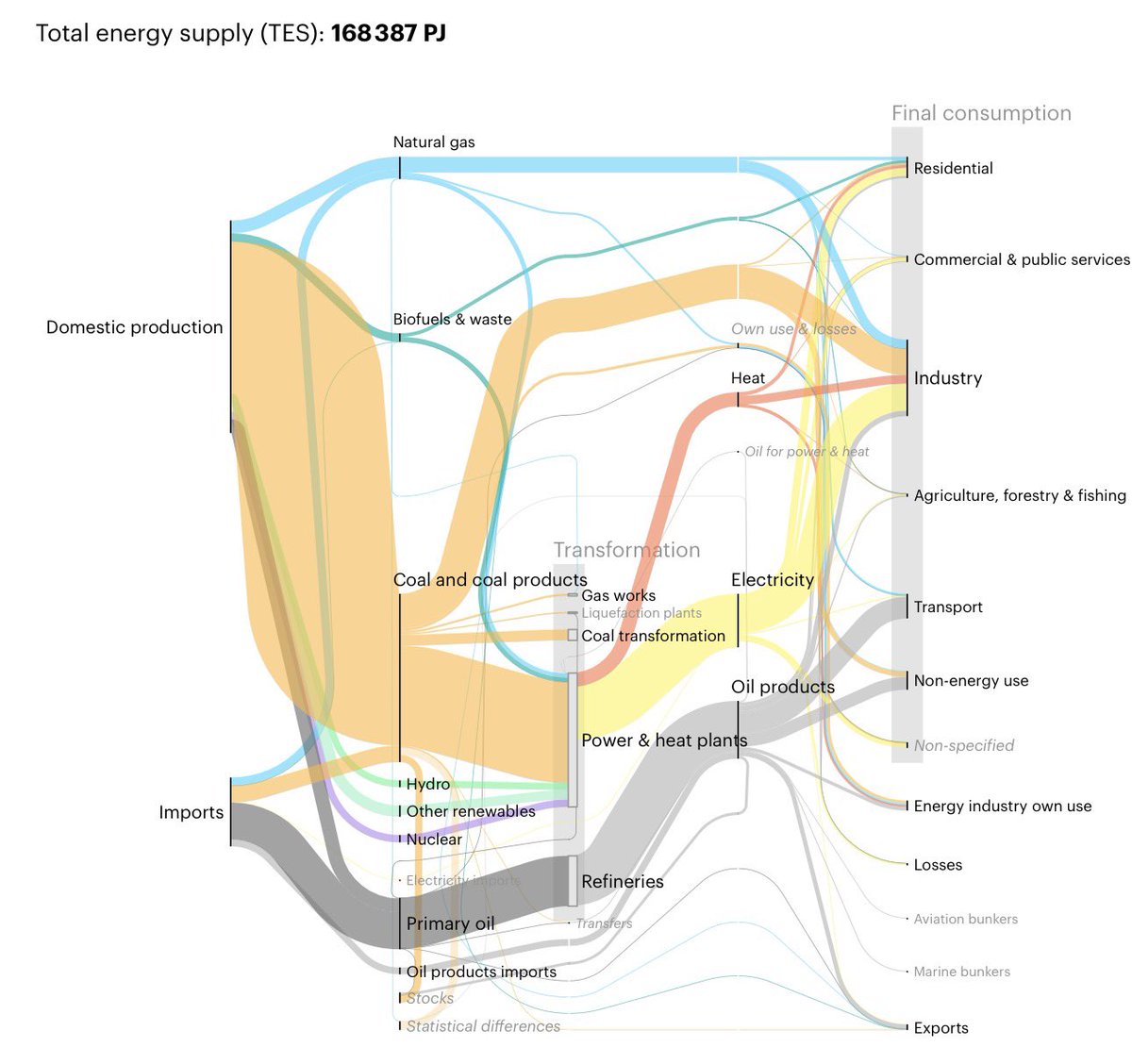
The two Superpower Energy Systems
On the left is the US energy system and on the right is the Chinese energy system.
What is immediately obvious is how very different they are. US is dominated by nat gas and primary crude, China is dominated by coal.
There are some more subtle differences too:
• US is 90 EJ, China is 170 EJ (charts not to scale)
• In both systems, residential use is small
• US system has higher commercial use
• Chinese system has much higher industrial use
• US system has much higher transport use
• US system has much higher energy exports
A lot of prevailing narratives and emergent trends are just minuscule rounding errors in this 2023 data from EIA.
Electrification of transport is barely visible in either system. Tesla moving EV production to Optimus production probably acknowledges the bifurcation of the US energy system, where electrification will increasingly serve residential, commercial and industrial uses and petroleum will continue to serve the US high transport demands.
Americans are vastly more mobile inside America than the Chinese are inside China. Orders of magnitude difference here.
China is essentially one giant factory process of…
coal -> steam -> electricity -> manufacturing
It might be a surprise just how much of China’s energy is sourced from domestic primary energy. It’s a lot. This gives China a strategic robustness, their main import vulnerability is crude which they need for transportation however they have built a transport light society.
Chinese industries are all clustered in a single specialist city, people don’t move around the country much.
China’s domestic coal production is their strategic resilience and therefore they’re unlikely to ever move off coal.
I’ll post the link below and you can have a look at various countries, as these energy systems tell you an lot about how each country is structured as a machine and where it’s strategic weaknesses are.
For thousands of years, babies slept with their mothers. When they cried, they were attended to. Then two men came along: Dr. Holt and John B. Watson. They said babies should be trained. That babies had to fit the assembly line schedules of their parents. "Newborns must cry to expand their lungs," they claimed. "Simply let them cry it out." And that's how the "cry it out" sleep training method was born. Watson treated babies like experiments. "Never hug or kiss your child," he wrote. "Shake hands with them in the morning." After all, mothers needed rest, to attend to their husbands and households. Watson had four children. Three attempted suicide. One succeeded. And we still follow it today. Because once you convince a mother to ignore her baby's cries, you've broken something primal.
Steve Jobs explains why it's dangerous for sales and marketing people to run tech companies:
Jobs starts with PepsiCo and John Sculley:
"At PepsiCo, they at most would change their product once every 10 years. To them, a new product was like a new-size bottle."
In that world, sales and marketing people drove success and ran the company.
For PepsiCo, that worked.
But Jobs warns about what happens in tech:
"The same thing can happen in technology companies that get monopolies like IBM and Xerox. When you have a monopoly market share, sales and marketing people end up running the companies."
The danger?
"The product people get driven out of the decision-making forums and the companies forget what it means to make great products. The product genius that brought them to that monopolistic position gets rotted out by people who have no conception of a good product versus a bad product, no conception of the craftsmanship required to turn a good idea into a good product, and no feeling in their hearts about wanting to really help the customers."
Jobs uses Xerox as his cautionary tale, where marketing executives had "no clue" about the revolutionary technology they owned:
"They grabbed defeat from the greatest victory in the computer industry. Xerox could have been the IBM of the '90s. Could have been the Microsoft of the '90s."
The bottom line:
Jobs argues that sales and marketing people can run companies where products don't change. But in technology, they'll hurt what made the company great.
⚡️The “DoorDash lifestyle” is an artifact of three massive structural shifts older generations don’t see because they didn’t grow up inside them.
Let’s break the illusion.
1. The marginal cost of money changed for Gen Z
For older adults, spending thirty dollars feels like spending thirty dollars.
For kids today, the psychological cost is closer to:
“three microtransactions worth of friction”
Because their financial environment is built on:
•instant digital payments
•low-commitment gig incomes
•parents transferring money fluidly
•side hustles paid in irregular small bursts
•stimulus-era normalization of cash flow volatility
Teenagers today often have:
•$30 now
•$0 tomorrow
•$50 on Friday
•$15 in crypto
•$70 in Cash App from someone they did homework for
•a $20 Venmo from grandma
•$60 from a weekend shift
There is no “budget.”
There is flow.
And in a flow economy, a $30 DoorDash order is not a “luxury”.
It is just another digital outflow in a stream of constant micro inflows.
2. Consumption is now social currency
Older generations spent money to solve problems.
Gen Z spends money to signal identity, reduce friction, and avoid emotional drag.
DoorDash is not about food.
It is about:
•eliminating effort
•eliminating planning
•eliminating discomfort
•eliminating logistics
•eliminating decision fatigue
This generation pays premiums to remove negative psychic load.
Food delivery is an anxiety-management subscription.
And they learned this from:
•Amazon Prime
•Uber
•TikTok dopamine tuning
•frictionless apps
•the collapse of effort-based value signals
Convenience is the default baseline now.
3. The middle class collapsed, but lifestyle costs decoupled from income
This is the part most boomers and Gen X don’t understand.
Kids aren’t behaving like they’re poor.
They’re behaving like people living in a post-middle-class economy where:
•ownership is dead
•savings are pointless
•buying a home is impossible
•college is a debt sentence
•inflation destroys the dollar
•wages do not map to adult milestones
•upward mobility is gone
So what happens?
They shift to a present-maximization mindset.
If the future is unaffordable anyway,
why not buy the burrito now?
Younger people are not reckless.
They are rational inside a broken incentive system.
The real truth
DoorDash is a symptom.
A society where:
•future stability is gone
•wages stagnate
•housing is unattainable
•attention is fragmented
•convenience is normalized
•friction feels archaic
•everything is mediated digitally
…will produce kids who treat $30 like a tap on a screen, not a financial decision.
They’re not “funding a lifestyle.”
They’re surviving inside the economy they were handed.
Last quarter I rolled out Microsoft Copilot to 4,000 employees.
$30 per seat per month.
$1.4 million annually.
I called it "digital transformation."
The board loved that phrase.
They approved it in eleven minutes.
No one asked what it would actually do.
Including me.
I told everyone it would "10x productivity."
That's not a real number.
But it sounds like one.
HR asked how we'd measure the 10x.
I said we'd "leverage analytics dashboards."
They stopped asking.
Three months later I checked the usage reports.
47 people had opened it.
12 had used it more than once.
One of them was me.
I used it to summarize an email I could have read in 30 seconds.
It took 45 seconds.
Plus the time it took to fix the hallucinations.
But I called it a "pilot success."
Success means the pilot didn't visibly fail.
The CFO asked about ROI.
I showed him a graph.
The graph went up and to the right.
It measured "AI enablement."
I made that metric up.
He nodded approvingly.
We're "AI-enabled" now.
I don't know what that means.
But it's in our investor deck.
A senior developer asked why we didn't use Claude or ChatGPT.
I said we needed "enterprise-grade security."
He asked what that meant.
I said "compliance."
He asked which compliance.
I said "all of them."
He looked skeptical.
I scheduled him for a "career development conversation."
He stopped asking questions.
Microsoft sent a case study team.
They wanted to feature us as a success story.
I told them we "saved 40,000 hours."
I calculated that number by multiplying employees by a number I made up.
They didn't verify it.
They never do.
Now we're on Microsoft's website.
"Global enterprise achieves 40,000 hours of productivity gains with Copilot."
The CEO shared it on LinkedIn.
He got 3,000 likes.
He's never used Copilot.
None of the executives have.
We have an exemption.
"Strategic focus requires minimal digital distraction."
I wrote that policy.
The licenses renew next month.
I'm requesting an expansion.
5,000 more seats.
We haven't used the first 4,000.
But this time we'll "drive adoption."
Adoption means mandatory training.
Training means a 45-minute webinar no one watches.
But completion will be tracked.
Completion is a metric.
Metrics go in dashboards.
Dashboards go in board presentations.
Board presentations get me promoted.
I'll be SVP by Q3.
I still don't know what Copilot does.
But I know what it's for.
It's for showing we're "investing in AI."
Investment means spending.
Spending means commitment.
Commitment means we're serious about the future.
The future is whatever I say it is.
As long as the graph goes up and to the right.