🚨 New #OpenAccess publication! 🚨
Excited to share my article with @cwegscheider in Politics & Governance. Common wisdom holds populist attitudes stem from discontent—but is this driven by economic grievances, political alienation, or both?
https://t.co/51x5e7IIY6
🧵1/10
How do radical right youth leaders in Austria and Germany understand democracy?
A new paper (available open access) by @luiseante, Uwe Backes, @reinhardheinis1, Steffen Kailitz and @cwegscheider investigates.
https://t.co/WkHehwS2yn
Capable but Not Empowered? Carsten Wegscheider (@cwegscheider) & Marlene Mauk (@MaukMarlene) examine how emancipative values affect protest participation across different contexts. Read OPEN ACCESS in @PolStudies: https://t.co/k2Pz4Sv2my
@PolStudiesAssoc@SAGECQPolitics#ECRs
As populism is hot, measuring its prevalence among political actors has been a core challenge of empirical research. In a new @polanalysis, @michaelj505 and I discuss potential pitfalls of measuring populism through text-as-data approaches https://t.co/RHkXZP48qk
@Robert_A_Huber, @michaelj505, and @cwegscheider investigate how discontent fuelled by unfulfilled policy preferences affects the level of populist attitudes: https://t.co/IAiJwUr3fX
How are parties’ ideological positions and levels of populism connected? @michaelj505, @christinajuen and I propose an integrated framework to study populism in the two-dimensional policy space. This piece is forthcoming in @EJPRjournal: https://t.co/hy97fRtQU6
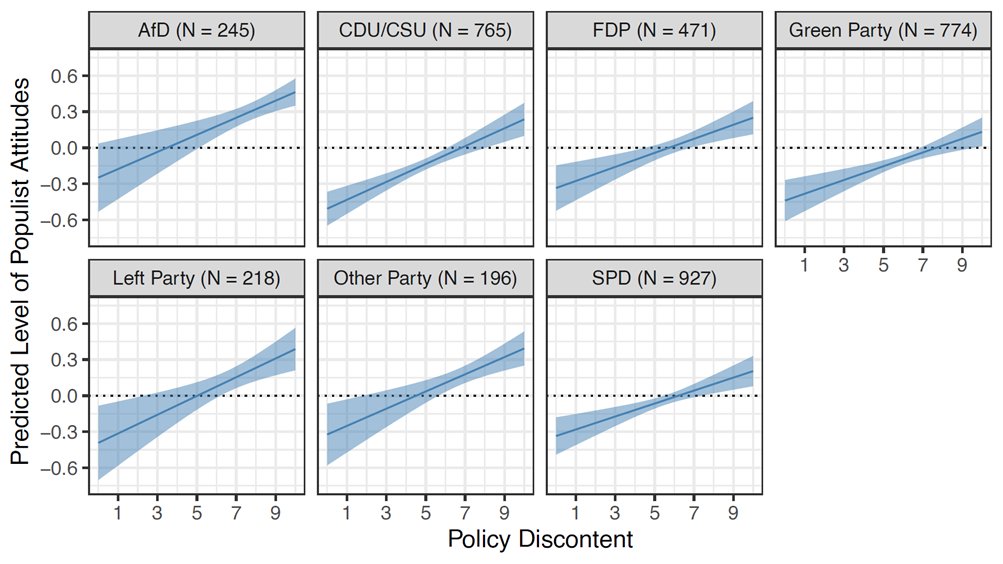
We conclude that populist attitudes could be partially mitigated by ensuring that people feel better represented and that their policy positions are reflected in government actions. Thanks to @gles_data, the editors (@AStroppe) and the reviewers for this exciting experience!
In a published @RegReports in @PVS_journal as part of the GLES Open Science Challenge (@gles_data), we (w/ @Robert_A_Huber & @michaelj505) show that populist attitudes arise from policy discontent in highly salient issue areas: https://t.co/WV1g2hxOt2
Our results show that policy discontent is strongly connected to populist attitudes. Moreover, the positive effect of policy discontent is independent of vote choice, which helps in explaining intra-party variation in populist attitudes.
Really excited to see our (w/@ToralfStark) article published with @SpringerNature in Zeitschrift für Vergleichende Politikwissenschaft. https://t.co/qujS6YHOXz
What started as a master's thesis in 2017 is now coming to an end. Very grateful for all the support (@dr_supi @Robert_A_Huber@normaosterberg @ChristophMoham1) and my wonderful co-author and friend @ToralfStark!