I’m super excited to share my new 𝘄𝗼𝗿𝗸𝗶𝗻𝗴 𝗽𝗮𝗽𝗲𝗿:
I investigate how winning or losing an election influences citizens’ understanding of whom a politician should represent.
PDF: https://t.co/Cl7NFDUz0W
A short 🧵: (1/9)
🚨Very excited to share that my first solo publication "Testing the social pressure hypothesis: Does in-party social pressure reduce out-party empathy?" is out in @PNASNexus 🚨
🔗 https://t.co/MLlQGen6Nj
Here’s what I find 🧵1/6
Nimbyism is often explained through property values or exclusion. But in recent work with @NNyholt, we explore a different perspective—local preservationism. It’s less about keeping people out and more about preserving neighborhood character. Read more: https://t.co/P3zN7VCDQx
This new database by @VHeddesheimer, @hannohilbig, @abwiedemann, and Florian Sichart is fantastic and incredibly useful for anyone working with German election data.
https://t.co/i3kSTIjRrg
"Immigration frequently does not trigger a nativist backlash or extremist political mobilization; the relationship between immigration and conflict is highly contingent on political decisions."
@RDancygier
https://t.co/8xpH9z2YYP
My work on immigrant integration considers policies that either remove structural barriers to integration without imposing cultural ones or that make specific accommodations for cultural diversity
Really happy to share a piece of this work @AJPS_Editor
https://t.co/HUBybyYCam
Der @Tagesspiegel berichtet über den Wahlkampf der AfD in Brandenburg, der sich speziell an Schüler:innen richtet. Unter anderem mit einer Einschätzung von mir zu den kurz- und mittelfristigen Implikationen solcher Strategien.
Now out in @PNASNexus! We find that correcting misperceptions about the out-party has no consistent effect on partisan animosity, support for partisan violence, or support for undemocratic practices, suggesting that corrections are not a panacea for addressing democratic ills.
In light of the UK extreme-right (ER) riots & Tommy Robinson's role in them, our conditionally accepted @BJPolS paper w/@FlorianFoos shows a causal effect of media exposure to extreme right actors, incl. Robinson, on support for extreme right views: https://t.co/ab8f91mCqH 1/11
Ever wondered about what social desirability bias can tell us about how society works, and how we can measure it? Then check our new working paper in which we test different ways to manipulate social desirability in online surveys👇
Interested in the effect of cross-class exposure on attitudes toward redistribution?
In a new paper in @BJPolS, Kim Sønderskov, @ThistedPeter, and I find that local exposure to poor individuals reduces support for redistribution among the well-off.
OA: https://t.co/5S5gf8cxWJ
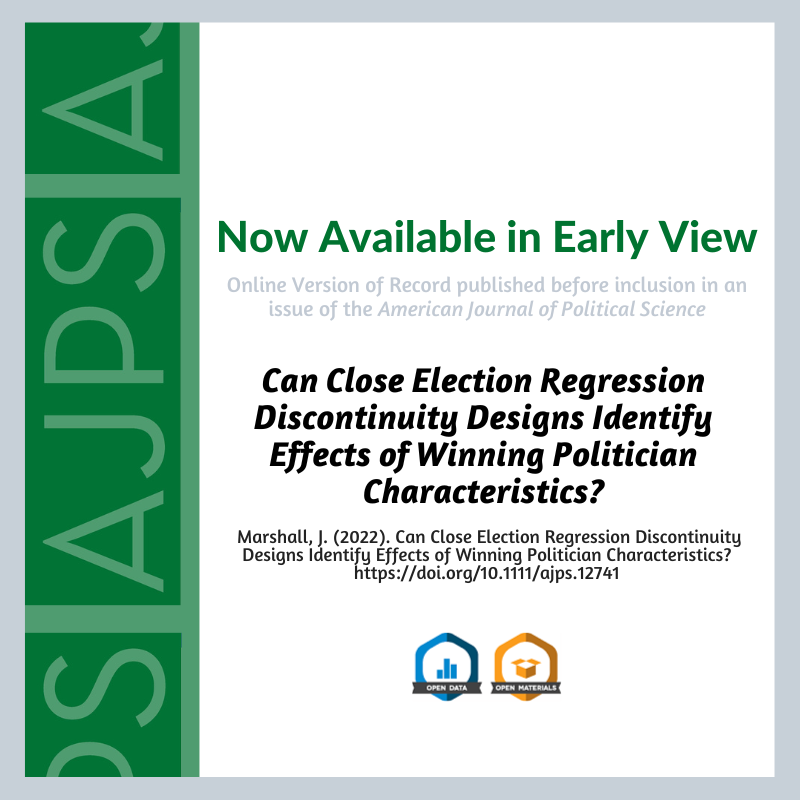
Can Close Election Regression Discontinuity Designs Identify Effects of Winning Politician Characteristics? by John Marshall is now available in Early View. https://t.co/nBW9YGAwQb
🚨Job🚨
I am looking for a postdoc for my @dfg_public project “Powerful Polls” (@unipotsdam).
Start date: October 1 (latest)
Please share widely and apply!
Do not hesitate to get in touch in case of questions.
Full job add: https://t.co/RbvbbzLrnI
Check out our new paper on the impact of political and economic inequalities on online hostility across 30 countries, with important implications for combating online hostility👇
Led by @boralexander1 with @M_B_Petersen & @A_Marie_sci
Next up in the Migration & Ethnicity Workshop @AarhusUni is @tim_allinger : "When institutionalized minority exclusion legitimizes hate crimes: The case of the nomad camps in Italy." All welcome 🤗