You get $1 million but must donate half to charity. What cause first?
A) Children's education
B) Animal shelters
C) Medical research
D) Homeless support
Elon Musk admitted he is not sure this one is possible.
Musk: “This absorbs more of my mental energy than probably any other single thing. But it is so preposterously difficult that there are times where I wonder whether we can actually do this.”
He does not talk like this. Mars gets a date. Robotaxis get a date. This gets a maybe.
Stern: “What is so hard about it for just a normal person to understand?”
His answer comes down to a single number.
Musk: “In order to make a rocket fully reusable, you’ve got to basically create a rocket that can do about 4%, if not more than 4%, of its lift-off mass to orbit, which hasn’t happened before.”
Four percent. Everything else standing on that pad is fuel, tank, and engine.
The landing gear, the heat shield, the extra structure that survives reentry, all of it comes out of that same four. None of it can be left behind. The vehicle has to come home.
Musk: “So that means you have to have basically A-pluses across the board: incredibly efficient engines, incredibly efficient structure.”
Across the board is what makes this brutal. Most engineering lets you buy a weakness in one place with strength somewhere else.
The margin here is thin enough that one component landing at merely excellent drops the whole vehicle below the line. Nothing carries anything.
Musk: “But if full and rapid reusability can be achieved, it reduces the cost of access to orbit by a factor of 100 or more.”
A hundred times cheaper turns nearly every question about space from whether into when. Telescopes, stations, factories, missions that never made it past a spreadsheet.
Musk: “So we’ve got to get rockets to the point where we simply refuel the rocket and we don’t throw it away.”
Every other vehicle humans build already works that way. Space is the one place we still build the machine, use it once, and let it fall into the ocean.
Musk: “It’s the difference between humanity being a single-planet species and a multi-planet species. It’s really that big of a deal.”
Now put his doubt in context.
Landing an orbital booster upright was considered impossible by most of the industry. He spent years being told so while boosters exploded on barges. Those landings became routine, then boring, then unwatched.
Then they stopped using legs.
A twenty story booster came back from the edge of space, slowed itself, and hovered next to the tower it launched from. Two arms closed around it and took its weight in midair. Nothing touched the ground.
That was a headline for about a day.
He has been on this side of impossible before, more than once. Doubt from him measures how hard the thing is at the start rather than how it ends.
Most people never attempt anything where failure is genuinely on the table. He found the hardest problem available and made it the center of his life.
That is what real ambition looks like from the inside. Not certainty. A number nobody has ever hit, and showing up to it every morning until it falls.
🔴La Unión Europea multa a X con 120 millones de euros por “falta de transparencia” del algoritmo.
🔴La respuesta de Musk? Publicar todo el algoritmo en GitHub, con actualizaciones cada cuatro semanas. Y no solo eso: hará públicas todas las peticiones de censura que llegan de los gobiernos, incluidas las de la propia Unión Europea, que parece especialmente aficionada a pedirlas.
La presión regulatoria de Bruselas ha acabado generando más transparencia de la que nunca habrían querido�� solo que no en el sentido que imaginaban los burócratas.
Hay que recordar qué hacía Twitter antes de la compra de ELON
Los Twitter Files demostraron que la plataforma colaboraba en silencio con el FBI, el DHS y diversas agencias americanas y europeas para suprimir contenido sin informar a los usuarios ni dejar rastro público. Shadowbanning, eliminaciones de cuentas, reducción de visibilidad… todo pasaba a oscuras.
Ahora, en cambio, la luz llega. Y llegará también a las peticiones de censura que llegan desde Bruselas.
La Unión Europea quería control y en cambio ha acabado obteniendo transparencia. Y eso, para los que creen en la libertad de expresión, es una victoria.
QUE OS PARECE?
See you at #CCN2026 in case you're around!
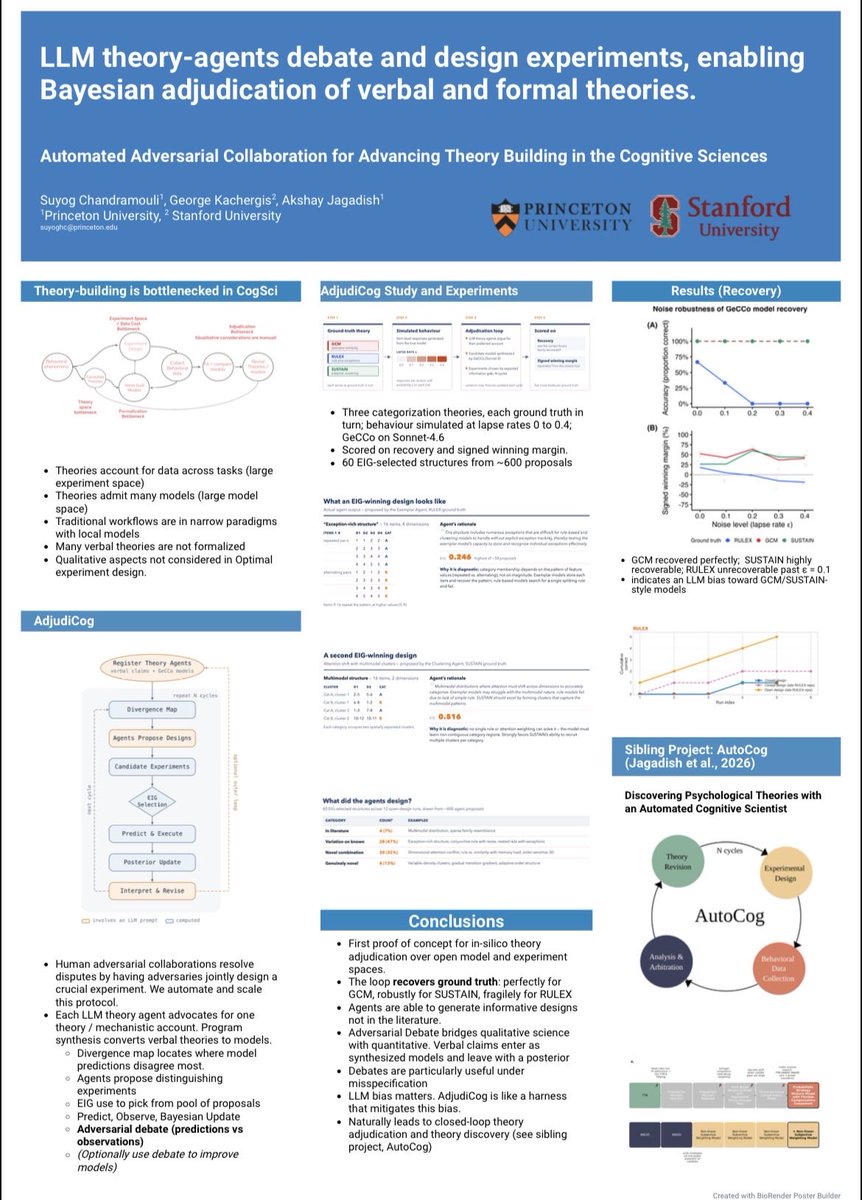
Our work shows how we can use LLMS to integrate qualitative aspects of science (often left to discussions, debates, and verbal theories) with optimal experiment design principles to generate informative experiments and adjudicate between theories.
(with @kachergis and @akjagadish)
@suyoghc will be presenting our work on Automated Adversarial Collaboration for theory building in the cognitive sciences. Come say hi!
Place: Board A10, Kimmel Center, Shorin Room
Time: Today 9:30–11:15am
#CCN2026
https://t.co/GpTDhzXeSL
Fun fact: this is the project that kickstarted our journey towards AutoCog ;)
TIL about nerd sniping! Yep, similar story here! The nerd-sniping feedback loop and contagion started a bit earlier with @akjagadish and @kachergis resulting in related work (https://t.co/PMnmuQIif2), but also spread quickly to Younes & many co-authors who'd been thinking about these topics for a while!
Main symptoms imo: obsession and loss of sleep from trying "just one more thing", expanding the scope and rabbit-holing to adjacent questions, then trying to narrow it down, and finally having "we're almost done" become a somewhat chronic state!
By predicting unseen experiments, and not by matching names!
We used a published dataset with different stimuli and participants by Hilbig et al. (2014) for validation. And we also test predictions from the AutoCog-proposed theory in a prospective preregistration on a new set of participants.
BTW, generalization also acts as selection pressure within the loop itself! Any theory proposed in a given cycle has to also predict well, the data collected by the system in previous cycles on different experiment configurations.
Can AI agents autonomously discover theories of cognition? Turns out, yes!
Excited to share AutoCog, led by @akjagadish and Younes Strittmatter — a project that's been great fun to be part of 👇
1/ 🚨 New preprint: "Closing the Loop to Discover Psychological Theories with an Automated Cognitive Scientist"
Co-led w/ Younes Strittmatter
Co-mentored by @suyoghc and @cocosci_lab
In collaboration w/ @kachergis, @norijacoby, @nathanieldaw, & @cpilab
Introducing AutoCog — a fully autonomous AI system that runs the entire scientific discovery cycle in cognitive science to surface novel theories of human behavior 🧵
#CognitiveScience #AI4Science #LLMs