A New Fed. An Old Playbook.
Will the Fed Start Surprising Investors Again?
When I started trading more than 40 years ago, the Federal Reserve wasn't in the business of telegraphing every policy move weeks or months in advance. There were no dot plots. No quarterly economic projections. No press conferences after every meeting. And certainly, no endless stream of speeches designed to prepare markets for every possible policy move.
If the Fed changed policy, there was often no advance notice. You'd simply hear across the trading desk, "The Fed just lowered the Discount Rate." That was the announcement.
Over time, that changed dramatically.
The Evolution of Fed Communication
• Before February 1994 – The Fed generally did not issue immediate public announcements after FOMC meetings. Market participants often had to infer policy changes by observing the Federal Reserve's open-market operations.
• February 4, 1994 – For the first time, the FOMC publicly announced a policy decision immediately after a meeting, marking the beginning of a significant shift toward transparency.
• February 2000 – The Fed began issuing a statement after every FOMC meeting, regardless of whether rates changed.
• Early 2000s – The Fed increasingly embraced forward guidance, using communication to shape expectations about future policy.
• After the 2008 financial crisis – Forward guidance became a central policy tool, reinforced by press conferences, economic projections, and the now-famous dot plot.
The objective was understandable. Greater transparency was intended to reduce uncertainty, improve the transmission of monetary policy, and help households, businesses, and investors prepare for changes in interest rates. In some respects, it succeeded.
But like most things in markets, every benefit comes with a trade-off.
The more policymakers reveal in advance, the more that information becomes embedded in prices before the event occurs. Markets become more efficient. Surprises become less frequent. And opportunities created by mispriced expectations become harder to find.
For active investors, that's an important distinction.
Information alone has never produced exceptional returns. Insight does. Markets reward investors who recognize something the crowd hasn't yet fully appreciated. When policy is carefully choreographed months in advance, one of the market's greatest sources of investment opportunity - information gaps - begins to disappear.
That's one reason I've found the recent discussion surrounding Chairman Kevin Warsh's desire to reduce the Federal Reserve's reliance on forward guidance so interesting. Some commentators view it as a dramatic departure from modern central banking. I don't.
To me, it's simply a return to a style of policymaking that was standard for much of my career. Whether that's ultimately better for the economy is a legitimate debate.
From the perspective of an active investor, however, I have little objection to a Federal Reserve that reveals less and lets markets do more of the analytical work. Markets should respond to changing facts—not to an endless stream of forecasts about what policymakers might do months from now, which is simply a form of manipulation. Too often, those forecasts create as much confusion as clarity.
Markets function best when independent thinking is rewarded, not when everyone is handed the same script.
Will the Fed start surprising investors again? Time will tell.
But one thing hasn't changed. Markets have never paid investors for knowing what everyone else already knows. They reward those who prepare better, think independently, and recognize change before it becomes consensus. Whether it's the Federal Reserve, corporate earnings, or the next market leader, the edge has never come from following the crowd.
Greatness is not a one-time event or a hit or miss affair, it's a process and a lifestyle... and greatness in all forms requires discipline. If can't be disciplined, you can't be great. It's as simple as that.
Why does everyone think KMT is now a puppet party of CCP?
Constant report via WeChat to their CCP boss.
Shame on KMT legislators for betraying the trust of Taiwanese citizens.
You only need one strategy to get rich in the stock market. The sooner you commit to being great at it, the sooner it will pay you. But you will never get paid well for knowing a little about many strategies. To be great at one thing you have to sacrifice others. Now get to work.
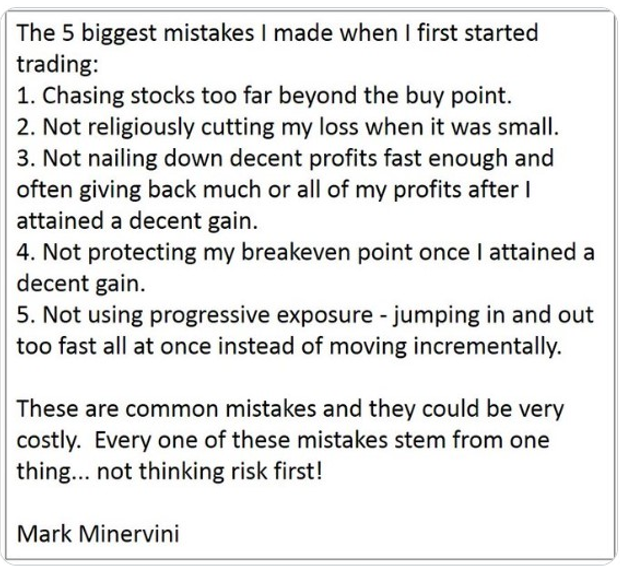
Here are some of the biggest mistakes I made when I was new to trading and very likely the same mistakes you will make a well. They all stem from one thing!