Kurt Gödel established that for any reasonable set of mathematical axioms, it’s impossible to prove that they won’t eventually lead to contradictions. This meant that mathematicians could never again be certain that their rules were self-consistent. https://t.co/rOzVXJUdO9
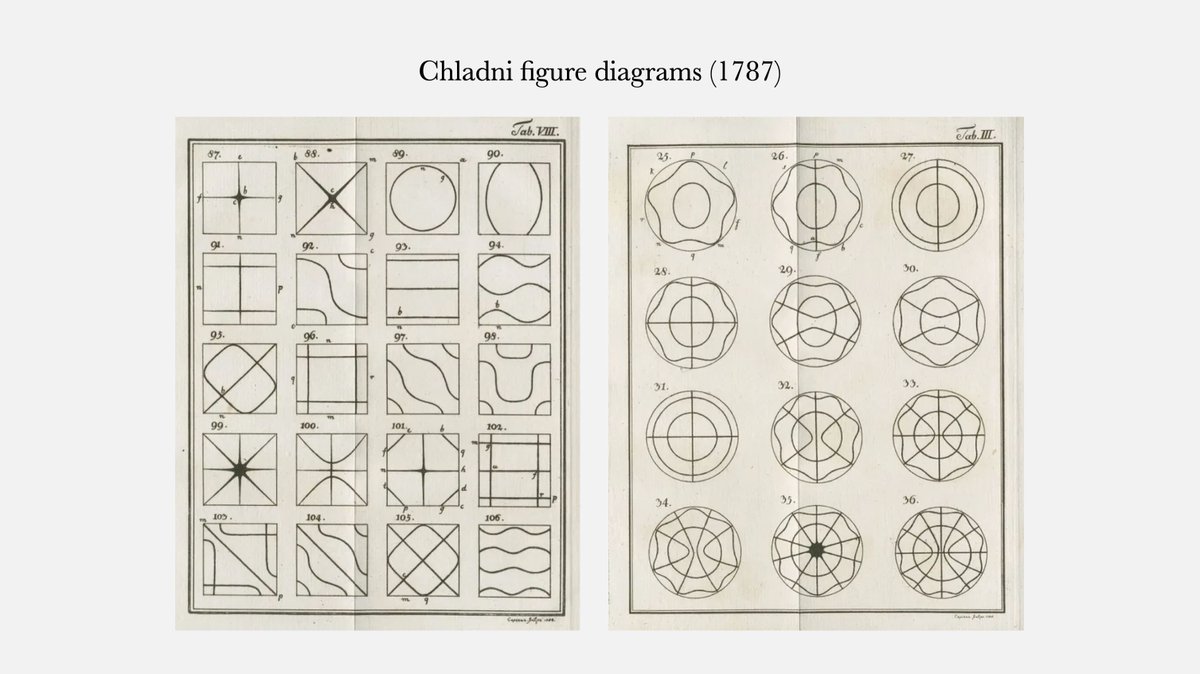
Ernst Chladni was a German physicist and musician, often called "the father of acoustics." In the late 18th century, he developed a technique that made sound visible: he sprinkled sand on metal plates and bowed them with a violin bow. The sand migrated to the nodal lines revealing geometric patterns now known as Chladni figures.
In 1808 when Napoleon saw the demonstration and was so impressed he offered a prize for the best mathematical explanation. Sophie Germain, a self-taught French mathematician was the only entrant who got the approach right - though her solution had some flaws. She became the first woman to win a prize from the Paris Academy of Sciences for her work on elasticity theory.
The math describing Chladni figures later showed up in quantum mechanics when Schrödinger used similar mathematics to describe electron orbitals.
"I have learned more from my failures than can ever be revealed in the cold print of a scientific article and now I would like you to learn from them, too."
The opening line of Sir Tony Hoare's 1980 Turing Award lecture. He passed away last week at 92
This week we feature the annotated version of the full lecture: "The Emperor's Old Clothes"
The idea that math is some fixed, immutable edifice has never been right. It’s always changing, and mathematicians are constantly reexamining their own assumptions, even ones they hold dear. Our new series, “The Evolving Foundations of Math,” offers a glimpse of how modern research mathematics became what it is today — and what it might be tomorrow. https://t.co/DqZsuuo32H
You may think you know how to count. But when mathematicians count, they mean something very specific: matching the objects in a mathematical “set” to the natural numbers (1, 2, 3,…). When they apply this matching method to infinite sets, things get interesting. https://t.co/PLLchh213o
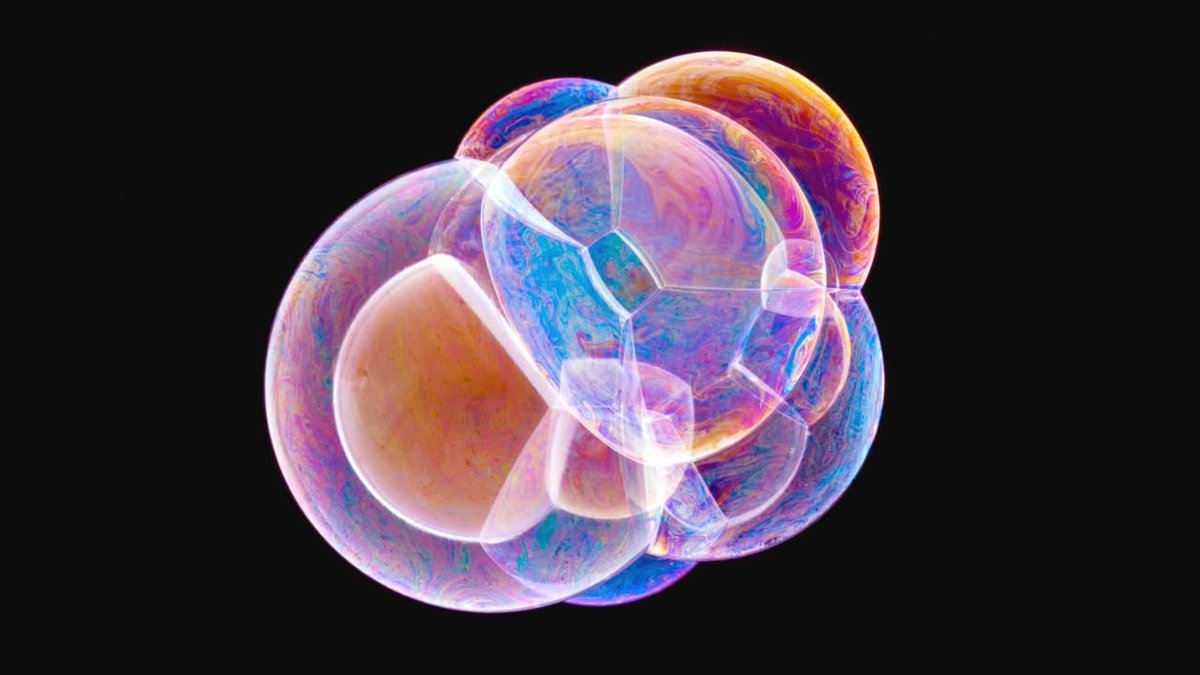
Symmetry has long been a guide for mathematicians, but sometimes the most beautiful answer to a problem is not the best answer. In the bubble problem, beauty and symmetry have prevailed once more. (From the archive) https://t.co/vjdvdkqZiL
Principia Mathematica is a famous book written by Alfred North Whitehead and Bertrand Russell.
In this book, they spent hundreds of pages developing logic before finally proving that 1 + 1 = 2 in Section *54 on page 379.
The title Principia Mathematica to *56 means this edition includes content up to Section *56, which covers the basics of arithmetic.
What’s the point of handwriting? Lane Greene, our language correspondent, explains why writing trumps typing when trying to learn: https://t.co/ZxZiRuUJrK
Difficulty of proving the Generalized Poincaré Conjecture as a function of dimension:
- n=1: Trivial
- n=2: Easy (19th century)
- n=3: Perelman (2003), declined Fields Medal
- n=4: Freedman (1982), won Fields Medal
- n≥5: Smale (1961), won Fields Medal
Don't flip out! Pushing our hardware to its limits with RL feats helps make a better robot for our customers.
Watch the full video: https://t.co/XJpPMN2wR2
Meet Atlas: 5 feet, 9 inches, 200-pound AI-powered humanoid created by Boston Dynamics. It has learned to crawl, walk, run, and dance autonomously. https://t.co/nLtymEbQts