@BryceJohanneck@a16z@rmcentush@Cypher_Coin If you guys are interested, just read this blog, maybe you'll remember me as the crypto guy who actually worked it out:
Introducing InterGridCoin
https://t.co/81GdtU3vZO
@Cypher_Coin is laying the foundations of e-business today.
I have greater confidence that this is now a capable product particularly beneficial for commercial/legitimate applications without the shortcomings of centralized infrastructure.
⏩️⏩️⏩️
So, an advisor had complained that my blockchain wasn't exactly a public blockchain. He naively called it a consortium chain, which isn't accurate either. Well, ok, WTH does a public blockchain do? It's a retarded idea in the first place. Don't get hung up on a random design that was made to enable drug trafficking.
A public blockchain is nearly useless. It's dogshit for finance. It doesn't work.
Are you guys STUPID?
Don't be stupid, and you can think new things. 😉
Update on @Cypher_Coin: It was relatively easy to solve the scalability problem but the privacy solution remains somewhat incomplete. I had thought of that as a problem to solve along the way. Improvising a little. 😅
ICOs (aka token launches) are making a comeback. Here's why:
1. Incentive alignment: Token buyers are more invested in protocols than airdrop recipients. While airdrops can drive initial network activity, engagement numbers crash and burn after incentives end. 50% of airdrop recipients dump tokens immediately vs. just 12% in ICOs.
2. Higher upside: ICOs level the playing field for retail investors. No more “high FDV/low float” token launches that favor VCs. No more projects raising private rounds at one FDV, launching publicly at a 20x higher FDV weeks later, and facing constant sell pressure from private markets as they unlock. With ICOs, retail gets better entry points and upside.
3. User acquisition: ICOs bootstrap early user acquisition by selling tokens to incentive-aligned investors that drive word of mouth and product evangelism. A couple hundred evangelists > thousands of detached users.
4. New sale mechanisms: With new sale types available — auctions, node sales, fixed price sales — builders can choose a launch mechanism that best suits their unique priorities instead of just running the meta.
5. Funding: ICOs bootstrap capital formation to fund DAO or foundation operations.
6. Decentralization: ICOs allow projects to achieve decentralization earlier in their lifecycle. Decentralized projects with broad, incentive aligned ownership thrive longer than centralized ones.
7. Regulatory shift: With a Trump-era SEC, the upcoming MiCA token launch framework in Europe, and an increasing number of crypto friendly jurisdictions around the world, founders feel more emboldened to launch tokens without fear of enforcement.
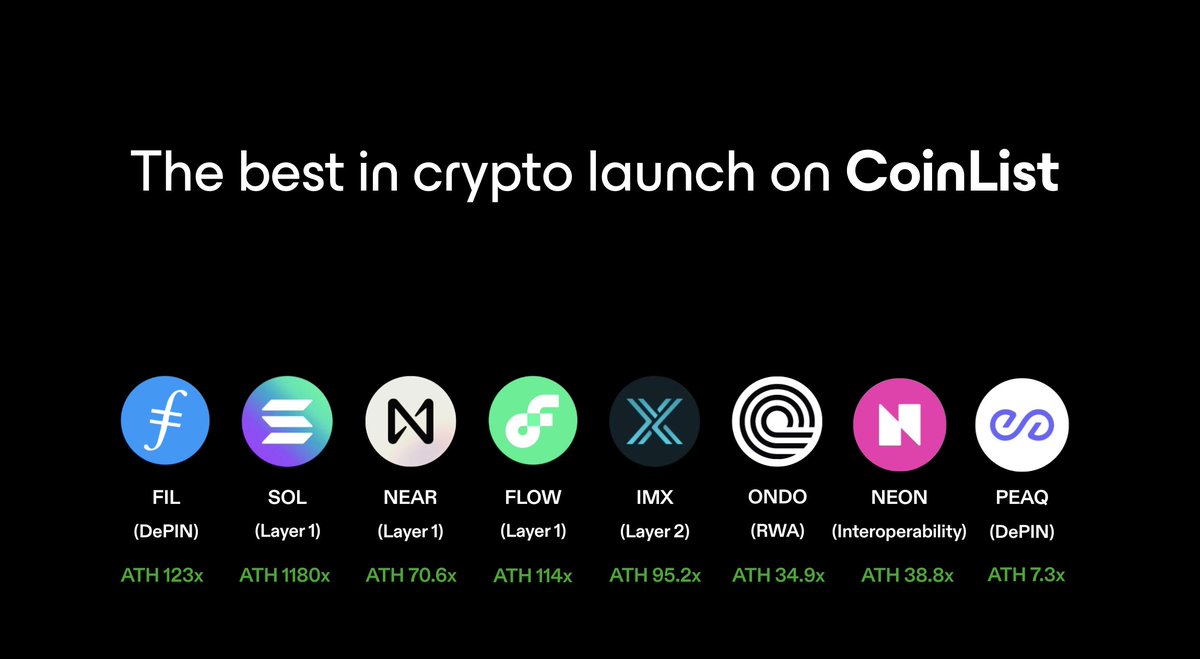
No platform knows ICOs like CoinList. The numbers speak for themselves.
A few of the things we’re excited about in crypto (2025)
→ An AI needs a wallet of one's own to act agentically
→ Enter ‘decentralized autonomous chatbots’
→ As more people use AI, we’ll need unique proof of personhood
→ Going from prediction markets… to better information aggregation for everything
→ Enterprises will increasingly accept stablecoins for payments
→ Countries explore putting government bonds onchain
→ We’ll see greater adoption of the ‘DUNA’, a new industry standard for blockchain networks in the U.S.
→ Liquid democracy online goes physical
→ Builders will reuse, not just reinvent, infrastructure
→ Crypto companies will begin with the end (-user experience), instead of letting the infrastructure determine the UX
→ ‘Hiding the wires’ helps usher in web3’s killer app
→ The crypto industry finally gets its own appstores, and discovery
→ Crypto owners become crypto users
→ Various sectors may start tokenizing ‘unconventional’ assets
Learn more: https://t.co/ZmkfoGnRZy