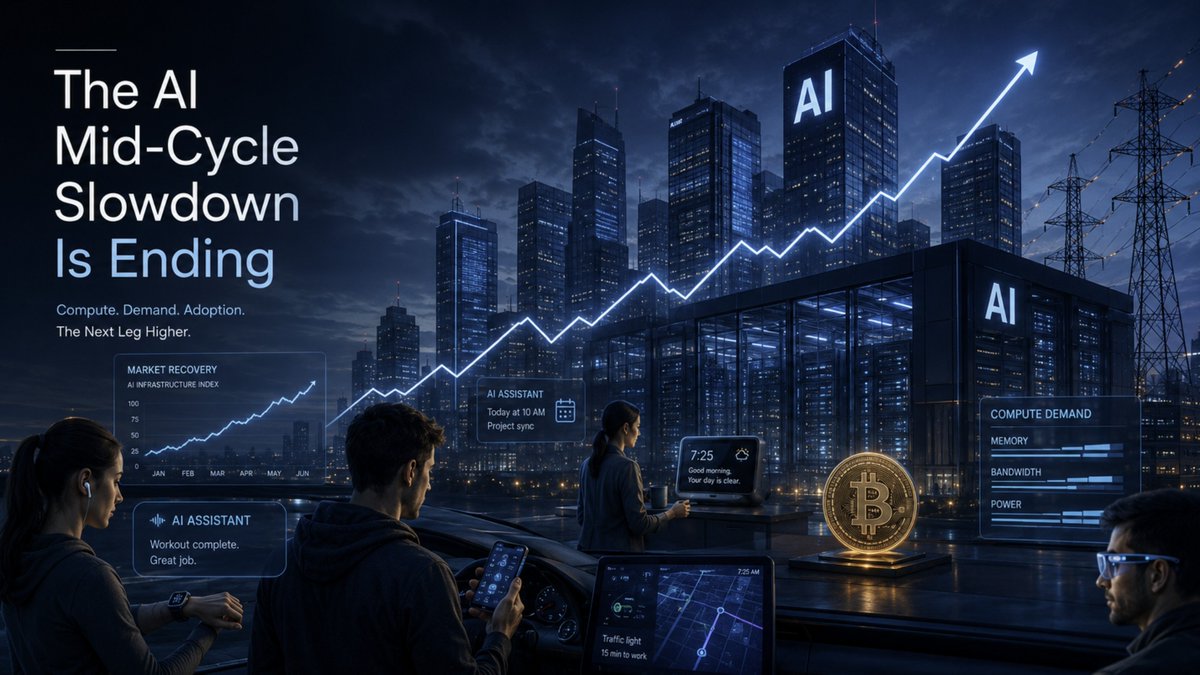
The surprise of he AI mid-cycle slowdown is ending.
The last several weeks were a positioning reset, not the end of the structural bull market. Leverage was flushed, semis became deeply oversold, and the narrative turned bearish just as the underlying demand story kept strengthening.
In this week’s video, I cover:
• Why exponential token demand is colliding with linear supply
• Why memory, bandwidth, power and compute remain scarce
• Why the token index is being misunderstood
• How consumer agents could create the next step-function in usage
• Why Scott Bessent told you Bitcoin, stablecoins and agentic commerce are becoming part of the same AI macro story
• What the technical reset means for the next leg higher
The correction changed positioning. It did not change the trajectory.
Watch here: https://t.co/0lrdMKEasd
Les pompiers pyromanes en politique, c’est exactement ce que nous subissons depuis trop longtemps en France.
Ils passent leur temps à allumer des incendies un peu partout : ils laissent la dette publique exploser sans jamais remettre en cause les dépenses inutiles et le clientélisme, ils accompagnent le déclin industriel avec des normes, des taxes et des interdictions qui étouffent nos entreprises, ils maintiennent une immigration massive et incontrôlée pendant que la sécurité se dégrade jour après jour dans nos villes et nos campagnes, et ils multiplient les contraintes idéologiques sur les Français qui veulent simplement travailler, produire et vivre normalement.
Et une fois que le feu a bien pris, que les services publics craquent, que le pouvoir d’achat fond et que la colère des citoyens monte, les voilà qui reviennent en héros : plan d’urgence par-ci, loi exceptionnelle par-là, quelques milliards supplémentaires jetés sur le bûcher pour calmer temporairement les esprits… avant de recommencer exactement le même schéma quelques mois plus tard.
Plus déconnecté de la réalité des Français, ce n’est pas possible. Ces responsables qui ont organisé ou laissé faire le désastre s’indignent ensuite que le pays brûle, tout en protégeant avant tout leurs intérêts, leur idéologie et leur petit jeu de pouvoir.
En réalité, ces pompiers pyromanes cherchent surtout de l’attention : médiatique, politique, électorale.
Chaque crise qu’ils contribuent à créer leur offre une nouvelle scène pour apparaître, annoncer des mesures spectaculaires, occuper le terrain et se donner l’image de ceux qui "agissent", même si c’est pour éteindre un feu qu’ils ont eux-mêmes contribué à allumer.
Fascinant n’est-ce pas ?
La solution est pourtant simple et radicale : il faut arrêter de leur donner cette attention qu’ils recherchent tant. Et de montrer leurs contradictions sans les prendre au sérieux.
Cela passe par un grand refus citoyen :
ne plus accepter leurs plans d’urgence permanents, exiger un retour strict à la réalité (maîtrise des dépenses, priorité à la production et à la sécurité, arrêt net des dogmes idéologiques), et surtout voter massivement pour des responsables qui n’ont pas passé leur carrière à mettre le feu au pays.
Nous n’avons plus besoin de ces pyromanes en costume qui créent des crises pour mieux se mettre en scène.
Ok, here’s my honest take.
Every piece snapping into place like clockwork.
China has spent years dodging Western oil sanctions by quietly sourcing from Venezuela and Iran, keeping its economy insulated from USD pressure. Trump’s non-negotiable mission is to obliterate BRICS, bury de dollarization for good, and reinstall the USD as the unchallenged global reserve currency for the next century. To refinance America’s towering debt load he needs interest rates driven into the ground. To steamroll the 2026 midterms he needs stock markets in full blown euphoria. The cleanest, fastest way to deliver both at once?
Precision geopolitical conflict that spikes energy prices, supercharges defence and industrial stocks, floods the system with liquidity, and forces every player back onto America’s chessboard.
Connect the dots because they’re not random:
- The US moves decisively on Venezuela, securing its enormous oil reserves, lithium, gold, and rare earth minerals.
- Canada now fully aligned and openly supporting the US steps up with comprehensive diplomatic cover, logistical bases, intelligence sharing, and even limited expeditionary support. Ottawa’s move instantly locks down the entire Western Hemisphere energy corridor, creates a seamless North American fortress, and sends an unmistakable signal to every ally and adversary: “The West is unified, and America is back in charge.” China’s first major lifeline is severed overnight.
- Beijing, panicked, doubles down on its Iranian supplies.
- Then, literally last night, Trump green-lights “Operation Epic Fury” devastating precision strikes (with Israeli support) that target the Iranian regime’s command centers, nuclear sites, and oil infrastructure while broadcasting direct calls for the Iranian people to rise up. China’s second critical lifeline is gone in hours.
That leaves only Russia.
But here’s the masterstroke that’s still flying under the radar…Russia and the US I think are already in back channel talks for a historic deal on energy, trade, and security that brings Russian oil and gas flooding into Western markets. Canada’s rock solid alignment gives Trump the perfect geopolitical bridge…a bulletproof North American energy bloc plus Russian resources creating an unbreakable alliance that completely isolates China.
BRICS is dead in one decisive stroke.
Once China is totally cut off it has zero leverage left. Beijing will be forced to come crawling back to the United States for everything…oil, minerals, technology, and market access. Trump’s response? “Hold our debt.”
America sets the terms.
China is handed massive tranches of US debt at favorable rates, the dollar undergoes a controlled, orderly reset, and the entire global financial system realigns under Washington’s leadership. Central banks worldwide have been stockpiling physical gold for exactly this moment as the ultimate backstop and hedge against the transition.
And here’s what happens to Bitcoin in the next phase because crypto is the missing piece that turns this from dominance into total supremacy:
As the conflict premium hits energy markets and defense budgets explode, liquidity floods risk assets.
Bitcoin, already positioned as digital gold and the ultimate inflation hedge, breaks out violently first surging past $200k on pure market momentum and institutional FOMO.
Then, once the Russia deal is signed and the dollar reset is underway, Trump drops the bombshell…an executive order establishing a strategic US Bitcoin Reserve. Using seized Venezuelan assets and windfall revenues from the new energy alliance, America becomes the world’s largest sovereign Bitcoin holder overnight. This single move does three things at once:
1. It legitimizes Bitcoin under American control, pulling it away from Chinese mining dominance forever;
2. It gives retail and institutional investors the green light to pile in without regulatory fear;
3. It supercharges the market rally needed for midterm victories.
🔴🇫🇷ALERTE INFO | Laure Beccuau, procureure de Paris, appelle sur franceinfo les potentielles victimes françaises à se faire connaître dans le cadre de l’affaire Epstein.
Elle annonce l’ouverture de deux « enquêtes cadres » au parquet de Paris.
For those of you that are enduring their first major Bitcoin dip, it might be confusing as to why the FUD (Fear Uncertainty and Doubt) seems to be coming from so many different random venues. This is not a mistake.
The reason many bitcoiners (myself included) have such a strong aversion to crypto is because it is a distraction from Bitcoin itself and it usually ends with newer players allocating capital to the wrong place.
That distraction gets amplified in co-ordinated FUD attacks that are often led by the crypto VCs, and the crypto leaders. Last round XRP were paying @Greenpeace to lie about bitcoin’s environmental impact.
This round we have seen Z-Cash get tabled as Bitcoin with privacy by a whole host of crypto bros and VCs and it was later proven that people were being paid to circulate this nonsense (privacy can be effectively handled using coinjoin on bitcoin).
Next came the quantum FUD, we don’t know who is behind this (yet) but it is definitely another coordinated effort with a number of VCs who definitely know better behind the narrative - today Julius Baer (second largest swiss private bank) wrote a report stating that because of quantum risk potentially releasing Satoshi’s coins and lost early coins Bitcoin could no longer be considered a store of value asset - this is like saying that because China may find a large gold deposit in 20years time, gold can no longer be considered a store of value asset - but these are the idiotic things that get said when the FUD does its work.
As for “pedo coin”, (Jeffrey Epstein having apparently backed some early bitcoin devs and therefore there is some backdoor for evil people built into Bitcoin), I had assumed that this would be openly ridiculed but somehow some people actually think that this is an issue as mentioned by Gary Cardone on the town hall yesterday - who thinks some newer OGs will sell on the back of this. (It’s open source for God’s sake!! 🤯)
If this is your first cycle, a lot of this can seem very real and frightening, but it is just the same old bullshit dressed in different clothes. People paid to put bitcoin down to promote some shitcoin that fixes privacy, or quantum, or just to get you to sell (to them)….
The truth is, it is all designed to scare you, to shake your conviction, to make you sell. The FUD is indeed coordinated.
Rather than panic or get concerned, just do your own research, there is plenty out there on coinjoins, and quantum processing levels needed to crack wallet encryption and likely timelines and solutions being proposed / worked on. All these attacks just help your conviction when you take the time to learn.
Bitcoin is the only hope to escape from much of the evil that the fiat system creates…
Nothing is ever certain and while the current FUD is all bullshit, I am not saying that we have already won and Bitcoin becomes the new monetary system…. but for the sake of humanity, I hope it does. 🙏🏼
BREAKING 🚨 TESLA IS DELETING AN ENTIRE SUPPLY CHAIN BY PRINTING ITS POWER MAGNETICS 🧲
If you want to understand how Tesla plans to cut vehicle costs in half, don't look at the Gigapress—look at the power magnetics.
These are the unsung heavyweights of the EV world. Transformers and inductors are the massive chunks of copper and iron that convert grid voltage into something your battery can actually use. In almost every other power converter on earth, they are the heaviest, most expensive, and hardest-to-manufacture parts on the board.
But Tesla is deleting them—or at least, the version we know.
Published back in August 2024, patent WO 2024/167845 A1 revealed a massive shift in how Tesla handles this "power nervous system." And they aren't stopping there—just last month (December 2025), a continuation patent (EP4662685 A1) dropped, confirming that this planar architecture is the long-term play for their next-gen global fleet.
Basically, Tesla is replacing an entire ecosystem of clips, coils, and bobbins with a printed circuit board.
Here is the deep dive into how they are doing it.
🦖 The problem: Traditional magnetics are a dinosaur
If you have ever taken apart an onboard charger, you know the struggle. The traditional wire-wound transformer is the "dinosaur" of the circuit board. It is bulky, stands tall like a skyscraper on a flat map, and is a nightmare to manufacture.
You need specialized vendors for magnetic cores, plastic bobbins, and Litz wire. Then you have to wind it, solder it (messy), and bolt it down (risky). Plus, these tall components act like thermal bottlenecks and radiate electromagnetic interference (EMI) like a radio tower. It is the single biggest thing stopping us from making chargers smaller and cheaper.
🧩 Tesla's solution: The integrated planar PCB transformer
Tesla’s answer is to flatten everything down by integrating the transformer windings directly into the layers of the printed circuit board itself. Instead of wrapping copper wire around a plastic bobbin, they print the "windings" as flat copper traces, which drastically lowers the vertical profile of the component and eliminates the need for complex manual assembly.
But they didn't just flatten it; they merged the resonant inductor and the transformer into a single magnetic "super-structure." By sharing a central core post between these two functions, they create a device that can be manufactured automatically on a standard PCB assembly line.
🪄 The "invisible" inductor winding: doing more with less
One of the most brilliant efficiency hacks in this patent is the elimination of a distinct inductor winding. In a discrete setup, you usually have a transformer coil and a completely separate inductor coil, taking up valuable real estate.
Tesla’s integrated design uses the existing primary winding of the transformer to double as the inductor winding. By wrapping the primary winding around a shared center post that includes a precise air gap, the winding performs two jobs simultaneously: it creates the necessary leakage inductance for the circuit to function while driving the transformer.
This reduces the component count from three windings down to two and cuts the number of magnetic legs from six down to four, drastically reducing the copper resistance and physical size.
🌊 Flux shaping: The "guardrails" that stop the heat nightmare
This feature is so critical it actually spawned its own dedicated patent family (WO 2024/167847 / EP4662686, check out this post: https://t.co/qzbf7I6vPQ if you want a full deep-dive on Flux shaping)
The problem with shrinking magnets is that the magnetic field doesn't like to stay neatly inside the core. It behaves like water spraying out of a leaky hose connection—spraying out the sides in a "fringing field." When this stray magnetic spray hits the nearby copper windings, it creates useless "whirlpools" of electricity (eddy currents) that generate massive amounts of waste heat.
Tesla’s solution is to physically steer this spray using "flux shaping plates." Imagine inserting traffic cones right into the magnetic air gap. These thin magnetic plates catch the leaky field and force it to flow smoothly alongside the copper wires rather than cutting across them.
By guiding the magnetic flow, they stop the heat-generating whirlpools before they start. This clever geometric hack protects the cooling plate from stray currents and allows the charger to run at blazing-fast speeds (>100kHz) without melting down—key to the Cybertruck’s thin "pizza box" design.
🛡️ The pot-core and hybrid architecture: trapping noise while shedding weight
One of the biggest enemies in high-frequency power switching is electromagnetic interference, or EMI, which can wreak havoc on sensitive electronics nearby. Tesla tackled this by designing a fully enclosed "pot-core" structure where the magnetic material effectively wraps around the PCB windings like a shell to keep stray magnetic fields confined.
However, realizing that a fully enclosed core is heavy and expensive, they also introduced a clever "hybrid" structure that acts like a mullet—business in the front, party in the back.
They utilize the enclosed pot-core structure on the inductor side where the magnetic noise is loudest, but switch to an open "EE" or "EI" structure on the transformer side. This reduces the overall weight and ferrite material cost significantly without compromising the shielding where it matters most.
⚖️ The 4-legged core: symmetry and balance
For specific power converter topologies (like LLC resonant converters), where you might want to split the inductance, the inventors introduced a novel 4-legged "EE" core structure. Unlike the standard 3-leg design, this version adds a fourth leg, allowing engineers to distribute the resonant inductance symmetrically or asymmetrically across the primary and secondary sides.
By tweaking the air gaps on the outer legs, they can fine-tune the inductance values independently without changing the main transformer geometry. This creates a "tunable" magnetic platform that allows circuit designers to dial in specific performance curves without redesigning the entire physical assembly.
🔩 Mechanical shielding: the "notched" connection
Connecting a rigid ferrite core to a metal heatsink is a mechanical nightmare because ferrites are brittle and surfaces are rarely perfectly flat. Tesla solved this with a specialized metal shield design featuring "multiple small sections of notches."
These notches act like a suspension system, ensuring co-planarity so that the shield makes solid thermal contact with the heatsink at all points. Additionally, they use raised walls on the heatsink to compensate for height differences between the bottom core and the cooling surface.
This ensures that the heat generated inside the core has a direct, low-resistance path out to the cooling system, preventing the ceramic material from cracking under thermal stress.
📐 Winding geometry: the art of the overlap
The layout of the copper traces on the PCB is where the real magic happens, as Tesla employs a vertical overlapping technique for the primary and secondary windings. By stacking the input and output terminations right on top of each other or interleaving them between layers, they achieve a cancellation effect where the magnetic fields from opposing currents nullify each other.
This dramatically lowers the AC resistance and inductance at the termination points, which are usually major sources of heat and loss in high-current applications, effectively solving the "hotspot" issue that plagues traditional planar designs.
📚 Laminated cores and reluctance control: mastering the bond line
When you scale up power in these integrated structures, you inevitably run into eddy current losses within the magnetic core material itself. Tesla’s design mitigates this by splitting the large magnetic cores into smaller, laminated sections rather than using one giant block.
However, the glue (or bond line) between these split cores can accidentally act like an unpredictable air gap. Tesla solves this via "reluctance control," using the main air gap on the center post to "dominate" the reluctance of the entire circuit.
This means they make the intentional air gap so significant that the tiny, inconsistent variations in the glue thickness between the laminated core pieces become mathematically irrelevant, ensuring consistent inductance values across mass production.
🏭 The supply chain revolution: Ending the chaotic dance of vendors
Perhaps the most underrated aspect of this patent is not electrical but logistical, as it fundamentally changes how these parts are sourced. Traditional transformers require a chaotic dance of vendors supplying Litz wires, ferrite cores, clips, insulation tapes, and bobbins.
By moving to a PCB-based magnetic structure, Tesla effectively consolidates the supply chain down to just the PCB manufacturer and the magnetic core supplier. This vertical integration means they can produce these critical components at massive volume with far lower costs and higher reliability, removing the "black box" of third-party magnetic assembly from the equation entirely.
🚀 How this patent contributes to Tesla's now and future
This technology is not just a component upgrade; it is a strategic enabler for the "Unboxed" manufacturing process that will define Tesla's next-generation vehicle platform.
✅ Cybertruck & EVs: The PCS2 (Power Conversion System) in the Cybertruck is already using planar magnetic technology to fit a high-power onboard charger into an elongated, ultra-thin profile that traditional "cubical" chargers could never match.
✅ Optimus: Space inside a humanoid robot is even more critical than in a car. Tesla's Optimus team is explicitly hiring for power conversion roles to manage "hundreds of devices," and a planar, printed transformer is the only way to fit that much power distribution into a slim robotic torso.
✅ Megapack: Grid-scale storage relies on massive inverters. By using planar magnetics here, Tesla can increase power density and simplify the manufacturing of these massive units, ensuring they can be deployed faster to stabilize the grid.
By explicitly consolidating the supply chain from over six vendors down to just one or two, Tesla eliminates the markup of multiple Tier 2 suppliers. This vertical integration is critical for hitting the aggressive cost targets required for the mass-market compact vehicle and the Robotaxi.
Furthermore, while traditional wire-wound transformers create production bottlenecks due to manual winding and soldering, these planar PCB magnetics act as standard surface-mount components. They can be placed by high-speed robots, perfectly aligning with Tesla's goal to cut factory footprints by 50% through extreme automation.
CES 2026 = The Great Validation Chamber for Tesla. The signal from Vegas is loud and clear: The industry isn't catching up to Tesla; it is actively validating Tesla's strategy... just with a 12-year lag. Two critical takeaways solidify our thesis:
Venezuela: The $60B+ Bitcoin "Shadow Reserve"
Markets focus on the $17T+ in Oil that Venezuela owns.
But what they don't know is that Venezuela one of the largest active $BTC holders in the world.
Similar in scale to both $MSTR and Blackrock.
Here's how this impacts markets and prices:
Intelligence reports indicate that the Venezuelan regime accumulated a "shadow reserve" of Bitcoin (BTC) and Tether (USDT) estimated at more than $60 billion. (HUMINT)
his hoard was built through "gold swaps" and the requirement that oil exports be settled in USDT to evade sanctions.
Intelligence cited by Whale Hunting (authored by Bradley Hope and Clara Preve) indicates that the accumulation began in 2018, coinciding with the aggressive liquidation of the Orinoco Mining Arc’s gold reserves.
- The regime likely converted ~$2B of gold proceeds into Bitcoin at an average price of $5K, which would have been around 400,000 BTC. At Jan 2026 price of ~$90K, that specific tranche alone would be worth $36B.
As the "Petro" experiment failed, the regime pivoted to using Tether (USDT) as a proxy for the petrodollar during cruide oil sales. However, Venezuela began to "Wash" that into Bitcoin, recognizing that USDT retains the ability to freeze addresses.
Given market intelligence, we can estimate that Venezuela has roughly:
Gold Swaps: 2018–2020, Gold Bars, Value Now: ~$45B - $50B
Petro-Crypto: 2023–2025, Crude Oil, Value Now: ~$10B - $15B
Mining Seizures: 2023–2024, ~$500M
Giving a grand total between 2018–2026: ~$56B - $67B in Bitcoin, implied at 660K+ Bitcoin, with a floor at 600K in Bitcoin.
That does not mean US has full control of the Bitcoin yet. The days following today will be defined by a high-stakes interrogation to secure the Bitcoin.
The U.S. will likely offer plea deals, reduced sentencing, or protection for family members in exchange for the surrender of seed phrases. Given the severity of the narco-terrorism charges, the leverage is there.
So now the revelation of the $60 billion hoard fundamentally alters the supply/demand dynamics of the Bitcoin market for 2026, as the Venezuelan reserve is estimated at: 600,000+ BTC.
This is 12 times larger than the German sale and 2 times larger than the U.S. government’s entire pre-raid stockpile.
In 2024, the German state of Saxony liquidated ~50,000 BTC ($3 billion). This 50K BTC sale caused a 15-20% market correction and weeks of bearish sentiment.
Now compare that to 600,000.
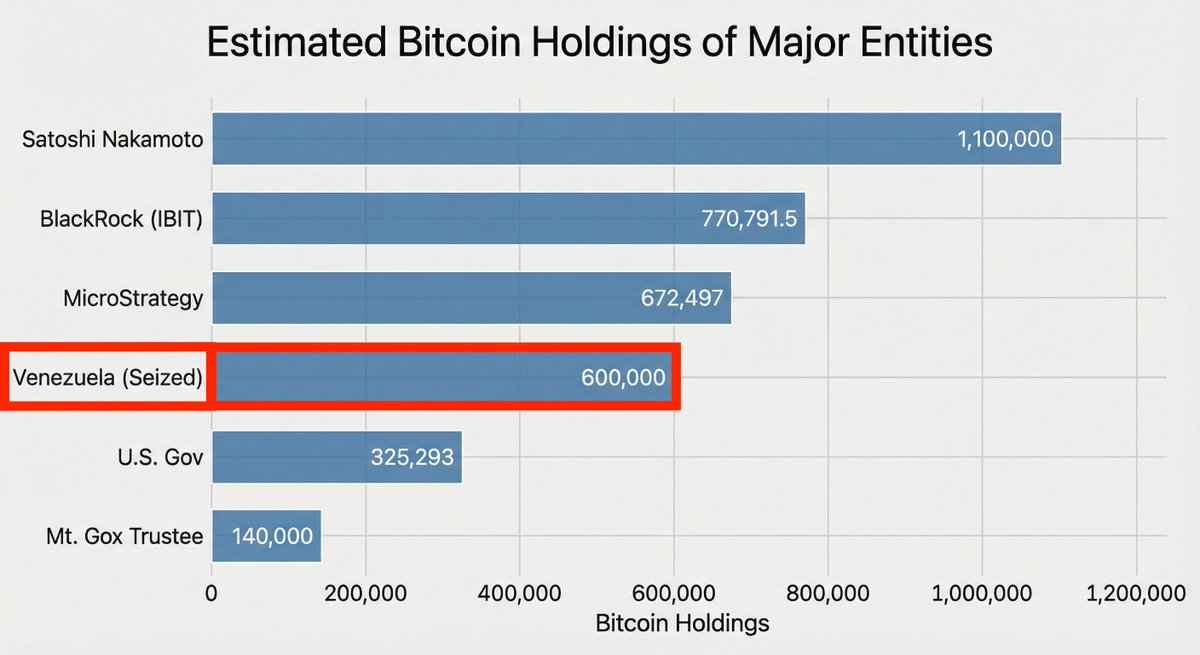
Here's the leading entity holders of Bitcoin:
1. Satoshi Nakamoto ~1,100,000
2. BlackRock (IBIT) ~770,791.5
3. MicroStrategy ~672,497
4. Venezuela (Seized) ~600,000
5. U.S. Gov ~325,293
6. Mt. Gox Trustee ~140,000
Now, here's what will likely happen from here:
The "Frozen Asset" (High Probability):
The assets are seized but immediately entangled in complex litigation Creditors file injunctions; the DOJ claims forfeiture. The keys are held in escrow by the U.S. Treasury, but the coins cannot move.
Short-term volatility due to uncertainty, followed by a bullish "supply shock" narrative.
Short-term volatility due to uncertainty, followed by a bullish "supply shock" narrative. The market realizes that 600,000 BTC (3% of circulating supply) have been effectively removed from the market for 5-10 years. This acts as a massive "lock-up," reducing liquid supply and supporting higher prices.
The "Strategic Reserve" Pivot (High Probability):
Influenced by the "Strategic Bitcoin Reserve" movement, President Trump orders the Treasury to hold the Bitcoin as a permanent U.S. asset.
This too acts as a massive lock up, reducing liquid supply and supporting higher prices.
The "Fire Sale" (Very Low Probability):
The U.S. DOJ declares the assets "perishable/volatile" and executes an immediate liquidation via Coinbase Prime or USMS auctions to fund the occupation costs.
However, this is unlikely due to Trump's positive stance toward Bitcoin "Reserves" from confiscating assets.
_
Results:
Markets have been looking at the massive oil reserve and beneficiaries, while ignoring the elephant in the room: Bitcoin.
The "second order effect" is likely a massive supply lock-up.
If the U.S. seizes these assets, they will likely move from "active liquid reserves" of a rogue state to "frozen sovereign assets" of the U.S. Treasury, reducing available supply and potentially acting as a catalyst for higher prices in Q1 2026.
There will likely be increased volatility. But for market participants shorting Bitcoin because of fears of "conflict", this event is generally seen as bullish for $MSTR and Bitcoin holders as this effectively locks up supply for many years to come.
Ongoing story : Venezuelas Bitcoin and Tether stockpile will be added to US Strategic Bitcoin Reserve
Venezuela's alleged Bitcoin accumulation stems from efforts to evade U.S. sanctions since the late 2010s, primarily under Nicolás Maduro's regime. The state built a "shadow financial network" to convert national resources into cryptocurrencies, focusing on Bitcoin ($BTC) and Tether ($USDT).
Key Mechanisms of Accumulation
- Gold Swaps (2018–2020): Venezuela exported significant gold reserves (e.g., 73.2 tons in 2018 alone, worth ~$2.7 billion at the time) from the Orinoco Mining Arc. Proceeds were allegedly swapped into $BTC at low prices (average ~$5,000–$10,000), yielding massive gains as BTC rose.
- Oil Settlements in USDT (2023–2025): State oil company PDVSA increasingly required payments in USDT for crude oil exports (up to 80% of revenues by late 2025). These stablecoins were then "washed" into $BTC to avoid freezes by Tether and reduce dollar exposure.
- Included seizures from domestic Bitcoin mining operations and failed experiments like the Petro cryptocurrency.
Estimated Holdings
Intelligence reports (primarily from the Whale Hunting newsletter, citing human intelligence sources) estimate a "shadow reserve" of up to $60 billion in BTC as of early 2026. This implies roughly 600,000–660,000 BTC (about 3% of circulating supply), accumulated since 2018.
Note: These figures are unverified by on-chain analysis and rely on HUMINT estimates. No public wallets have been conclusively linked, and the holdings were likely distributed across cold storage controlled by regime insiders.
Post-Regime Change Context (January 2026)
Following the U.S.-led operation that captured Maduro on January 3, 2026, attention has shifted to recovering these assets. The private keys are a key focus of interrogations, with potential plea deals offered for access. If seized:
- The BTC could be frozen as forfeited assets or added to a U.S. strategic reserve.
- This would represent a major supply lock-up (larger than BlackRock or MicroStrategy holdings), potentially bullish for BTC prices by reducing liquid supply.
Prior to 2026, Venezuela's official/on-chain holdings were minimal (e.g., ~240 BTC from seizures/mining reported in some trackers). The $60B figure refers specifically to this alleged off-the-books reserve built to bypass sanctions.
Agency > Intelligence
I had this intuitively wrong for decades, I think due to a pervasive cultural veneration of intelligence, various entertainment/media, obsession with IQ etc. Agency is significantly more powerful and significantly more scarce. Are you hiring for agency? Are we educating for agency? Are you acting as if you had 10X agency?
Grok explanation is ~close:
“Agency, as a personality trait, refers to an individual's capacity to take initiative, make decisions, and exert control over their actions and environment. It’s about being proactive rather than reactive—someone with high agency doesn’t just let life happen to them; they shape it. Think of it as a blend of self-efficacy, determination, and a sense of ownership over one’s path.
People with strong agency tend to set goals and pursue them with confidence, even in the face of obstacles. They’re the type to say, “I’ll figure it out,” and then actually do it. On the flip side, someone low in agency might feel more like a passenger in their own life, waiting for external forces—like luck, other people, or circumstances—to dictate what happens next.
It’s not quite the same as assertiveness or ambition, though it can overlap. Agency is quieter, more internal—it’s the belief that you *can* act, paired with the will to follow through. Psychologists often tie it to concepts like locus of control: high-agency folks lean toward an internal locus, feeling they steer their fate, while low-agency folks might lean external, seeing life as something that happens *to* them.”
We published this today. Phenomenal analytical work to understand how things could play out. give us 1,000 retweets and 5,000 likes, and we make it publicly available and do a space to discuss findings first week of Jan.
⚡ ⚡ #MSCI about to de-list #ARAMCO from its indices? ⚡ ⚡
Excluding companies for owning Bitcoin would contradict decades of index methodology applied to oil and gold producers.
Saudi Aramco is not excluded from equity indices because it owns vast oil reserves.
#GOLD miners are not excluded because their balance sheets are dominated by gold in the ground.
Ownership of a volatile underlying asset has never been grounds for index exclusion.
It is precisely what defines these companies’ economic reality.
Yet MSCI is currently considering a Digital Asset Threshold that would penalise companies simply because they own Bitcoin.
That would mark a sharp departure from long-standing index principles.
Volatility is not a disqualifier.
It is a parameter, to be measured and sized by investors.
Index providers are not there to decide which assets are “acceptable.”
They are there to faithfully represent the investable universe, without asset-specific judgments.
If owning oil does not disqualify Aramco,
if owning gold does not disqualify miners,
then owning Bitcoin cannot, by itself, justify exclusion.
For this reason, many market participants are calling on MSCI to withdraw the proposed Digital Asset Threshold.
👉 If you believe index construction must remain neutral and consistent, please sign the call: https://t.co/i6ptTrSGEr