New uses require new interfaces
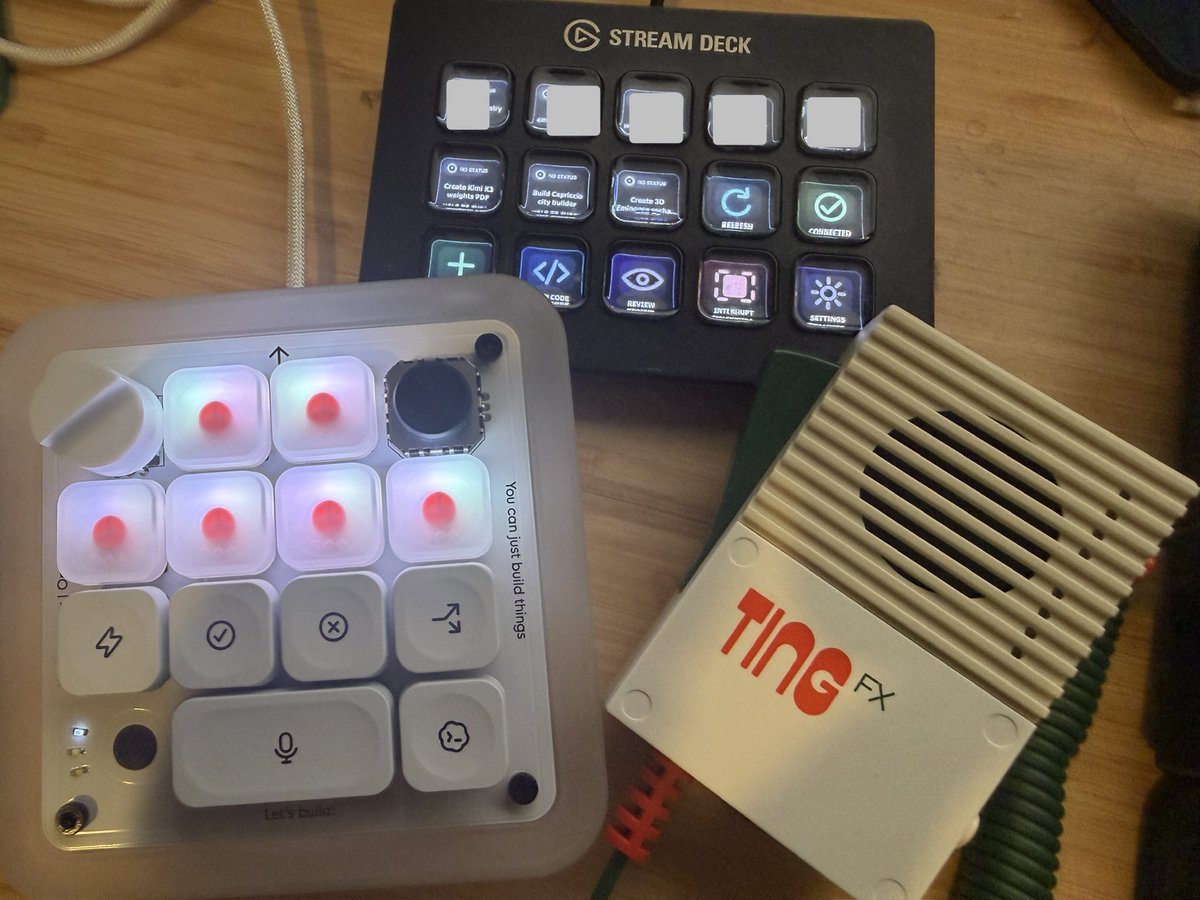
These are the three things I have been trying out to control Codex. Given how useful voice mode is, the Teenage Engineering Ting walky-talky has been a surprising favorite. The Codex micro is beautiful & fun, but too little info vs the Stream Deck
@satyanadella I am glad you can. Days after official announcement, the various links on your sites to the waitlist still don't work. Glad my Claude Tasks DO work!
'Unlimited' access to frontier models is the new status symbol. Flashing your 'Ultra' (Gemini), 'Max' (Claude & Perplexity), 'Pro' (ChatGPT) or 'Heavy' (Grok) status is 'nerd chic'. That is $1,050: an entry-level LV bag PER MONTH.
Beware of AI browsers and how they handle privacy. For example, @FellouAI and @diabrowser have their own settings panes which do not show the ability to disable third party cookies. Thus: HARD DELETE; NO TRUST.
At least with Dia you can invoke the settings in the address bar via 'chrome://settings/cookies', but Fellou does not even allow that. Fellou seems really dubious.
Fortunately, GPT Atlas and Comet are more transparent and have the standard Chromium settings panel.
Finally. After years pontificating how LLMs are not the path to AGI, but not showing any concrete alternative, @ylecun has now been shown the door. Meta is just not a player in GenAi. Still, others are making credible noises about world models (especially @drfeifei with @theworldlabs), so I truly hope that Yan Le Cun will come up with some breakthroughs. The only vindication possible.
This requires its own entry in custom instructions:
"Do not use the em dash (—) in any assistant-generated outputs. Replace any intended em dash with an appropriate alternative: use commas for short parenthetical phrases; use parentheses (round brackets) for asides or clarifications; use a colon to introduce explanations or lists; use a semicolon to join closely related independent clauses; use a hyphen (-) only for compound words and hyphenation (not as a substitute for a dash); use an en dash (–) only for ranges (for example 1999–2003). If none of these alternatives are suitable, rephrase the sentence so a dash is unnecessary. Preserve user-supplied text verbatim only when the user explicitly requests exact reproduction; otherwise convert any em dashes in supplied text into an appropriate alternative."
@sama Dear Sam, as do many others, I have had a ChatGPT Pro subscription since day one, but am located outside of North America. It is very galling that you make Sora 2 (not the iOS app, but access to it via the web page) available to free users of ChatGPT in the USA & Canada, but not to Pro users 'abroad'. When I last checked, your average revenue per user is around $1 dollar per month, so we are paying 200x more than the average user. Increasingly I don't see any benefit to being a Pro subscriber now that early access to new features has fallen by the wayside. I think you should bring this to the attention of your team.
From Static Docs to Dynamic Instruments: The AI Revolution Reshaping How We Work—A View from @natebjones That We Have Been Articulating Ever Since We Saw the First Artefacts from Claude:
- The core unit of work is shifting from static deliverables (documents, slides, spreadsheets) to interactive "instruments"—executable, auditable artefacts that combine inputs, logic, UI, and governance.
- Recent tech advancements (e.g., ChatGPT-5, Claude) now make it possible for anyone to build and share lightweight, no-code, interactive tools that help accelerate decision-making.
- The main barriers to adopting this change are cultural—such as over-trust, sprawl, and lack of standards. Success will require clear ownership, governance, version control, and mapped meeting cadences.
- Strategic benefits include the ability to replace multiple meetings and slide decks with a single collaborative interface, create a visible audit trail, generate reusable assets, and increase trust through transparency.
- Software platforms have an opportunity to compete by providing primitives for these new "instruments"—such as modular components for inputs, logic, tests, and exports—moving beyond just static text fields.
- Business rules and approvals will increasingly be encoded as "policy as code" within these instruments, streamlining and governing execution.
- For adoption, organisations should start with small, low-stakes uses, measure adoption, reward instrument-driven outcomes, and gradually evolve towards a collaborative "instrument studio" with clear standards.
- The value is shifting from document authoring to the runtime execution and collaborative usage of these instruments.
- To succeed, organisations must establish clear standards, reward usage of instruments, and focus on building trust through transparent governance and proper versioning.
- Tool builders must shift from generic document editors to execution surfaces—supporting users with opinionated, composable building blocks for sophisticated, interactive workflows.
Notable quote:
"We crossed a Rubicon with ChatGPT-5—the unit of work is shifting from static deliverables to interactive instruments. The value now accrues at runtime, not author-time."
While AI in higher education presents challenges, its potential to enhance learning and accessibility outweighs the risks when implemented thoughtfully.
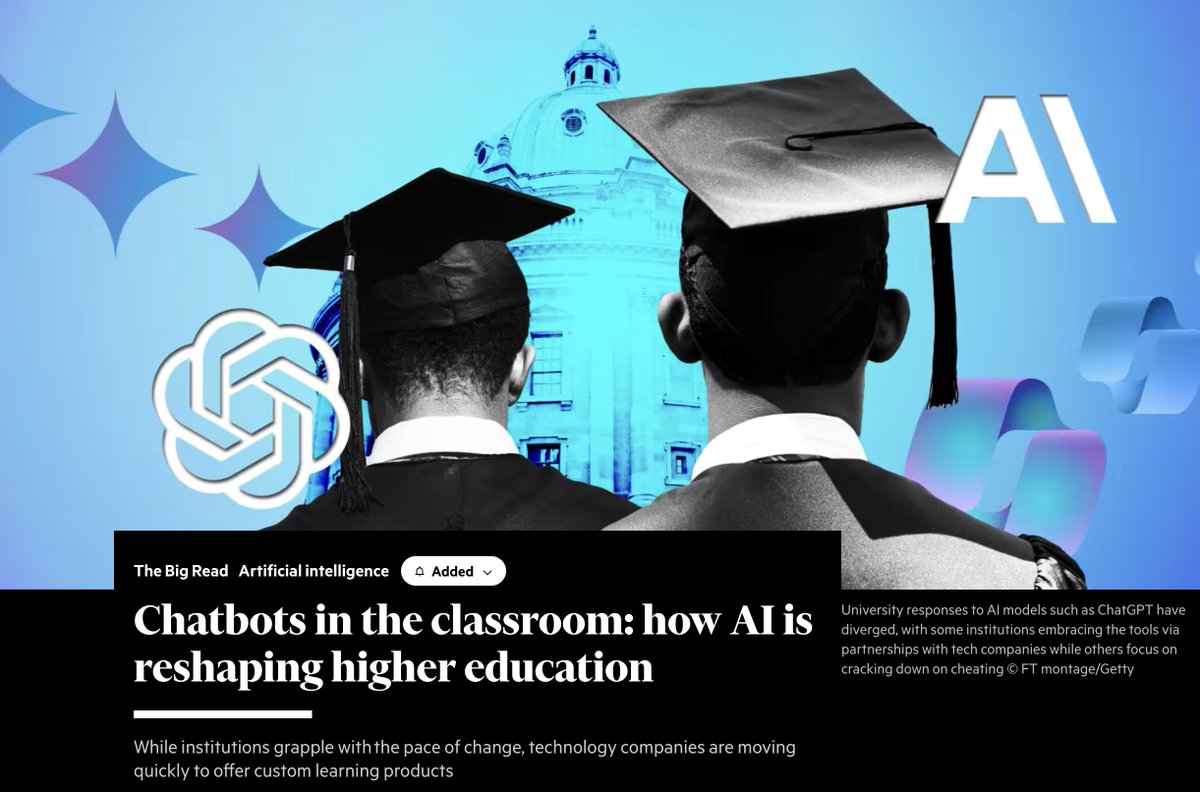
This Financial Times article highlights the rapid adoption of AI in universities, with some embracing custom tools and others worried about cheating and loss of critical thinking.
Pros: improved research, personalised learning, and support for diverse learners.
Cons: increased plagiarism, potential erosion of foundational skills, unclear best practices, and job market disruption.
I support AI in higher education because, when used responsibly, it can empower students, foster creativity, and prepare graduates for a technology-driven future. The key is ensuring guidance, clear policies, and a focus on critical thinking skills alongside AI integration.
In light of this discussion I would like to introduce the concept of SQ - Symbiotic Intelligence (akin to IQ and EQ).
SQ is a powerful concept that works on multiple levels.
Why SQ works brilliantly:
Memorable - Follows the IQ/EQ pattern naturally Meaningful - Immediately conveys the collaborative nature
Forward-thinking - Positions AI as a partner, not a tool or threat
Inclusive - Emphasises that both human and AI contribute value
Actionable - People can understand and develop their SQ
SQ would measure abilities like:
- Knowing when and how to leverage AI effectively
- Understanding AI capabilities and limitations
- Crafting effective prompts and interactions
- Building productive workflows with AI systems
- Recognising which tasks benefit from human-AI collaboration
- Adapting communication style for different AI systems
- Creating feedback loops for better outcomes
The narrative power:
High IQ = Smart with abstract reasoning
High EQ = Smart with people and emotions
High SQ = Smart with AI partnership and collaboration
This framing suggests that just as we developed social and emotional intelligence to thrive with other humans, we now need symbiotic intelligence to thrive in an AI-augmented world. It's not about competing with AI or just using it as a tool, but creating a genuine partnership where both sides enhance each other.
SQ could become a critical competency for the 21st century workforce and beyond.
In light of this discussion I would like to introduce the concept of SQ - Symbiotic Intelligence (akin to IQ and EQ).
SQ is a powerful concept that works on multiple levels.
Why SQ works brilliantly:
Memorable - Follows the IQ/EQ pattern naturally
Meaningful - Immediately conveys the collaborative nature
Forward-thinking - Positions AI as a partner, not a tool or threat
Inclusive - Emphasises that both human and AI contribute value
Actionable - People can understand and develop their SQ
SQ would measure abilities like:
- Knowing when and how to leverage AI effectively
- Understanding AI capabilities and limitations
- Crafting effective prompts and interactions
- Building productive workflows with AI systems
- Recognising which tasks benefit from human-AI collaboration
- Adapting communication style for different AI systems
- Creating feedback loops for better outcomes
The narrative power:
High IQ = Smart with abstract reasoning
High EQ = Smart with people and emotions
High SQ = Smart with AI partnership and collaboration
This framing suggests that just as we developed social and emotional intelligence to thrive with other humans, we now need symbiotic intelligence to thrive in an AI-augmented world. It's not about competing with AI or just using it as a tool, but creating a genuine partnership where both sides enhance each other.
SQ could become a critical competency for the 21st century workforce and beyond.
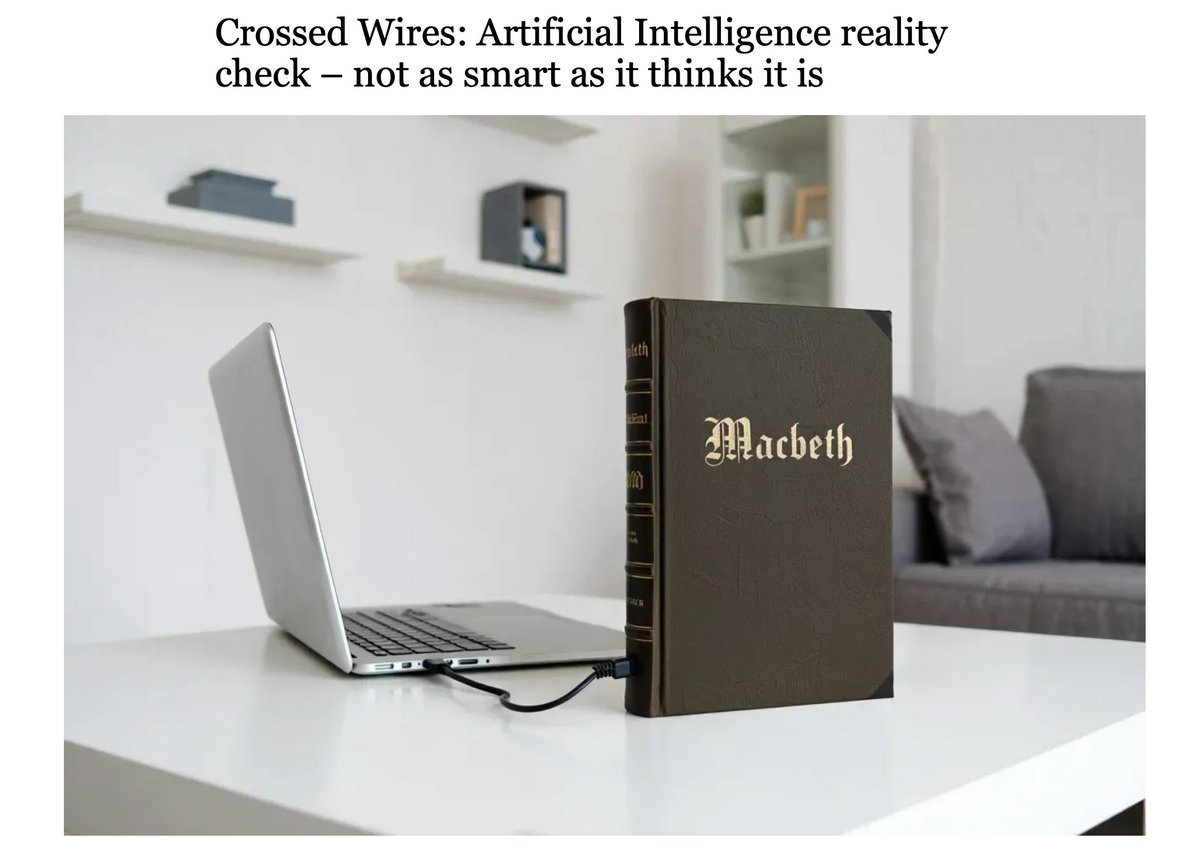
@stevensidley's Column in Monday’s (16 June 2025) Daily Maverick about Apple’s recent paper ‘The Illusion of Thinking’ is misguided and forgets to take into consideration that its publication coincided with the WWDC25 Keynote last week Monday (9 June 2025) and was meant to take away attention from their own failings in the GenAi domain.
Such articles perpetuate the misconception that GenAi is not 'smart' enough to take your job in the near future.
However, more and more companies are announcing job cuts or hiring freezes because of GenAi's ability to do their work.
The GenAi revolution is real, but you will only realise it if you pay for (and become super conversant with) the use of ChatGPT, Gemini, Claude, Grok and others.
To summarise the criticism of the Apple paper, as expressed by many *real* experts:
Lack of Novelty: The central argument of the paper—that Large Language Models (LLMs) face challenges with complex puzzles and do not strictly adhere to provided algorithms—is not a new revelation for the AI community and has been a known characteristic for years.
Misconception of LLM Design: The paper appears to evaluate LLMs as if they were traditional, pre-programmed software or calculators, expecting consistently accurate outputs. This reflects a misunderstanding of their fundamental design as probabilistic neural networks built for generative tasks and producing plausible responses, not for exact computations.
Ignoring the Use of Tools: A significant methodological flaw is the paper's failure to consider the ability of LLMs to leverage external tools to perform complex reasoning and calculation tasks. For example, when a model was given access to code, it successfully solved a multiplication problem it had previously failed.
Token Limit Constraint: Some of the complex problems presented to the LLMs in the study exceeded the models' token limits for a response. This inherent limitation on the output length would naturally hinder performance, regardless of the model's underlying reasoning capabilities.
Preconceived Bias: The authors of the paper may have approached their research with a preconceived bias about the limitations of LLMs. This is supported by their decision to move away from math benchmarks, where "thinking models" were outperforming "non-thinking models," and to instead use puzzles that better supported their narrative.
Misinterpretation of Model Behaviour: The paper expresses surprise that LLMs fail even when explicitly given the algorithm to solve a puzzle. This is expected behaviour for a probabilistic system, where even a high probability of correctness at each step can compound over millions of steps and lead to an error.