Claude Desktop is lowkey installing a hidden browser bridge that bypasses the sandbox in 7+ Chromium browsers (even ones you don’t have installed). It can potentially access your sessions and data, and it rewrites itself every time you open the app so it’s annoying to remove.
@AnthropicAI, what are we doing here?
Quick 8-min breakdown just dropped on @NeuralintelOrg. Worth the listen.
Is Traditional Software Engineering Dead?
“Does this mean that traditional software engineering is dead? Absolutely not. Software engineers—even the ones who are not necessarily tuning or training AI models—these are now among the most leveraged people on earth. Sure, the guys who are training and tuning models are even more leveraged because they’re building the tool set that software engineers are using.
But software engineers still have two massive advantages on you. First, they think in code, so they actually know what’s going on underneath. And all abstractions are leaky. So when you have a computer programming for you—when you have Claude Code or equivalent programming for you—it’s going to make mistakes.
It’s going to have bugs. It’s going to have suboptimal architecture. So it’s not going to be quite right. And someone who understands what’s going on underneath will be able to plug the leaks as they occur.
So if you want to build a well-architected application, if you want to be able to even specify a well-architected application, if you want to be able to make it run at high performance, if you want it to do its best, if you want to catch the bugs early, then you’re going to want to have a software engineering background.
The traditional software engineer is going to be able to use these tools much better. And there are still many kinds of problems in software engineering that are out of scope for these AI programs today. The easiest way to think about those is problems that are outside of their data distribution.
For example, if they need to do a binary sort or reverse a linked list, they’ve seen countless examples of that, so they’re extremely good at it. But when you start getting out of their domain—where you have to write very high-performance code, when you’re running on architectures that are novel or brand new, when you’re actually creating new things or solving new problems, then you still need to get in there and hand code it.
At least until either there are so many of those examples that new models can be trained on them, or until these models can sufficiently reason at even higher levels of abstraction and crack it on their own…
And remember: there is no demand for average. The average app—nobody wants it, at least as long as it’s not filling some niche that is filled by a superior app. The app that is better will win essentially a hundred percent of the market. Maybe there’s some small percentage that will bleed off to the second-best app because it does some little niche feature better than the main app, or it’s cheaper, or something of the sort.
But generally speaking, people only want the best of anything. So the bad news is there’s no point in being number two or number three—like in the famous Glengarry Glen Ross scene where Alec Baldwin says, “First place gets a Cadillac Eldorado, second place gets a set of steak knives, and third place you’re fired.”
That’s absolutely true in these winner-take-all markets. That’s the bad news: You have to be the best at something if you want to win.
However, the set of things you can be best at is infinite. You can always find some niche that is perfect for you, and you can be the best at that thing. This goes back to an old tweet of mine where I said, “Become the best in the world at what you do. Keep redefining what you do until this is true.”
And I think that still applies in this age of AI.”
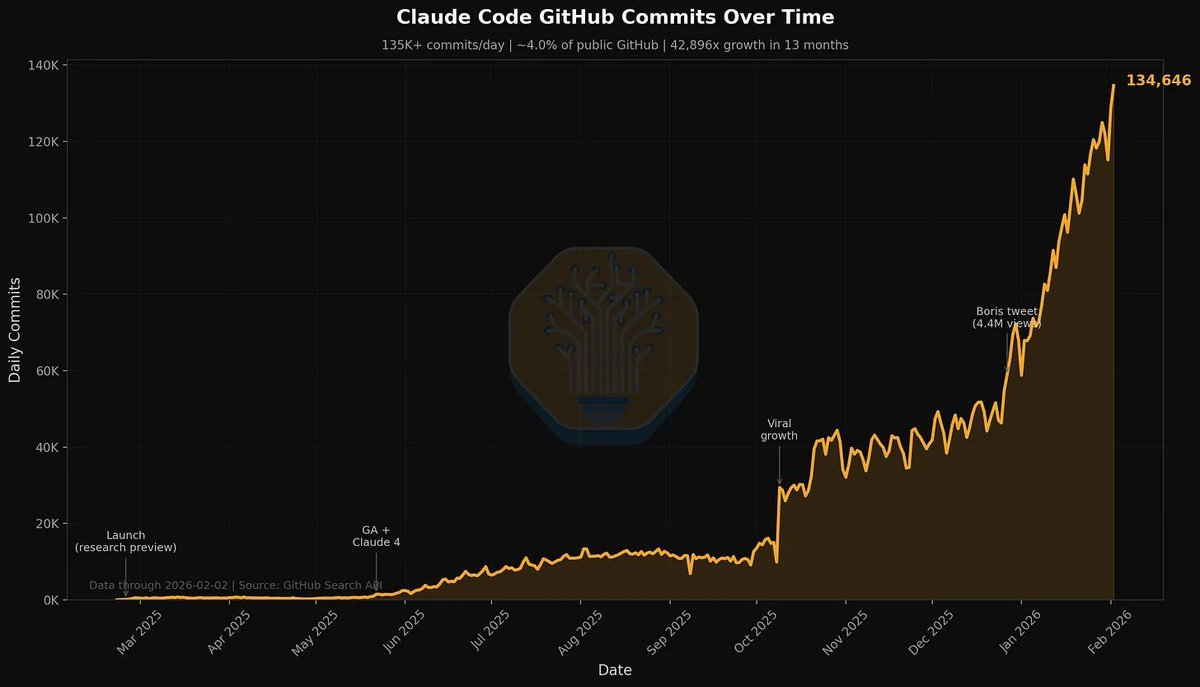
4% of GitHub public commits are being authored by Claude Code right now. At the current trajectory, we believe that Claude Code will be 20%+ of all daily commits by the end of 2026. While you blinked, AI consumed all of software development.
Stan Druckenmiller’s current positions:
- LONG Korea + Japan (+ Brazil)
- LONG Copper (AI + tight supply)
- LONG Gold (geopolitics)
- SHORT Bonds
Portfolio is no longer "AI-driven". He’s bearish on the Dollar but bullish on the US economy with disinflationary growth.
In der USA sind die meisten Menschen enthusiastisch.
In Europa werde ich beschimpft, Leute schreien REGULIERUNG und VERANTWORTUNG.
Und wenn ich wirklich hier eine Firma baue dann kann ich mich mit Themen wie Investitionsschutzgesetz, Mitarbeiterbeteiligung und lähmenden Arbeitsregulierungen abkämpfen. Bei OAI arbeiten die meisten Leute 6-7 Tage die Woche und werden depentsprechend bezahlt. Be uns ist das illegal.
LIQUIDATION CONTAGION
Wealth taxes are even worse than you think. Any asset held by Californian billionaires or Dutch citizens is now at risk of experiencing forced liquidation pressure.
So: it’s not just that you don’t want to hold assets as a Dutchman. You also don’t want a Dutchman to hold your assets. Because the logic of forced liquidation is contagion.
Let’s think it through.
(1) First, suppose there is an asset with a total market cap of $10,000, with 10 shares total, of which 1 share each is held by 10 different holders, all in the Netherlands. To simplify the math, assume the Dutch holders bought those shares at par, or close to $0.
(2) Now suppose today is the unrealized cap gains tax day, and the share price is $1,000 per share. Each Dutch guy is hit with a 36% tax, and owes $360. The first guy sells his one share, gets $1,000, and pays $360 in tax while retaining $640.
(3) But the first guy’s sale reduces the market price to $960 per share. So when the second guy sells, he only retains $600 after paying $360 in tax.
(4) Now assume that by the 7th guy, all the selling has pushed the share price to collapse to $200 per share. This is a very reasonable scenario if 60% of the cap table has suddenly been dumped. Indeed it might go much lower.
(5) At $200 per share, the 7th guy actually has to go into debt to pay the tax as he owes $360. He sells his one share, pays all $200 of the proceeds in tax. And still owes $160 more in tax.
(6) The 8th, 9th, and 10th guys are even more screwed. By the time they sell, the price will likely have crashed to $100 per share or less. As with the 7th guy, even 100% liquidation will not cover their tax burden.
(7) So we immediately see many negative things about the Dutch unrealized cap gains tax bill.
(a) First, it will cause large simultaneous forced liquidations. Everyone must sell 36% of their stake near the same time.
(b) Second, it may be literally impossible to pay if a critical mass of the cap table is all subject to it at the same time. In the example above it was 100% Dutch holders, but has it been just 60% the result would have been much the same: a collapse in the share price.
(c) Third, that means it would be disastrous to have too many Dutch citizens (or Californian billionaires!) on the cap table. Their forced sales will crash your share price.
(d) So, you might have to start mass blocking those resident in wealth-taxing jurisdictions from investing in your companies.
(e) This in turn makes the poor Western European guy even poorer, as he gets locked out of high growth assets.
To be clear: I really do feel bad for the formerly Flying Dutchmen, now Crying Dutchmen. They invented much of modern capitalism. They founded New Amsterdam, now New York. They’ve punched way above their weight. I wish them only the best.
Nevertheless…they should prepare for the worst. This may be a tough century for Western Europe. The first ones out might get to freedom, while the slowest may be stuck behind a new Iron Curtain, spending a century paying off the debts their states incurred over the last century.
Because the long run fruits of Western Keynesianism are the same as Soviet Communism, in the sense of wealth seizure and pauperization.
I mean, if you knew the future, you wouldn’t want to co-own a farm with a Russian in 1916. For similar reasons, you might not want to co-own a share of stock with Dutch national in 2026. Or with anyone in a seizure-curious jurisdiction…which unfortunately includes much of Western Europe, Canada, and Blue America.
You instead want assets that are not held by those subject to forced liquidations. Now, I grant that this is an unusual way to rank assets…Dutch holders considered harmful?!? Yet it might sadly be necessary to minimize your exposure to liquidation contagion.
PS: guess which crucial stock is most held by the Dutch? ASML. So: this unrealized cap gains tax may not literally be a communist plot, but it would have the same effect.
First of Kind: The @jgebbia interview
Why did Joe Gebbia go to Washington?
I met with America’s first-ever Chief Design Officer last fall to find out. We met on the White House grounds to discuss his newly created role, the formation of @ndstudio, and how Joe plans to weave design into the fabric of U.S. federal government.
00:00 - Eisenhower Exec Office Bldg
01:34 - From Airbnb to Washington
04:39 - The Federal Retirement Problem
06:31 - The Mine in the Mountain
08:29 - Do Things That Don’t Scale
11:35 - The Julie Prototype
14:20 - Down to 60 Seconds
16:33 - Consumer-Grade Government
18:31 - Nixon’s Federal Beautification
20:22 - The National Design Studio
24:24 - Trust Through Design
27:43 - Building the Dream Team
31:22 - The Silicon Valley Coalition
35:33 - A Golden Age of Design
Special thanks to Joe Gebbia and his team for making this conversation possible.
S2:E1 Joe Gebbia, Designer-in-Chief
Hosted by @soleio and produced by @room3nyc@firstofkind is powered by our sponsors:
@framer@cursor_ai@vercel@tryprofound
We’ve upgraded our specialized reasoning mode Gemini 3 Deep Think to help solve modern science, research, and engineering challenges – pushing the frontier of intelligence. 🧠
Watch how the Wang Lab at Duke University is using it to design new semiconductor materials. 🧵