This whole thing’s about me trying to sort out the real fight: why Israel keeps pushing for land, why wars flare up over ‘God’s promises.’ Some say salvation’s tied to that covenant, like Abraham’s ‘promised land’ is heaven (Gen 15:18). But if that’s it, why did Paul split blood from faith? (Rom 9) Why does Revelation erase borders? (Rev 21).
Core question: Can both be true? Literal land and grace through Christ, or do they contradict, cancel, undercut, or weaken each other?
The question is valid because nobody knows for certain. I don’t like the conclusion that ‘covenant = salvation’ but the question prompts valid end times discussion. Like ‘can both be true?’ And then go to scripture and poke holes, see if it’s even possible given all potential scenarios. It’s not about hate, it’s about claims, conclusions and discussion around truly controversial biblical ideas that have led to modern day warfare over God’s promises.
• If covenant = land only, why does Romans eleven say ‘all Israel saved’? Bloodline or faith?
• If salvation’s separate, why does Paul say ‘no Jew or Greek’ in Galatians?
• If land’s forever, why Revelation twenty-one—no temple, no borders?
Run the scenarios: literal land during millennium? Spiritual heaven now? Both? None? I’m not a scholar or even seminary trained ‘expert’…I just read and try to understand.
And if you’re over here just blasting ‘hater’ at anyone that disagrees with your view, you’re defending your ego rather than defending your knowledge, your belief, and your faith.
Here’s what I expect back:
• ‘You’re twisting Romans 11—bloodline saves!’
• ‘Revelation 21’s after the kingdom—read Scofield!’
• ‘Just trust God, don’t overthink!’
• ‘Bless those who bless you—eternal!’
• ‘You’re no expert—shut up!’
• ‘Humility? You’re the one defending ego!’
• ‘Replacement theology advocate! Supersessionist!’
If the answer to the question is yes? Your ‘one-or-the-other’ fight falls apart. If yes, land’s real during Christ’s reign, grace covers everyone. No wipe-out, just an upgrade. (Ezek 37: ‘I will take the children of Israel from among the heathen…and bring them into their own land.’ Zech 14: ‘The Lord shall be king over all the earth.’ Then Rev 20: ‘They lived and reigned with Christ a thousand years.)
If no? You’ve gotta explain why God promised dirt forever…then wiped it out. (Heb 8 leads to Jer 31 which leads to Rev 21)
Why don’t we all just stop? Stop fighting. Stop claiming. Stop bombing. And trust God…whether it’s land, grace, or both. If He promised it, He’ll do it. No need for us to play God.
Either way—I’m still reading and learning.
@unusual_whales They will do anything to prevent you from getting proper sun exposure…an activity essential to good health. It may be safer than other ingredients but there is not one sunblock that is healthy for you…it’s just another FDA/Pharma racket.
“lent $620,000,000”
Lent (verb): The past tense of “to lend.”
So… it was a loan. Supposed to be paid back.
By the way, y’all are screaming about Trump being corrupt, but did you forget Solyndra under Obama? George Bush and Halliburton’s no-bid contracts? Clinton and Whitewater? The Wall Street connections?
It’s the same game no matter who’s in office. It’s mostly the permanent ruling class taking care of itself. This left vs right bullshit needs to end. The real fight at the top is about who gets to run the scams with taxpayer money.
You brought up Galatians even though he never mentioned it, that’s a deflection. You didn’t answer either question he asked. The honest answer would’ve been: “Yes, we do teach that Jesus and Lucifer are spirit brothers,” and “Yes, we believe in exaltation, where faithful members can eventually create and rule over their own worlds.”
Saying “we don’t get our own planets, we’re just joint heirs with Christ” is a watered down version of the actual doctrine. You avoided answering directly and changed the subject instead.
Galatians is the typical approach most would use against LDS but it’s unnecessary…it’s like you were trying to force the guy into the most common avenue of attack or you assumed that’s the direction he was going. Just a weird way to respond…why not just be honest?
Also from Grok:
There’s some truth to it, but the “40% secretly sharing with strangers” part is exaggerated clickbait.
Windows has a feature called Delivery Optimization that’s turned on by default. It lets your PC download Windows updates or Microsoft Store apps from other people’s computers instead of just Microsoft’s servers — and in return, your PC can upload pieces of those updates to others.
• By default, it’s usually set to local network only (devices in your house), so it doesn’t touch the internet.
• If it’s set to “internet and local network,” then yes, it can upload to strangers, eating your upload bandwidth (not download).
That upload traffic can absolutely raise your ping and cause lag spikes in games like Valorant, Fortnite, or CS2 — especially on connections with slower upload speeds. The “40%” number is bullshit though; it doesn’t secretly reserve or use a fixed 40%. It uses whatever it needs, and some people notice it eating noticeable upload.
The gpedit.msc QoS Packet Scheduler “Limit reservable bandwidth” thing you’re referencing is an old myth. It doesn’t actually reserve 20% or 40% of your bandwidth for normal use. Changing it to 0% is mostly placebo — it doesn’t fix real issues.
The real fix (takes 30 seconds):
Go to Settings > Windows Update > Advanced options > Delivery Optimization and:
• Turn off “Allow downloads from other PCs” completely, or
• Set it to “Devices on my local network” only (safer middle ground).
You can also go into Advanced options there and cap the upload bandwidth to something low like 5-10% if you want to keep it partially on.
That’s the actual setting that matters, not the gpedit one. Do that and your ping should stabilize if Delivery Optimization was the culprit.
So what you’re saying is you’re the punctuation police now. If you had half a brain you’d have listened to the clip…it’s a good one btw. Then you’d know she is quoting. ffs pull your head out of your ass and stop defending your ego. Admit you’re wrong and move on. Shifting to my name calling is standard for people who don’t like to admit they’ve made a mistake. Address your issue before you start calling out others hypocrite.
@HallKathi@TerriGreenUSA Her post is a direct quote of precisely what Macarthur said in that sermon. Now go examine yourself for not paying attention, being quick to accuse, and for being a typical internet moron. Now pull your head out of your backside and listen to the clip.
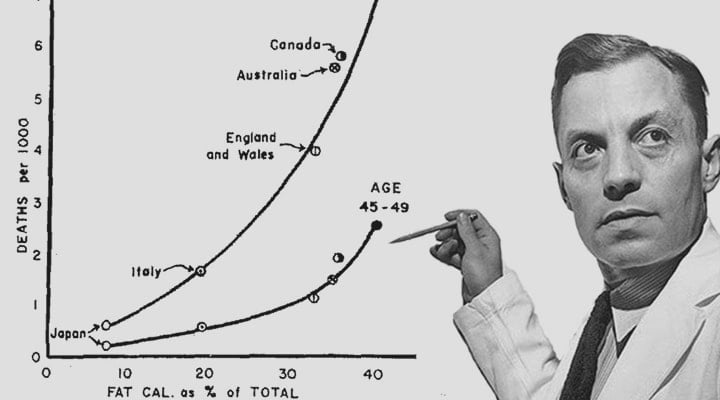
In 1953 an American physiologist called Ancel Keys stood up at a World Health Organization conference in Geneva and presented a graph.
The graph plotted fat consumption against heart disease mortality in six countries. The United States at the top. Japan at the bottom. A smooth upward curve in between. The room was convinced. The graph would go on to define global nutrition policy for the next seventy years.
There was one small problem with the graph.
Keys had data from twenty-two countries. He chose six.
The other sixteen, which included France and Switzerland eating vast quantities of butter and cheese with low heart disease, and countries like Chile eating almost no animal fat and having high heart disease, did not produce the line he wanted. So they were not on the graph.
When this was pointed out, in print, at the time, Keys did not engage with the science. He launched a career.
He became chair of the American Heart Association's nutrition committee. He got himself on the cover of Time magazine. He organised the Seven Countries Study, a sequel to the cherry-picked six, which selected populations and time points that would confirm his hypothesis and excluded those that would not. Crete was measured during Lent. The comparisons were, by design, not fair.
Then he did the thing that turned him from a scientist into a politician.
He went after the opposition.
Dr John Yudkin, a British physiologist, published a book in 1972 called Pure, White and Deadly, arguing that sugar was a better fit for the heart disease data than fat. His data covered more populations, more years, and more accurately matched the rise in cardiovascular mortality across the twentieth century.
Keys called him, in print, a charlatan. He used his position at the AHA to block Yudkin's research from conferences. He pressured editors. He lobbied funders. Yudkin's grants dried up. His reputation was systematically dismantled by a man who was, at this point, not doing science but running a protection racket for a hypothesis.
Yudkin died in 1995 in obscurity. His work has since been quietly vindicated. Nobody has apologised.
Meanwhile the American Heart Association, funded since 1948 by a $1.7 million donation from Procter and Gamble (makers of Crisco, a product that urgently needed a reason for Americans to stop cooking with lard), adopted Keys's recommendations and issued them as medical advice.
The American public complied. Butter consumption collapsed. Margarine tripled. Seed oils, negligible in 1950, became the dominant cooking fat. The food industry reformulated thousands of products to remove fat and replace it with sugar, because the fat was the enemy and the sugar was not.
American obesity rates, stable for fifty years, began to climb in 1977, the year the McGovern committee translated Keys's hypothesis into federal guidelines.
They have not stopped climbing since.
Type 2 diabetes followed. Metabolic syndrome followed. Fatty liver disease, which barely existed in 1950, became endemic. The entire constellation of chronic metabolic disease now occupying every doctor surgery in the developed world tracks, almost perfectly, onto the adoption curve of the guidance Keys spent his career promoting.
He retired to Italy, drank olive oil, ate cheese, lived to 100, and described himself in interviews as a pioneer.
He was a pioneer.
He pioneered the practice of producing a predetermined conclusion from selective data, destroying the reputations of anyone who noticed, and using institutional capture to convert the conclusion into policy.
Ancel Keys was not wrong the way scientists are sometimes wrong.
Ancel Keys was wrong the way politicians are wrong.
Deliberately. Profitably. Without consequence.
You are still eating the consequences now.
@Mark_Wilson_25 I’m exploring the “can both things be true?” angle after years of study. Basically tired of the tribalism and incessant arguing over this very thing so I appreciate your perspective.
@SedeRabbit@StephenKokx Gatekeeping a thread, how truly unique and clever of you but it’s a weak and lazy way to avoid engaging on the points.
If you’ve got an actual rebuttal, I’m listening.
@TabbyThrowback@StephenKokx Calling me a heretic doesn’t answer the question. Paul said the restrainer must be ‘taken out of the way’ — that’s sudden removal, not a 500-year slow decline.
If you’ve got an actual rebuttal, I’m listening. If not, the name-calling isn’t very impressive.
@KrsnaCarlos@StephenKokx Calling me a heretic doesn’t answer the question. Paul said the restrainer must be ‘taken out of the way’ — that’s sudden removal, not a 500-year slow decline.
If you’ve got an actual rebuttal, I’m listening. If not, the name-calling isn’t very impressive.
“When reviled, we bless; when persecuted, we endure; when slandered, we entreat.” (1 Corinthians 4:12)
This is not natural. This is the life that has been shaped by Christ. Everything in us wants to answer reviling with reviling, to defend ourselves, to prove a point, to return what was given. But the gospel produces something different.
When we are reviled, we bless. Not because the words do not hurt, but because our response is no longer governed by pride. “Bless those who persecute you; bless and do not curse” (Romans 12:14).
When we are persecuted, we endure. Not by strength we generate, but by grace we receive. Endurance is not passive. It is steady trust that refuses to turn away. “If we endure, we will also reign with Him” (2 Timothy 2:12).
When we are slandered, we entreat. We respond with gentleness and truth, not retaliation. “Keep a good conscience so that… those who revile your good behavior in Christ will be put to shame” (1 Peter 3:16).
This is how Christ is shown. Not in comfort, but in conflict. Not when we are treated well, but when we are wronged and still choose to reflect Him. This kind of life cannot be produced by effort. It comes from being united to Christ, who “while being reviled, did not revile in return… but kept entrusting Himself to Him who judges righteously” (1 Peter 2:23).
So this is the mark. Not how loudly we speak, but how we respond when we are opposed. That is where Christ becomes visible.
@NickQuient I take the position that if you wear a clown suit while preaching, you’re not to be taken seriously 😂 So, most clergy is out. I am easier on the flock because most of them are just mindlessly following but I sure pray that they’ll get past needing clergy to commune with Christ.