Vey excited to share our work. #1/5 We find actin filament polymerization force can regulate Arp2/3 binding affinity. And, this dominates how migrating cells mechano-sense highly varying ECM and make self-adaptive migrations in it. https://t.co/B5i0c1QcPC
Amazing open resource for diverse binder kinetics! We released a lot of our BindCraft binders that were not tested experimentally in the original study! Releasing consistent data like this will help the community to grow!
I recommend reading this essay by Dario, our CEO. He lays out predictions for the next 5-10 years better than anyone else I’ve seen. It’s a substantial essay and well worth reading. https://t.co/4xAUZZeOvL
@horizon2020@Mechanocontrol@kwf_nl@Cancer_UMCU @UMCU_CMM @UMCU_Intl@ErasmusMC@mcgillu Tissue pulling by leader cells during the collective invasion of breast cancer organoids in 3D collagen I.
Yellow (Leader cells, endogenous Krt14), Cyan (Nucleus, H2b-mScarlet), Magenta (Collagen I, reflection). https://t.co/OvMtDeg078
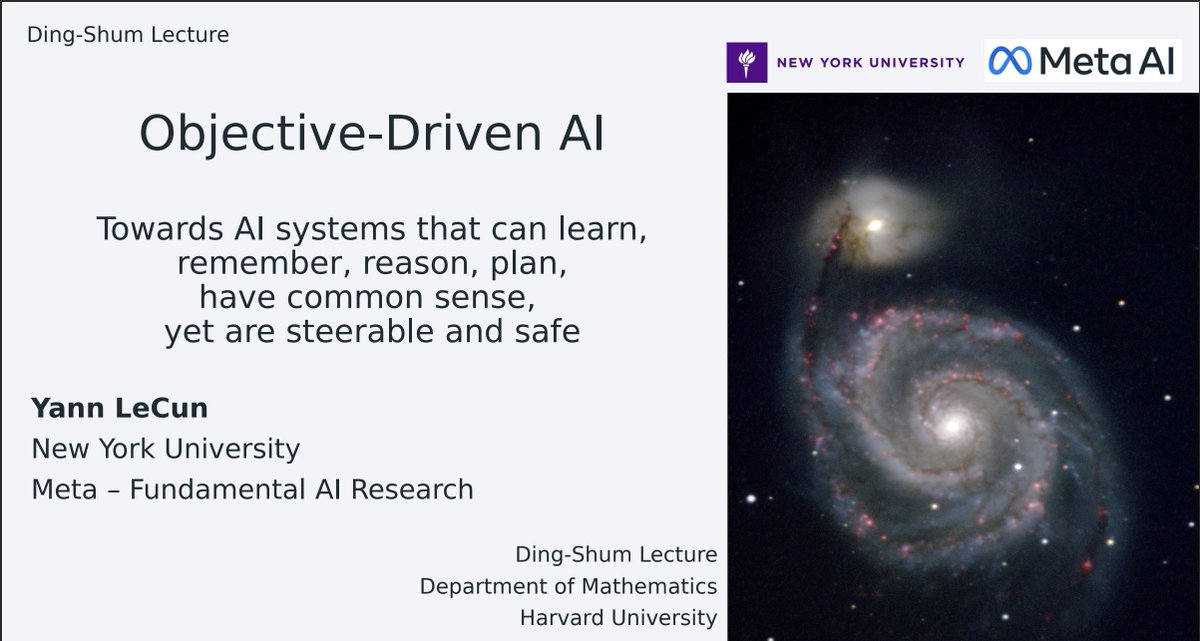
Yann LeCun @ylecun delivered a lecture on Objective-Driven AI.
He began with a reality check: "Machine Learning falls short compared to humans and animals!"
Here's his insight on constructing AI systems that learn, reason, plan, and prioritize safety:
1/5
Looking forward to my @TEDTalks on building #AI with universal physical understanding. Excited to announce our recent works building the foundations for such a model.
Language models have shown impressive capabilities with universal text understanding capabilities, but they are not enough for science and engineering tasks since the ideas that they propose still need experimental validation, which is expensive and time consuming, and usually the biggest bottleneck. We can overcome this by training AI models that can simulate physical phenomena and generate novel designs in a physically-valid manner.
Partial differential equations (PDE) form the foundation for simulating many physical phenomena and we have shown AI models, Neural Operators, to be their universal approximators. Using Neural operators to solve PDEs has been shown to achieve 4-5 orders of magnitude speedups over numerical simulations while maintaining accuracy. This has previously been applied for weather forecasting, nuclear fusion, fluid dynamics and catheter design. Our recent @NatRevPhys article https://t.co/ewJSOIkyvL provides an overview. But so far, the AI models are mostly limited to a narrow domain and trained on data from that domain.
LLMs have proven that training one large model for a wide variety of tasks is not just successful at solving those tasks, but outperforms custom narrower models at those tasks. We now show a similar result for physics-AI models solving PDE tasks: a model pre-trained on a multitude of them doesn't just solve the different tasks but outperforms models trained on those individual tasks.
We propose two frameworks: (1) an auto-regressive Denoising Pre-training Operator Transformer (DPOT) and (2) Co-domain Attention Neural Operators (CoDA-NO) for multiphysics PDEs. Together, they allow us to handle diverse set of PDEs and coupling of multiple PDEs needed for multiphysics.
DPOT is the largest foundation PDE model (0.5B) to date, achieving state-of-art accuracy. We collect massive PDE data, including more than 100k trajectories from more than ten datasets consisting of diverse PDEs, such as Navier-Stokes equations, diffusion-reaction equations, and shallow-water equations, with vastly different properties. We design an auto-regressive denoising pre-training strategy by injecting Gaussian noise into training data. By predicting the next time step using noisy inputs, we show robustness and generalization in downstream tasks.
CoDA-NO builds a foundation model from a different perspective: ability to easily couple multiple PDEs to solve multiphysics problems. It tokenizes functions along the codomain or channel space, enabling self-supervised learning on multiple PDE systems. We extend positional encoding, self-attention, and normalization layers to the function space. CoDA-NO can learn representations of different PDE systems with a single model. On complex downstream tasks with limited data, such as fluid flow simulations and fluid-structure interactions, CoDA-NO outperforms existing methods on the few-shot learning task by over 36%.
There are several challenges here, and it is not as straightforward as image and text models mainly due to the complexity and diversity of different PDE tasks. First, different from images and text, PDE datasets require the ability to train and test at different resolutions. To solve this, neural operators were developed which learn mappings between function spaces and can be discretized to any grid or resolution.
Second, different PDEs exhibit significant variations in dimensions, number of temporal steps, resolutions, and geometric configurations. Further, different types and cases of PDEs have their own regularity and numerical ranges. This diversity necessitates the model and the pre-training strategy to be flexible to handle diverse inputs and scalable in its representational capacity to generalize to unseen data.
Papers: https://t.co/zvELjwLhCq https://t.co/UnC6vqqxpN
Code: https://t.co/U8oqnHRKLw
@julberner@Ashiq_Rahman_s@Robertljg @ZongyiLiCaltech @crwhite_ml@RaymondYeh@JeanKossaifi@Azizzadenesheli@caltech
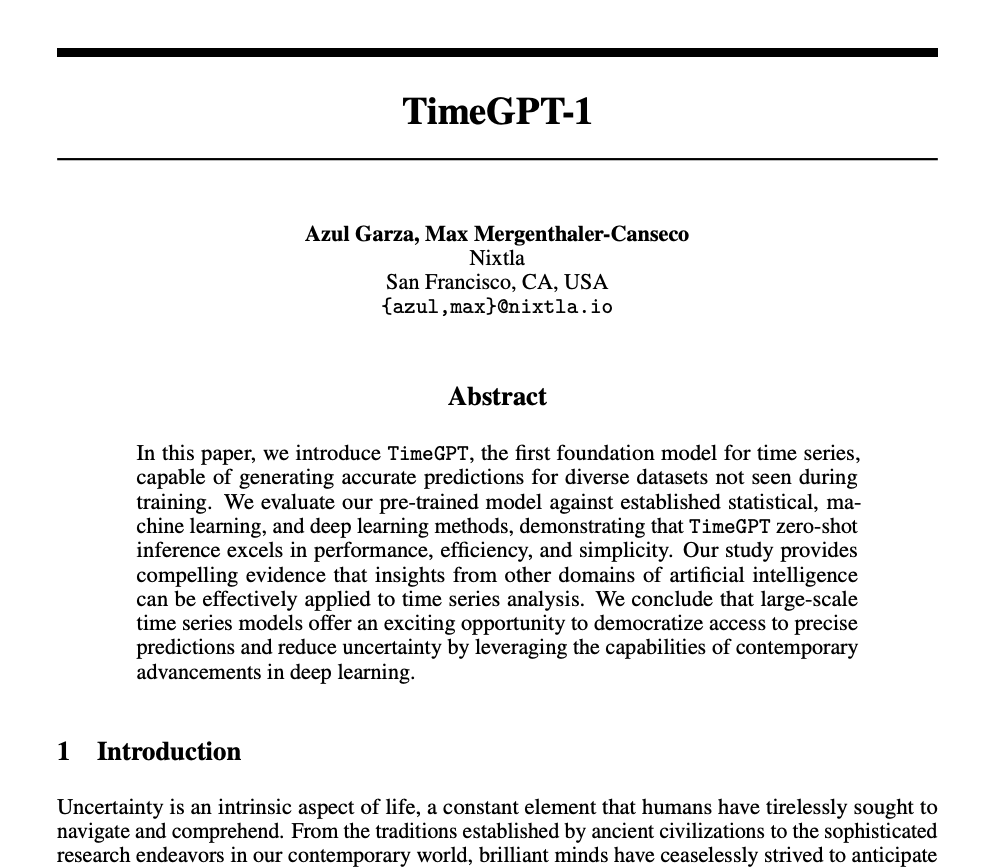
TimeGPT is the first foundation model specifically designed for time series analysis.
It excels at generating precise forecasts across a diverse range of datasets and domains.
Here's what you need to know about it:
1/8
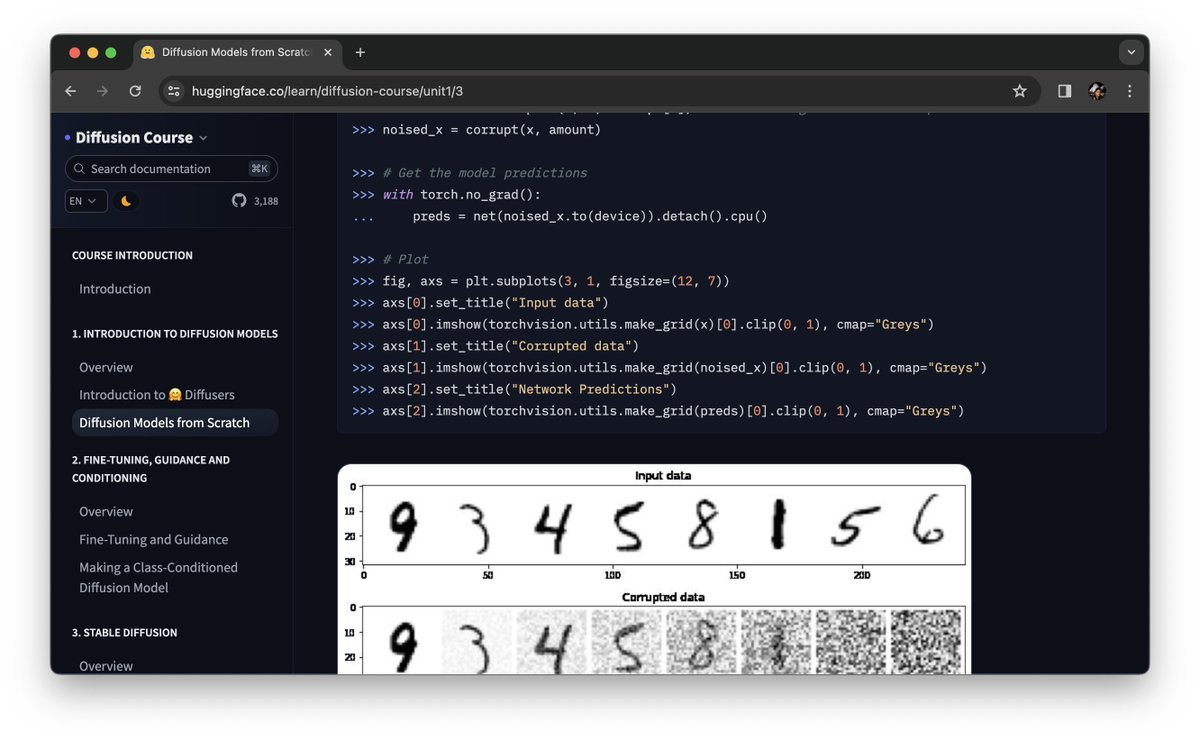
We've just published diffusion course by @johnowhitaker@_lewtun et al. at https://t.co/hbuk2maq27
It is a great resource to learn the basics of diffusion models & @diffuserslib
VN-EGNN: E(3)-Equivariant GNNs with Virtual Nodes Enhance Protein Binding Site Identification
New method to find binding pockets of proteins. Virtual nodes allow to employ distance losses directly.
P: https://t.co/XsJmf88jvn
C: https://t.co/JptRdDNqJR
🤗:https://t.co/jKbqKcdkwV
Diffusion is an extremely powerful and general purpose approach - here we combine it with _policy guidance_ to improve the distribution mismatch in offline RL, which in turn offers the chance to bring RL to the real world without having to collect online data.
I love this tutorial on the self-attention mechanism used in transformers. It shows how all matrices are computed, along with the matrix sizes and code to implement it.
https://t.co/vbfc4Awu3S
🔍 Does Multi-modal LLMs Truly Understand Diagrams in Visual Math Problems?
🧐 Interest in visual math reasoning has surged in the era of Multi-modal LLMs (#MLLMs). Although showing promising potential, it remains uncertain whether MLLMs utilize visual or textual shortcuts to solve visual math problems.
🚀 For the first time, our project #MathVerse uncovers this mystery by dissecting visual problems into six probing settings: Text Dominant, Text Lite, Text Only, Vision Intensive, Vision Dominant, and Vision Only.
🤯 Surprisingly, by merely removing visual contexts from original problems (Text Only), GPT-4V sees a 5.9% gain, while the open-source MLLM, SPHINX-MoE, achieves a significant 17.9% boost.
💡 This outcome illuminates a crucial reason behind the hallucinations observed in some current MLLMs: a tendency to neglect visual inputs and rely on memorizing QA patterns from training data.
🔗 For more insights, check out our work:
Project: https://t.co/1y7mgVkpSR
Dataset @huggingface@_akhaliq: https://t.co/gRny6cvMH5
Code: https://t.co/QGbJEYfdHQ
ArXiv: https://t.co/xrxwCmVfaR
Daily paper: https://t.co/CJuKdF0Toy
Visualization: https://t.co/gLqnYkGHRT
Leaderboard: https://t.co/jgl9J98PGe
😜Thanks to MMLAB CUHK, @opengvlab, and @uclanlp for their collaborative efforts on MathVerse!
"Where do I think the next amazing revolution is going to come? And this is going to be flat out one of the biggest ones ever.
There's no question that digital biology is going to be it."
Jensen Huang, founder & CEO of NVIDIA.
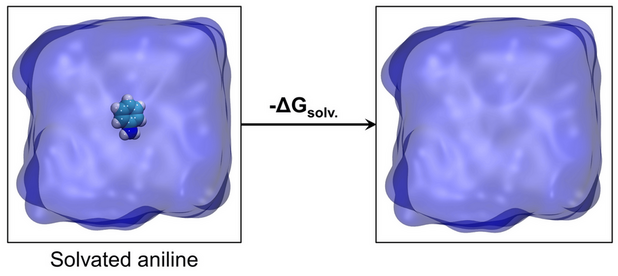
#5/5 We show that branched actin filaments can adaptively generate propulsive force, and reveal its mechanism. Another work based on all-atom molecular dynamics computation will also come out to demonstrate this in detail.
Vey excited to share our work. #1/5 We find actin filament polymerization force can regulate Arp2/3 binding affinity. And, this dominates how migrating cells mechano-sense highly varying ECM and make self-adaptive migrations in it. https://t.co/B5i0c1QcPC
#4/5 As a result, while some of the binding surfaces on the concave side of the bending actin filaments is buried, inducing the decrease of the binding affinity of Arp2/3, the convex side undergoes stretch, facilitating Arp2/3 complex binding and improves Arp2/3 binding affinity.