The only way is through.
Every time you walk into the fire you burn away the old version of yourself and come out built for a life the old you could never handle.
Not only is there no way around it...
It's a requirement for becoming.
Accept it.
Embrace it.
Stand in front of it.
Soak it in.
Look it in the eyes and laugh knowing…
Nothing can fucking break you.
Nothing.
#100to0
There’s something powerful about seeing someone and thinking, “If that guy can do it, I can do it too.”
More than 12 years ago, I was selling exotic cars to affiliate marketers. I assumed they were all computer hacker geniuses. I can barely turn my laptop on most days, so I figured this world wasn’t for me and stayed in my lane.
Then one day, a guy walked into my office who was so dumb I’m not sure he could string two logical sentences together.
I remember thinking “If this guy can do it, I can definitely do it.”
That single thought changed the trajectory of my entire life. I pivoted, dove in headfirst, and figured it out as I went (I had the help of an amazing mentor named Dave)
Last night, I was at a private e-commerce event and met a guy doing more than a billion dollars a year in sales.
He’s relatively “new” to e-commerce, only five years in.
I asked how he got started.
He told me he saw a YouTube video of some guy doing massive numbers and thought, “If that guy can do it, I can do it too.”
So he pivoted, dove in headfirst, and figured it out as he went.
Now let me be that guy for someone else.
I’m legitimately not smart.
I’m technologically illiterate.
I’m impulsive, impatient, disorganized, stubborn, and I have a wild temper.
I’ve made nearly every mistake possible and invented a few new ones along the way.
But somehow, I’m still doing it.
You do not have to be the smartest person in the room. You just have to be willing to enter the room, get embarrassed, make mistakes, and stay long enough to figure it out.
If I can do it, you can do it too.
It’s that simple.
Full grown adults that can’t swim, cycle, skate, backpack, take a gap year, vacation, play an instrument or speak multiple foreign languages. Just a lifetime of hustling and trying to leave survival mode. These are subtle poverty metrics that no one really talks about
You Cannot Hit a Target You Cannot See.
Imagine an archer preparing to shoot without a target.
Where does the arrow go?
Anywhere.
That is how many people live. Busy. Working. Moving. Hustling.
But without direction.
Remember: movement is not always progress. Progress requires direction.
A beautiful morning to you.☺️🙏🏿🫂
Growing up, one of the things that frightened me most was retirement.
I watched men who once had good jobs and comfortable lives struggle after retirement. Some went from grace to grass simply because the salary stopped and there was nothing else to fall back on.
I made up my mind early: I wanted options.
I wanted to grow old with multiple skills and multiple streams of income. And when I became a father, I began teaching the same philosophy to my children.
Life is unpredictable. Give your children options.
Before we relocated to the UK, I called Aunty Joy to teach my children how to make hair. I taught them bread and cake making and other practical skills. My wife taught them soft skills.
We exposed them to art, music and crafts. We are also deliberately teaching them entrepreneurship, financial literacy and how to turn a skill into something that can create value and generate income.
But there is an important rule in our home:
None of these should disrupt their academics.
School remains a priority. These additional skills are developed around their education—during holidays, weekends and available free time.
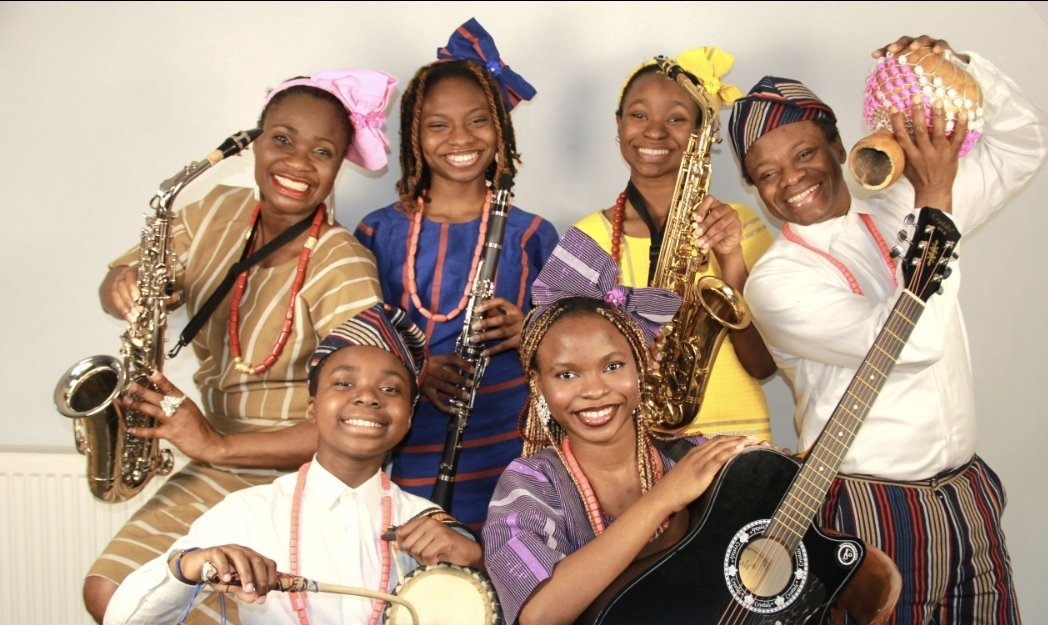
My 16-year-old daughter can play the saxophone, flute, clarinet and piano. Recently, I bought her an electric guitar and a bass guitar. Within three weeks, she was already playing them.
She draws and paints. In fact, she draws better than me now. 😅
She crochets, makes her own hair, bakes incredibly well and enjoys all kinds of crafts.
Her sisters are also multi-skilled.
My son plays the drums and draws very well. But during this long holiday, we noticed gaming was beginning to take too much of his time.
Instead of merely complaining about the games, we gave him something productive to master.
I brought back their music teacher (online) to teach him piano. And for the other sisters and holiday makers.
Within two weeks, he was already playing in church.
That reminded me again:
Never underestimate a child's capacity to learn.
Expose them to sports.
Music.
Art.
Coding and technology.
Public speaking.
Languages.
Cooking.
Practical crafts.
Financial literacy.
Entrepreneurship.
They don't have to turn every skill into a career.
They don't even have to keep all of them when they become adults.
Let them explore.
Let them discover what their hands and minds are capable of doing. When they show particular interest or ability in something, help them go deeper.
And teach them entrepreneurship too.
Teach them that a skill can solve a problem. A problem solved can create value. And value, properly packaged and delivered, can become a business.
They should understand money—how to earn it, save it, invest it and manage it.
But don't sacrifice their education in the process.
The goal is not to overload the child.
The goal is exposure, competence and options.
Life can change.
Jobs can disappear. Industries can change. Technology can disrupt careers. People can relocate to another country and suddenly have to start again.
But knowledge travels with you.
Skills travel with you.
The ability to create value travels with you.
So educate your children.
Then, as much as their age, interest and capacity allow, give them skills, give them exposure, teach them entrepreneurship and give them options.
One day, the skill they thought they would never need may become the very skill that opens a door for them.
Watching devs slander “vibe coders” is so tiring.
Sure, if you really want to prove a vibe-coded app is “bad,” you can run load tests until it blows past its DB connection limits, inject network chaos to expose missing circuit breakers, run 48-hour soak tests to uncover memory leaks, or audit a monolith under 50k users for unindexed queries, N+1s, row locks, thread starvation, and broken cache invalidation.
And after all that, you might discover something uncomfortable: 95% of software doesn’t need any of it.
Most people vibe coding aren’t trying to build the next Google. They’re turning an idea into functional software for 50 users, solving a problem, learning, or just having fun.
Software engineering is much deeper than pulling out enterprise-scale benchmarks to dunk on something someone built on the internet.
There’s distributed systems, performance engineering, databases, compilers, networking, concurrency, system design, and a thousand genuinely hard problems to master.
You don’t need to fight vibe coders to prove you’re an engineer.
Let people build. Then go build something hard yourself.
Old people don’t give a fuck what anyone else thinks. And we eventually become old people. So our end, most evolved state, is not giving a fuck.
I think enlightenment is not waiting until you’re 80 to get there.
Purpose without action remains a wish.
Write the vision. Build the plan. Break it into small actions. Then do something every day that moves you towards it.
Sometime in 2016, my family and I were considering relocating. I made enquiries and discovered it would cost about ₦15 million for a family of six.
Haaaa! ₦15 million? 😅
I told my wife, “If we have this kind of money, our yoghurt factory go set be dat!”
That conversation made us revisit our yoghurt dream.
We bought an exercise book and wrote the vision again:
To build one of the foremost yoghurt brands in Nigeria and, eventually, Africa.
Then we broke the dream down:
NAFDAC registration.
Name for the yoghurt
Factory location.
Packaging and label design.
Production process.
Equipment.
Raw materials.
Market research.
Suddenly, we realised something:
We didn't need all the money at once.
Breaking the dream into smaller pieces made the giant look like an ant.
So almost every day, we did something towards it - a phone call, market visit, enquiry, research, sourcing raw materials or meeting someone.
And because we were doing something about the dream, we began to attract favour along the way.
People helped. Information came. Opportunities opened. Resources appeared from places we hadn't anticipated.
That experience taught me:
Sometimes favour meets you on the road, not in your room.
Don't wait until you have everything.
Write the vision.
Break it down.
Start with what you have.
Do something today.
Big dreams are built with small, consistent actions.
Look, I beg you. Become really good at something. Like wickedly good. Then let as many people as possible know you’re really good at that thing. The consequences will change your life.
You have a duty to God to become more competent, disciplined, and influential than you ever imagined yourself capable. You must become a weapon against evil.
We're in the middle of the second renaissance where proof of work replaces the resume, an audience replaces the employer, and taste replaces credentials.
I highly recommend having hobbies cause it distracts you from falling in love unnecessarily, and I have an explanation. An ideal mind always mistakes loneliness with love, but busy minds have standards, because when most of your days are filled with things like lifting, creating, reading, learning things like that, you stop chasing people for excitement, because we have a really bad habit of romanticizing every bit of attention that we get. Even if it was not not directed at us with the same intensity of intention, most of the time you are simply wanting something to do.Instead of the feel that you're confusing with wanting.And I strongly believe that best relationships are built when two complete lives meet instead of two bored people who try to become each other's hobby, the interdependence in that situation would create the pressure which finally would become the reason for the eventual breakdown.
Don’t give AI the whole project at once to build.
A good workflow is:
1. Product requirements
→ What are we actually building?
2. System architecture
→ What are the major components and how do they interact?
3. Domain model
→ What are the entities, relationships and business rules?
4. API/contracts
→ What does each service expose and consume?
5. Design system
→ How should the product look and behave?
6. Project conventions
→ How is code organised and written?
7. Implementation plan
→ Break the system into independently implementable units.
8. AI implementation
→ Give AI one bounded unit with the relevant context.
9. Tests
→ Verify the implementation against the contract.
10. Review/refactor
→ Make sure the implementation actually conforms to the architecture.
The key distinction is:
AI should answer “How do we implement this?” far more often than “What should our architecture be?”
You can absolutely use AI for architecture too, but you should make the final architectural decisions yourself.
AI is very good at generating alternatives, identifying trade-offs and spotting gaps; it becomes dangerous when its first generated solution silently becomes the architecture of your product.
I can see the future very clearly.
I see a South East where millions of children are no longer educated merely to pass examinations, but to build things the world will buy.
I see 13- and 14-year-olds building toys for Christmas, designing automated home systems, creating energy solutions, manufacturing electronics, solving security issues through technology and building drones in their hundreds of thousands to solve real African problems.
And then something extraordinary will happen: children will become creators of wealth before they are old enough to look for jobs. Some will become multimillionaires as teenagers, not from speculation, but from knowledge, engineering and solving real problems.
This is bigger than education.
We are laying the foundation for an industrial revolution.
We are raising a generation that will not look at technology and ask, “Where can we import this from?”
They will ask, “How can we build it ourselves?”
I can already feel this wave beginning. The energy is building. The mindset is changing. And once millions of young minds discover that mathematics, science and engineering give them the power to create, it will be incredibly difficult to stop them.
So I will say this now, while it is still early:
Start investing in the South East.
A generation of builders is coming.
And they are going to build things Africa has never seen before.
I got several DMs asking me to explain what I meant by DFS in my post.
DFS stands for
Depth-First Search
which is a graph/tree traversal algorithm.
But I also think of it as a mental model for learning.
The idea is that you pick a path and follow it to the end.
You don't have to stop every other hour to think, "Oh right, I need to learn 10 prerequisites before I can even understand this concept".
You just follow along till you understand it or get stuck because of a critical missing understanding.
Then you backtrack, filling in the gaps till you can get unstuck, and proceed deeper into the rabbit hole.
There's another reason why I like this analogy though.
If you approach learning fundamentals on their own, without having first struggled with the harder concepts that those fundamentals are prerequisites for, you can feel underwhelmed.
You might feel like, "Oh, this is just a fundamental".
You see a data structure or an algorithm or a piece of OS theory or a DB primitive and think, "Well there's a neat little toy example where it comes up".
But if you had first grappled with the harder concept that required that fundamental, your view of the fundamental would be quite different.
You would see it in a larger context.
The fundamental wouldn't be a standalone object of appreciation, but rather a building block to something you were trying to understand.
You don't learn B+ trees because it's on your roadmap of things to learn about databases, but because you wanted to understand storage engines, and you need to know B+ trees to understand storage engines.
You don't learn WAL as just another log, but as a critical enabler of durability, recovery, and consistency in the face of failures, crashes, and aborts - and how that feeds into the larger system that you're trying to understand.
The harder concept is providing you with the context to understand the importance of a fundamental.
And since you've already struggled with the harder concept, you now want to go deeper into understanding the foundational piece.
You can look at the primitive in less of a vacuum, and more in terms of how it fits into a larger system, how it's used, what limitations it has, the tradeoffs it makes, etc.
That, to me, is the really interesting part about this type of learning.
You get to do that kind of analysis only when you first struggled with the harder concept, and then went back and filled in the gaps.
Curiosity drives us to go deeper.
Your DFS traversal kicks in.
Go deep, get stuck, backtrack, repeat.
DFS your way through learning.
have you ever noticed how beautiful people compliment, happy people celebrate other people’s wins, multilingual people don’t mock someone’s accent, educated people share what they know, and confident people don’t feel the need to compete? secure people inspire instead of trying to make others feel small.
This is why having good people around you matters.
But you also have to be a good person to have around.
You can’t disappear for years, never show up for anyone, never bring value, then suddenly expect people to come through for you when you’re broke.
Be useful. Be present. Help people when you can. Build genuine relationships.
Because when life gets tough, the people you’ve poured into are often the same people who will be willing to pour back into you.
Protect your finances.
But don’t neglect your relationships either.