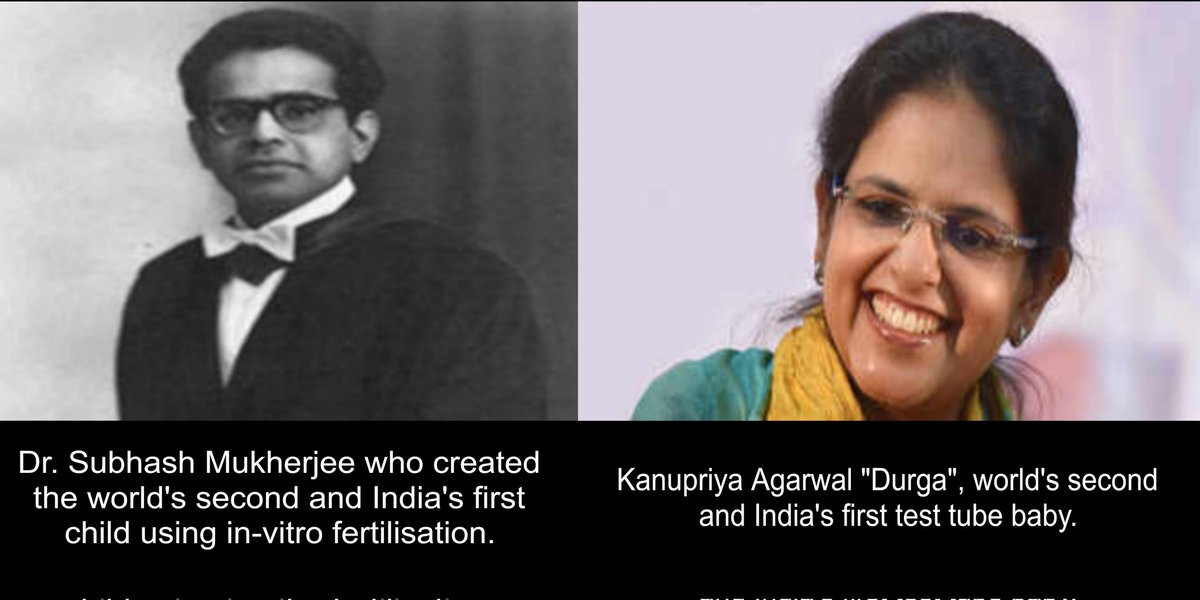
■ The Doctor Who Created Life, Only to End His Own: India’s Tragic Scientific Story. On October 3, 1978, in a small nursing home in southern Calcutta, a baby girl named Kanupriya Agarwal affectionately called “Durga” was born. She was India’s first child conceived through in-vitro fertilization (IVF) and the world’s second, arriving approximately 67–70 days after Louise Brown, the first IVF baby, in the UK on July 25, 1978.
■At the center of this achievement was Dr. Subhash Mukherjee, a physician and endocrinologist working at Kolkata’s Nil Ratan Sircar Medical College. He collaborated with cryobiologist Sunit Mukherji and gynecologist Dr. Saroj Kanti Bhattacharya. Using rudimentary laboratory facilities and limited resources, the team successfully performed IVF.
■His approach differed notably from the early British work by Patrick Steptoe and Robert Edwards, who initially relied on natural menstrual cycles for single-egg retrieval. He pioneered the use of gonadotropins (such as human menopausal gonadotropin) to stimulate the ovaries and produce multiple eggs, an innovation that later became the global standard in IVF protocols. Even more remarkably, his team cryopreserved an eight-cell embryo (frozen for about 53 days in this case) and transferred it, resulting in a live birth. This is widely recognized as the world’s first successful pregnancy and birth from a frozen embryo, a milestone replicated in the West several years later.
■Rather than celebration, his announcement faced intense skepticism and institutional hostility. The West Bengal government formed an inquiry committee dominated by specialists outside reproductive biology including a radio-astronomer/radiophysicist (chair), a nuclear physicist, a gynecologist, and a neurophysiologist. The committee subjected him to interrogations and ultimately dismissed his claims as unproven or bogus. He was barred from presenting his work at international conferences, denied permissions to publish formally in scientific journals and subjected to transfers, including one to the Regional Institute of Ophthalmology, far removed from his field of expertise.
■Isolated, professionally ostracized, and under immense psychological strain, he died by suicide in 1981, at his Kolkata residence at the age of 50.
■For years afterward, credit for India’s first IVF baby was attributed to the Mumbai team led by Dr. T.C. Anand Kumar and Dr. Indira Hinduja, whose baby Harsha was born in 1986 and was the first extensively documented case at the time.
■However, in 1997, Dr. Anand Kumar examined Mukherjee’s preserved handwritten notes, lab records, and spoke with the parents of Kanupriya Agarwal. Convinced of their authenticity, he publicly acknowledged Mukhopadhyay’s priority at a national conference and later published a paper titled “Architect of India’s First Test Tube Baby: Dr. Subhash Mukerjee” in Current Science. This act of scientific integrity corrected the historical record.
■By the early 2000s, ICMR and other bodies formally recognized Dr. Mukherjee’s contributions. His name was added to the Dictionary of Medical Biography, and a bust honoring him now stands at Nil Ratan Sircar Medical College in Kolkata. Kanupriya Agarwal (Durga) has herself spoken publicly about his pioneering role.
■Dr. Subhas Mukherjee's story remains a poignant chapter in the history of Indian science, one of remarkable ingenuity under constraints, followed by tragic institutional failure, and eventual posthumous vindication. His work helped lay the foundation for the millions of IVF births that have occurred worldwide since.
■Today marks the 45th anniversary of Dr. Mukherjee's passing. #OnThisDay 1981, India lost a visionary who achieved what the world’s leading centers had only just begun to explore yet was failed by the very system that should have celebrated him. His legacy endures in every IVF family, a reminder of the price sometimes paid by those ahead of their time.
Do you know who invented the backbone of #Internet ?
It started with a small question: Can Light bend? Scientists mocked him.
BUT, he was determined to find the answers, that led to the discovery of Fibre Optics.
Learn about the Indian scientist who invented the backbone of the internet and never got the Nobel Prize for it.
Meet Narinder Singh Kapany. Born in Moga, Punjab in 1926. You’ve probably never heard his name.
But right now, the data reaching your phone is traveling on technology he invented. 👇
Read on this thread 🧵
First 10 days it was 1 ton
In the next 5 days it’s 1ton
#carrymeback gaining momentum
If you wish to learn how you can replicate #Carrymeback at any pilgrimage or trek route along with Drive me back
Register here - https://t.co/Px1blQwup4
#HealingHimalayas
The word "Varna" literally means "Choice", one choses their own Varna, so much as one choses to be a doctor, teacher or worker.
Made from root वृञ् वरणे, original system was based on choice, if you choose to be a Brahmin can work hard to attain brahminhood through Vidya and tapa, you can be a brahmin.
The Govt has banned Telegram in India until June 22 over the use of the app by 'cheating rackets' for NEET-UG.
The Babu or the minister whose "big brain" idea this was should get the Param-Chaantt award.
They are assuming that the cheating network and their clients don't understand what a VPN is and can't access Telegram through one.
They think that because the paper was shared on Telegram last time, if it is leaked, it will only be shared on Telegram again. Are Discord, Signal, and WhatsApp a joke to them?
So, why not make your system foolproof and make leaks impossible instead of banning a mode of communication? Because it's a slippery slope. If the paper leaks and is shared tomorrow, you'll ban other apps too, and eventually the whole internet. But then again, papers were leaked and shared long before the internet era, too.
The reality of prized UN Missions. INDIAN ARMY AND
PAKISTAN ARMY
BHANGRA IN CONGO. Instead of merry making, wish someone had integrity to ask Pakis why they tortured and killed Capt Kalia & his 5 men patrol in cold blood against all humanity & Geneva Convention. Quite a shame.
A water buffalo appears in Mesopotamia around 2500 BCE. The animal is native to India. Nobody asks how it got there.
We did. The answer changes everything. 🧵
2800 BCE — An Indus merchant is living at Susa, writing in two scripts simultaneously.
2500 BCE — An Indian buffalo appears on a Mesopotamian frieze.
2050 BCE — A Harappan colony in Bahrain: 92 seals recovered from one site.
1675 CE — Bhai Lakhi Shah, Banjara landholder on Raisina Hill, Delhi.
Same corridor. Same community. 4,300 years.
The people who moved that buffalo were the same community whose descendants supplied the Mughal army at 100,000 oxen per campaign.
The Banjara. The vanajāraka guilds of 12th-century Rajasthan. The sārthavāha of the epics.
One logistics institution. Fifteen centuries of documented evidence. One corridor.
The buffalo didn't migrate. It was transmitted.
#Archaeology #IndusValley #Banjara #Mesopotamia #IndianHistory
Full paper (open access): DOI: 10.5281/zenodo.20557583
Every calculation you have ever done uses a system India invented.
Before Indian mathematicians gave the world zero and the decimal place, Greek and Roman maths used letters for numbers. Try multiplying MXLVII by CCXCIV. Merchants, architects and astronomers across the ancient world were trapped.
Baghdad's Al-Khwarizmi (c.780–847) transmitted it west. His book on the Indian place system and algorithmic calculation laid the foundation of modern mathematics. The word "algorithm" is a corruption of his name. "Algebra" comes from his treatise title. Both are Arabic transmissions of Indian originals.
Abraham Seidenberg's History of Mathematics credits India's Sulba Sutras as the inspiration for all mathematics of the ancient world.
Lin Yutang, Chinese philosopher: "India was China's teacher in trigonometry, quadratic equations, grammar, phonetics."
Carl Sagan thought Vedic cosmology the only ancient system whose timescales correspond to modern scientific cosmology.
Every time a computer runs, it counts in a system India designed.
A new space startup plans to sell on-demand sunlight at any hour, beamed directly from Earth's orbit.
California-based aerospace startup Reflect Orbital is looking to revolutionize how we experience the night by launching a constellation of satellites equipped with ultra-thin reflective mirrors.
Founded by former SpaceX engineer Ben Nowack, the company aims to make sunlight "programmable," allowing users to request a localized beam of light simply by entering GPS coordinates on a website.
The system is designed to redirect sunlight down to target areas roughly five kilometers wide, offering brightness ranging from a gentle full moon to peak daylight. Initial applications focus on expanding solar power generation into the evening hours, assisting disaster response teams, and lighting remote industrial worksites.
While the startup has generated massive commercial interest—receiving more than 260,000 inquiries and securing millions in venture capital—the concept of "sunlight-as-a-service" has sparked intense debate.
Environmental scientists and astronomers warn that artificial orbital illumination could severely disrupt nocturnal ecosystems, disorient migrating birds, and damage human circadian rhythms.
Critics argue that altering natural cycles of darkness constitutes a new, unregulated form of light pollution. Despite these concerns, Reflect Orbital is moving forward with plans to deploy its first test satellites, bringing humanity one step closer to a future where darkness is optional.
source: McKie, R. (2026). Satellite mirror plans could disrupt sleep and ecosystems worldwide, scientists say. The Guardian.
BREAKING🚨: Google’s quantum chip solved in five minutes a problem that would take 10 septillion years.
Physicists say it “proved” we live in a multiverse!
Researchers show that Claude Code is 98% not AI.
Anthropic never gave us the architecture for Claude Code. There were no docs. Just a tool that every developer is currently obsessing over.
Until it leaked recently.
A research team pulled the source code, analyzed all 500,000 lines, and found something ridiculous.
Only 1.6% of the codebase actually interacts with the AI model.
The core of Claude Code is literally just a simple while-loop. It asks the model what to do, runs a tool, and repeats.
So what is the other 98.4%?
It is hardcore, traditional software engineering.
The researchers found a massive, complex infrastructure designed entirely to babysit the AI and keep it from hallucinating or destroying your computer:
- A 7-mode permission system acting as a security bouncer.
- A 5-layer context compaction pipeline so the AI doesn't forget its goal.
- A subagent delegation mechanism with strict worktree isolation.
- Four different extensibility hooks to manage external tools safely.
Every startup right now is trying to build a better AI model to get better results.
Anthropic did the exact opposite.
They took an existing model and built a fortress of deterministic software around it.
They realized that the AI doesn't need to be smarter. It needs to be managed.
Every calculation you have ever done uses a system India invented.
Before Indian mathematicians gave the world zero and the decimal place, Greek and Roman maths used letters for numbers. Try multiplying MXLVII by CCXCIV. Merchants, architects and astronomers across the ancient world were trapped.
Baghdad's Al-Khwarizmi (c.780–847) transmitted it west. His book on the Indian place system and algorithmic calculation laid the foundation of modern mathematics. The word "algorithm" is a corruption of his name. "Algebra" comes from his treatise title. Both are Arabic transmissions of Indian originals.
Abraham Seidenberg's History of Mathematics credits India's Sulba Sutras as the inspiration for all mathematics of the ancient world.
Lin Yutang, Chinese philosopher: "India was China's teacher in trigonometry, quadratic equations, grammar, phonetics."
Carl Sagan thought Vedic cosmology the only ancient system whose timescales correspond to modern scientific cosmology.
Every time a computer runs, it counts in a system India designed.
⚠️ Windows 11 Update KB5094126 Freezes Systems, Forces BitLocker Recovery, and More
Source: https://t.co/7jUTQLfG7N
Microsoft's June 2026 Patch Tuesday cumulative update for Windows 11, KB5094126 (OS Builds 26200.8655 and 26100.8655), has triggered a wave of reports across community forums and enterprise environments, with users experiencing system freezes, forced BitLocker recovery loops, broken OneDrive Explorer integration, and disrupted local area network (LAN) access following installation.
Released on June 9, 2026, KB5094126 is Microsoft's monthly cumulative security update for Windows 11 versions 24H2 and 25H2.
#cybersecuritynews #windows11