How $GCTS Powers The Best Satellite IoT Devices On The Market
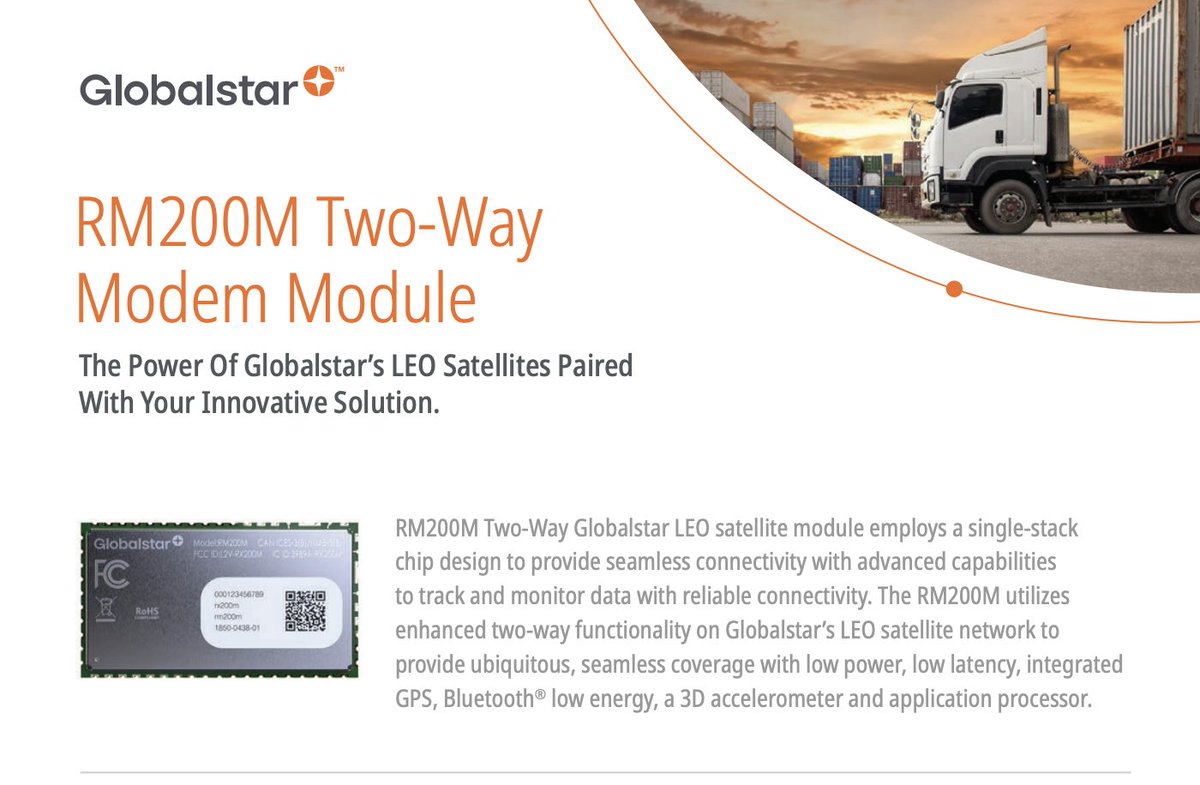
It’s been 9 months since $GSAT dropped the commercial rollout of the RM200M, and it’s made a massive footprint in the IoT game ever since 🛰️.
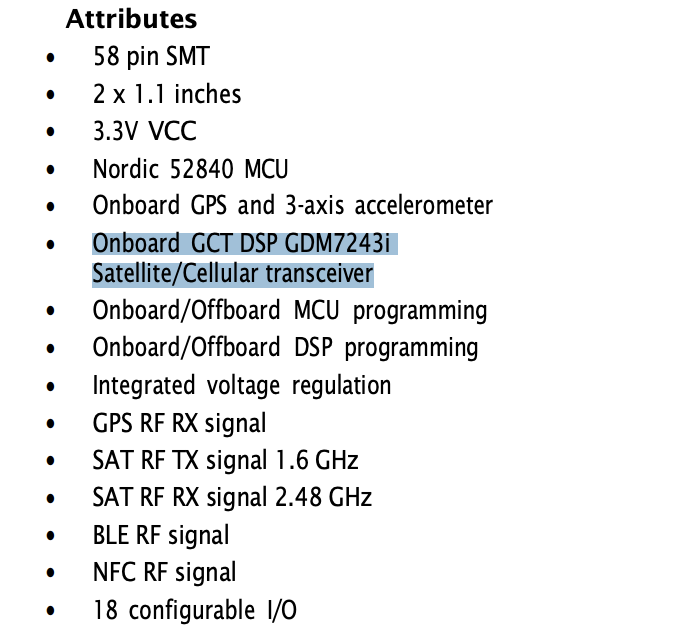
It all comes down to their unique ip, the GDM7243i chip.
Tracking assets globally is a headache. You either pay high premiums for constant satellite coverage, or you lose tracking data the second a truck or shipping container goes out of cellular range.
How does GDM7243i fix this?
Because of GCT, the RM200M is able to be a hybrid device. The chip can automatically, seamlessly switch between standard cellular networks (when in range, keeping data costs low) and Globalstar’s LEO satellite network (when off-grid, ensuring a constant connection). Your asset never goes dark, no matter where it is on the map.
Why didn't Globalstar just buy chips from giants like Qualcomm or MediaTek?
While giants like $QCOM build powerful NTN chips, bridging standard cellular with custom satellite spectrum (like GSAT’s L/S band) usually requires them to use complex, multi-chip setups. That translates to bulkier hardware, higher production costs, and severe battery drain.
So why GCT Chips?
GCT is integrating everything, the RF transceiver, baseband, GPS, and memory, into one ultra-efficient single stack System-on-Chip (SoC) specifically customized for dual mode action. All of this also equals longer lifespan, lower cost, and as reviews say simple setup.
And with over 120 patents around the tech, GCT's moat is essentially locked in.
As $AMZN is diving headfirst into the satellite game, with huge IoT and Physical Robotics plans, this could get spicy.
Just some notes on $POET AGM and read through on optical markets:
- "The top three laser suppliers control 68% of the market, and they’re completely sold out for the next two years"
$LITE CEO said into 2028, so POET implicitly confirms laser shortage is going into 2029 now.
- NRE with a new customer, building on POET’s interposer for high-power external light source.
This is high confidence $SIVE as laser supplier given the Sept 29, 2025 PR on ELS, and new customer qualification would be material for revenue if it goes into volume ramp.
- Poet expects Lumilens commercial agreement to scale to over $500 million over the next 5 years.
Lumilens claimed a top-3 hyperscaler was their initial customer (Linkedin OSINT)
- $830M cash on hand on balance sheet (this is more for Poet fundamentals).
- "The entire optical components industry today is facing a severe shortage of critical components."
Reaffirming what we know already regarding optical bottlenecks.
- "Production ramp in the second half of 2026 this year."
Just production timelines H2.
In terms of $POET volumes:
- existing capacity around 1 million optical engines per year
- projected demand exiting 2027 around 1 million optical engines per month
- roughly 10x capacity expansion
I don't own Poet, but if management delivers on these projections it directionally looks very positive.
However something to note is that unlike other suppliers that have named hyperscaler customers to to back up capacity revenues like $AAOI: $POET seems more questionable.
But this does look like a very positive outlook for $POET if they match projections.