@ENERGY hey I think it would be cool if maybe the next time we get to pick who is running our institutions we choose people who are not the dumbest motherfuckers to ever exist on planet earth to hold those positions
just an idea
You can image being an advocator of LLM for complex math problem, the more you say positive things about it, the more those companies want you to say. You then will not say negative things when you are not sure or you are biased already.
A PhD is really great for folks that don't yet have the skills they want.
For me I exited undergrad knowing:
- basically 0 programming
- 0 optimization
- 0 ML
(curse you physics)
but a PhD let me take time and develop those skills.
It is with immense pleasure that @KathiFisler, Ben Lerner, @joepolitz, and I announce the first version of our new book, DCIC: a Data-Centric Introduction to Computing. This brief thread explains the book a little. 1/10
https://t.co/3OT5hOLHsE
I’ve just started reading this book, and it’s fantastic! Super informative and funny. I don’t know the author, Michael Littman, personally, but it’s obvious from every page that he is a marvelous teacher. HIGHLY Recommended!
I’ve just started reading this book, and it’s fantastic! Super informative and funny. I don’t know the author, Michael Littman, personally, but it’s obvious from every page that he is a marvelous teacher. HIGHLY Recommended!
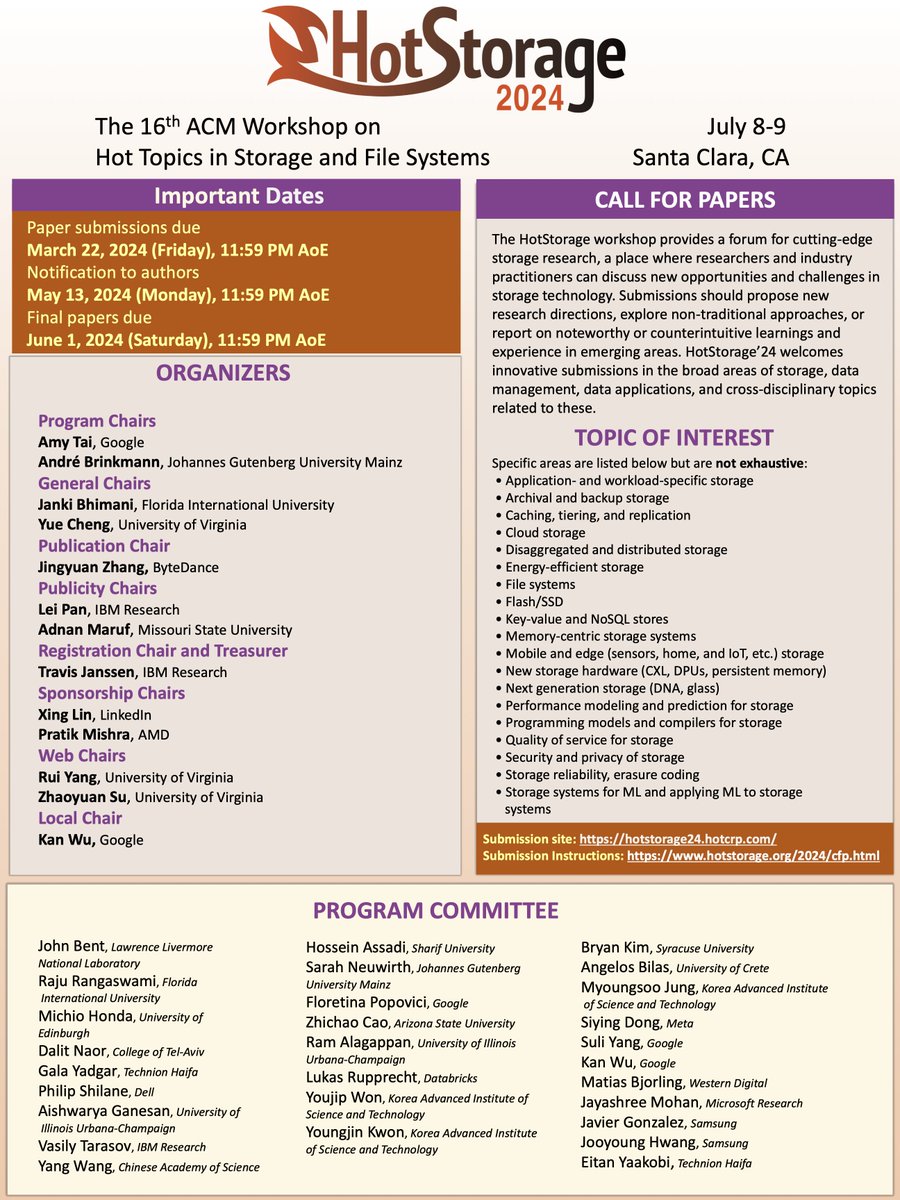
HotStorage’24 invites submissions (https://t.co/S7oEVbVGMD) on topics in storage, data applications and cross-disciplinary areas. Join us in shaping future of storage systems! Submissions due by 03/22/2024 (https://t.co/QH7yDq516T)
@usenix@TheOfficialACM@IEEEComputerSoc
Academia cares whether an idea is new. It doesn't really have to work
Industry only cares if an idea works. Doesn't matter if it's new
This creates a gap. Actually a few gaps:
Yes, the agent architectures that Yann LeCun and I work on are both instances of “the common model of the intelligent agent”. And it’s not just an AI thing. You can find the same ideas in psychology, economics, control theory, and neuroscience. See https://t.co/F1HgND82vo
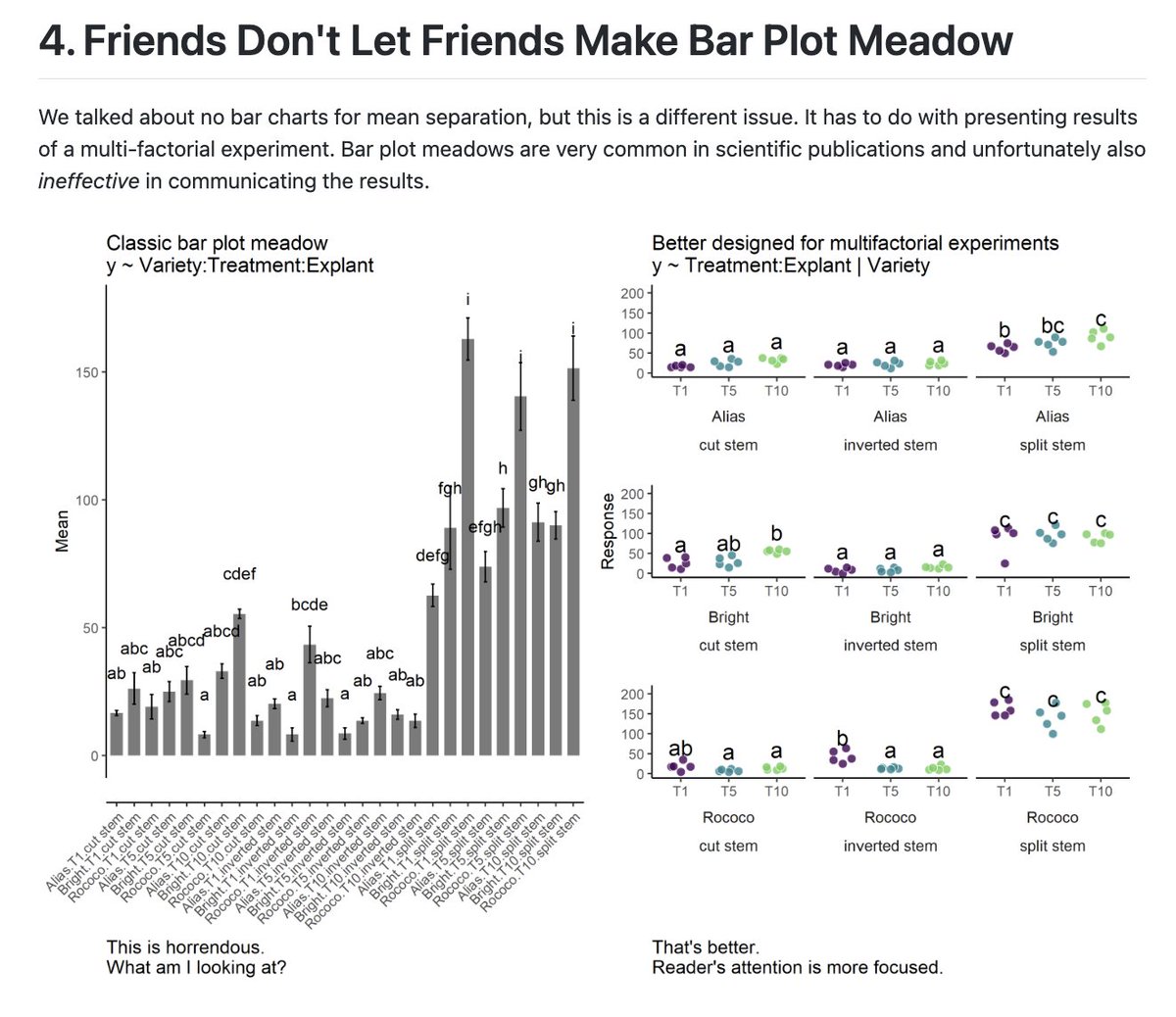
Friends don't let friends make bad charts!
Chenxin Li, pulled together a lot of great advice for data visualization, with clear "do this, not that" examples for each item.
Here are a few of my favorites, see the link below for more.
There's a common mistake young people make across many fields, which we might call "Goodhart overhang": sticking too long to old and familiar goal-metrics when the objective function has changed, and the metrics are no longer relevant. Examples: