Welcome to Daily Check HQ 🩺
The stories that matter in AI & healthcare innovation, checked by a doctor. Every claim sourced, no hype, 3-minute read.
📬 Free daily brief: https://t.co/V27Lyo4Gp8
🎥 TikTok: https://t.co/NxWUpkM2pQ
🌐 https://t.co/KBnuousEs2
Follow for daily updates 👇
#AI #HealthTech #Newsletter
@digitalhealth2 The number that decides this for patients is specificity. Each false positive on prostate MRI can mean an unnecessary biopsy, with infection and bleeding risk. If AI reads match expert radiologists, the real win is consistency in hospitals without a specialist uroradiologist.
@gbiondizoccai@TheLancet 98 patients is a start, but the number I'd want is the misses: in 10% of cases the diagnosis was wrong, and in primary care the danger is a confident wrong answer for chest pain or sepsis. Who caught those errors, the AI or the physician?
@healthtechworld The test that matters is what this adds to PSA. Early-warning proteins only help if they cut unnecessary biopsies and overdiagnosis of slow-growing cancers; a GP can't act on a 15-year risk score without a clear follow-up pathway.
@drbennisahmed Worth remembering why this was tested: dialysis patients were excluded from DAPA-CKD and DAPA-HF, so SGLT2 benefit here never had evidence. A neutral surrogate result plus good safety is still useful; the real question is whether a hard-outcome trial is worth funding.
The detail that matters for clinics: each patient's vaccine is built from their own tumour's sequencing, then given alongside pembrolizumab. If the reported 42% drop in recurrence or death holds up, the bottleneck becomes how fast sequencing and manufacturing can happen after surgery.
Agreed. A quick way to tell them apart: toxin-type food poisoning (Staph aureus, Bacillus cereus) usually strikes 1-6 hours after a shared meal, while norovirus takes 12-48 hours and then spreads person to person. Either way, gastro on a plane is a hygiene problem, not a pandemic.
Worth checking the cost line in the Science paper: on the emergency cases, the most accurate setup ordered more tests, not fewer (about $4,979 vs $3,400 per case). Accuracy and savings came from different configurations, so "better and cheaper" depends on which version a hospital runs.
@Berci The label also hides the comparison: these were text-only NEJM puzzle cases, and generalists rarely face those alone. In general practice the hard part is the patient who doesn't fit any vignette. A prospective trial in real clinics would tell us far more.
@DrCSBondugula Agreed, and in GP clinics the gap is concrete: a typical 10-minute consult leaves about 2 minutes for notes, so ambient scribes only earn trust if the physician can edit and audit every line. Clinician-led testing before rollout matters more than any demo.
@VanRijmenam The 88% figure rings true from general practice: what we look up is rarely "what is this?" but "what do I give, given their kidneys and other meds?". Benchmarks that only score the diagnosis miss exactly the step where a wrong answer reaches the patient.
🩺 Doctor's check: ⚠️ overstated
80% vs 47% on ER cases is real, in @ScienceMagazine. But it's a text-only benchmark vs generalist doctors, not real patients.
Lower cost? On ER cases the most accurate setup spent more on tests ($4,979 vs $3,400).
Would you trust it?
Our MAI Diagnostic system is now 1.7x more accurate than physicians in the ED, even when they have access to the web to look things up.
It's also lower cost & does fewer medical tests to get to its diagnosis.
Published in the journal Science today...
@Thom_Wolf Doctor's view: dual-use risk in medicine is handled with credentialed access (think controlled substances), not keyword blocks. Verified tiers with audit trails would serve clinicians and researchers better than blanket refusals.
@rtehrani Letting assistants trigger actions in third-party apps is where the real safety work starts. In clinic I'd want every AI-initiated order or message logged, reversible, and signed off by a human before it reaches a patient.
@GLTrax@NEJM@Lilly Agreed, untreated sleep apnoea quietly raises blood pressure and accident risk, so it deserves the attention. Worth remembering the drug is still investigational, so CPAP stays the standard for now.
A weekly shot cut sleep apnea events by up to 34 an hour 😴
In 2 phase 3 trials in @NEJM, @Lilly's experimental retatrutide beat placebo (~10/hour) at 80 weeks. Still investigational; Lilly funded the trials.
Would you swap your CPAP for a jab?
#SleepApnea#HealthTech
@DrLifesgud@businessXplain Thanks! The real test is whether the flag actually gets a dietitian to the patient sooner. Have you seen screening tools like this change that in practice?
@martinvars In general practice, not ordering is often the most useful decision we make: roughly half of people in their 40s with no back pain already show a disc bulge on MRI. An AI doctor should be judged on the cascades it avoids, not just the diagnoses it finds.
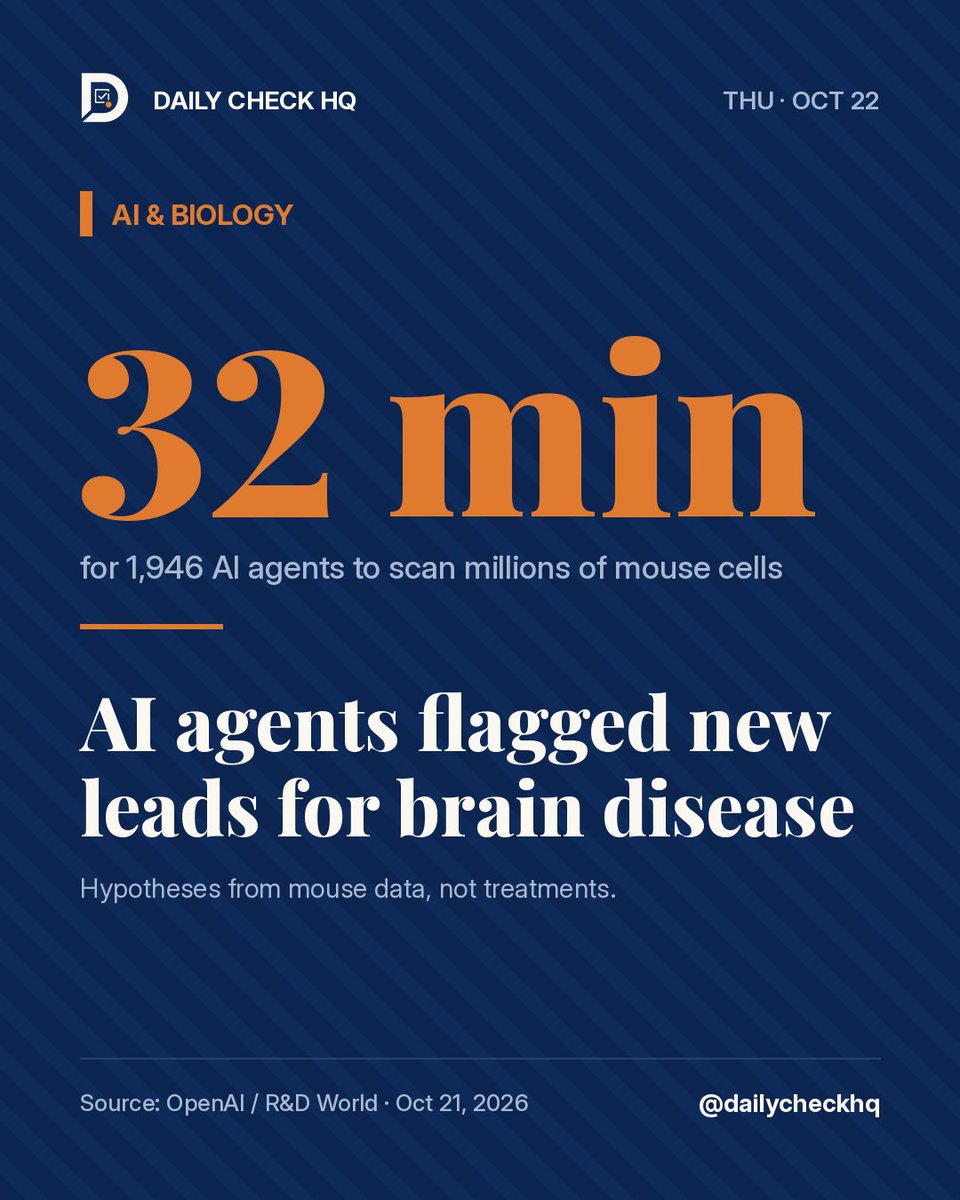
1,946 AI agents. Millions of mouse brain cells. 32 minutes 🧠
@OpenAI and @scrippsresearch say the agents flagged new brain-disease leads, work they estimate would take humans months. Hypotheses, not cures.
Would you trust AI to pick the next experiment?
#AI#Neuroscience
@AntLingAGI Open weights are the interesting part for hospitals: a model that runs on local servers means patient data never has to leave the building. HealthBench is a start, but I'd want to see it tested on real, messy clinical notes and on how often it is confidently wrong.
@kevinweil@lightspeedvp The bottleneck in drug discovery was never only ideas, it's the slow make-and-test loop. But roughly 9 in 10 drugs that enter human trials still fail, so the real test for faster preclinical labs is whether their molecules survive phase 2, not how many they make.