Google Brain founder, Andrew Ng:
"Prompting will be dead in 6 months. Loops and Graphs are what's replacing it."
In 1 hours at Stanford he shows what the best engineers build instead, and how you start building it today.
Everything a $500 course sells you is in the first 10 minutes. Free.
Watch it, then read the guide below on how to build a system that improves itself.
We're offering grants of up to $50,000 in Claude usage credits to researchers accelerating cures for rare diseases.
This is our first focused call within AI for Science, our program supporting scientists using Claude to speed up discovery. https://t.co/rZEmwh07cd
🚨 Este OCR GRATUITO puede leer letra de médicos, tablas complejas y ecuaciones matemáticas.
Se llama **Chandra**, de Datalab.
Y es uno de los OCR más completos que he visto.
Puede procesar:
📌 **Texto escrito a mano**
Notas médicas, formularios rellenados, letra cursiva o poco legible.
📌 **Tablas complejas**
Mantiene celdas combinadas, filas y columnas. Ideal para facturas, informes financieros y PDFs con muchos datos.
📌 **Fórmulas matemáticas**
Convierte ecuaciones directamente a LaTeX.
📌 **Formularios**
Reconoce casillas, botones y valores introducidos.
📌 **Documentos con diseños difíciles**
Textos a varias columnas, periódicos, libros y documentos con imágenes.
Puede devolver el resultado en Markdown, HTML o JSON.
Funciona en más de 40 idiomas.
Para instalarlo:
`pip install chandra-ocr`
Es gratuito para uso personal.
Dejo el link al repo en los comentarios 👇🏻
Anthropic pays engineers $750,000+ a year to understand how LLMs work.
Stanford just put a 2 hour lecture that covers 80% of it for FREE.
Bookmark this. Give it 2 hours today.
It might be the highest ROI thing you do this month:
Google just dropped a 1-hour course on agentic engineering from scratch:
00:00 – How to build your first AI agent
08:24 – Build agent memory (short, persistent, long)
28:34 – Agentic loops, long-running AI agents
40:04 – How to build MCP (MCP vs API)
1:00:22 – Multi-agentic systems
This 1-hour watch will replace 10 paid agentic courses on the internet.
Bookmark this. Watch this weekend.
"Introduction to Applied Linear Algebra" from Stanford University is one of the best free introductions to applied linear algebra I have come across.
This resource develops vectors, matrices, and least squares from first principles, connecting them to data fitting, machine learning, optimisation, image processing and control systems.
It is a resource I would recommend to students, engineers, and anyone interested in understanding the mathematical foundations of modern data science.
https://t.co/EiQPHvQn7p
Stop learning ML from random snippets. Build the fundamentals from scratch.
Machine Learning Refined is a GitHub companion resource for the 2nd edition university textbook Machine Learning Refined.
It helps you build a stronger foundation by tying together intuition, mathematical derivation, and Python implementation, instead of jumping straight to high-level libraries.
Key features:
• Free chapter PDFs – download the book chapters directly from the repo
• Colab/Jupyter notes – work through interactive notebook versions chapter by chapter
• From-scratch pedagogy – connect pictures, equations, and Python implementations
• Exercises + datasets – practice with wrappers and data linked from the repo
• Course materials – study roadmaps and PPTX slides help structure self-study or teaching
Free public GitHub repo; material is licensed CC BY-NC-SA 4.0.
Link in the reply 👇
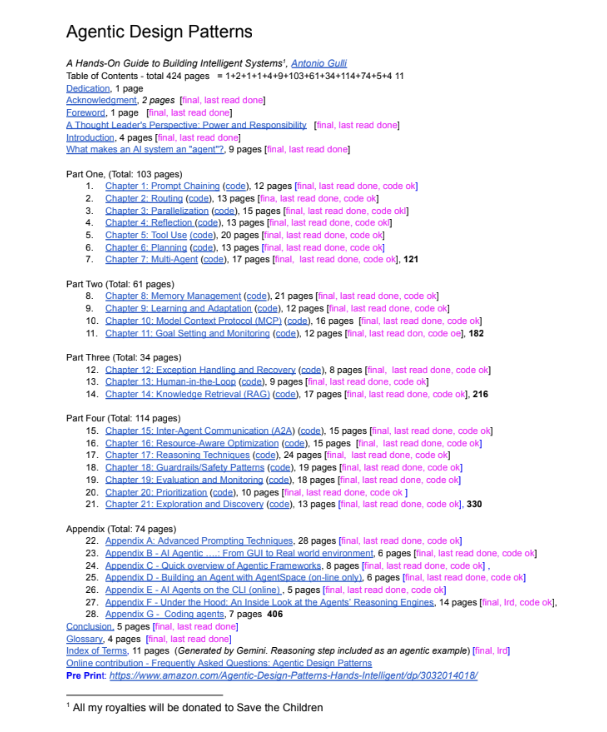
A SENIOR GOOGLE ENGINEER DROPPED A 421-PAGE DOC THAT NO ONE IS TALKING ABOUT.
It is called Agentic Design Patterns. 100% FREE.
Every AI builder paying $200/month for courses just got obsoleted.
This is the most comprehensive AI systems guide I have seen in 2026.
Code-backed and production-ready.👇
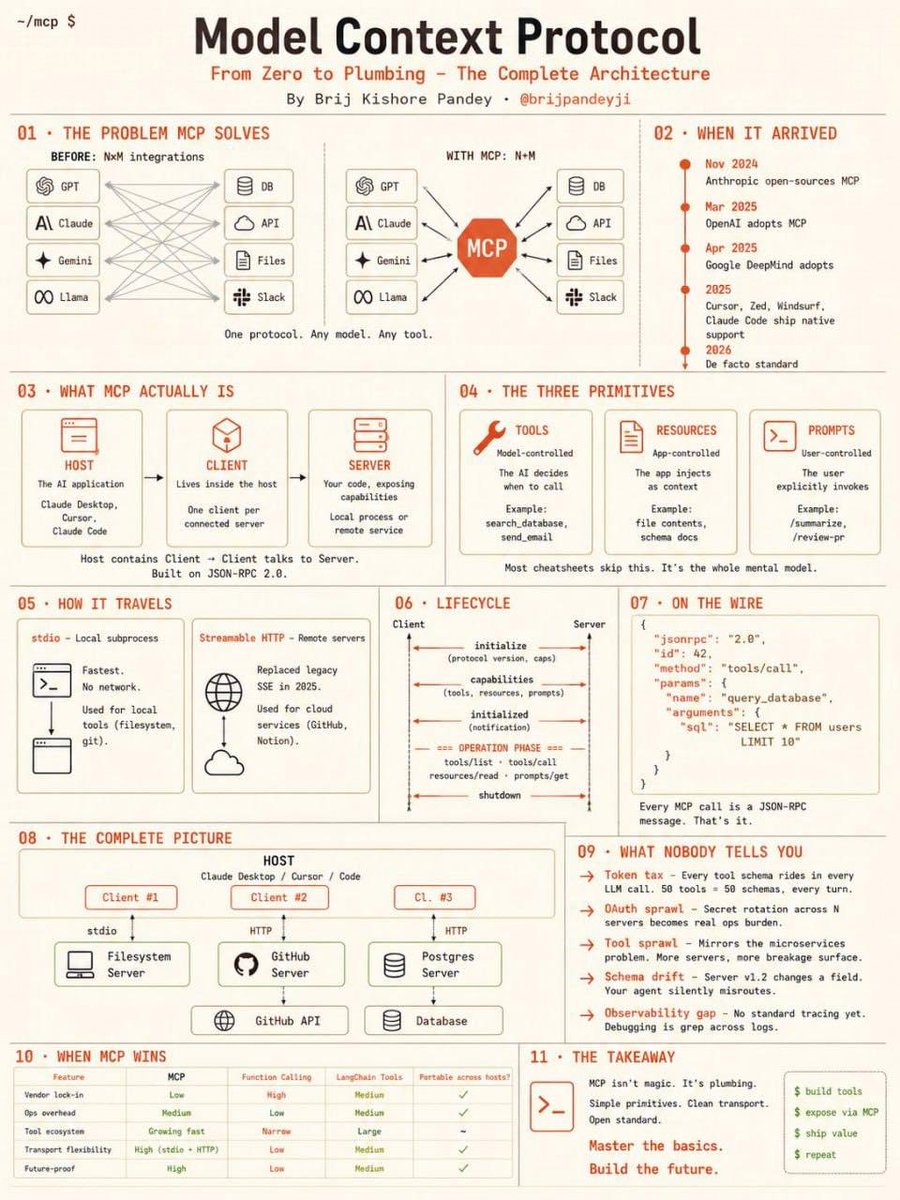
MCP stands for Model Context Protocol. It is an open-source standard created to help AI models securely connect to external tools, data sources, and software systems.
Most engineers using MCP can't explain what's actually happening on the wire.
They've cloned a repo, run a server, watched it work. Ask what `initialize` does, or why the token bill quietly doubled after they added a few servers, and the conversation gets short.
So I mapped the entire protocol. One image. Save it.
𝗪𝗵𝘆 𝗶𝘁 𝗲𝘅𝗶𝘀𝘁𝘀
Before MCP: N models × M tools = a custom bridge for every pair.
With MCP: N + M. One protocol in the middle.
𝗧𝗵𝗲 𝘁𝗵𝗿𝗲𝗲 𝗿𝗼𝗹𝗲𝘀
Host is the app you use. Client lives inside the host. Server is your code, exposing capability.
Underneath: JSON-RPC 2.0. Nothing exotic.
𝗧𝗵𝗲 𝘁𝗵𝗿𝗲𝗲 𝗽𝗿𝗶𝗺𝗶𝘁𝗶𝘃𝗲𝘀
Tools — model-controlled. The AI decides when to call.
Resources — app-controlled. The app pushes context.
Prompts — user-controlled. The user invokes them.
𝗧𝗵𝗲 𝗽𝗮𝗿𝘁 𝗻𝗼𝗯𝗼𝗱𝘆 𝘁𝗮𝗹𝗸𝘀 𝗮𝗯𝗼𝘂𝘁
Every tool schema travels in every LLM call. 50 tools = 50 schemas, every turn.
OAuth across many servers becomes real secret rotation work.
Tool sprawl is the new microservices sprawl.
Schema drift breaks agents silently.
MCP isn't a framework. It's a protocol. Mental model is HTTP, not LangChain. Boring, foundational, slowly everywhere.
Save the graphic for the next time someone asks how MCP actually works.
Credit: codewithbrij
Distance metrics help quantify how similar or different data points or sets are. This image shows visual examples of nine popular ones used across data science and machine learning.
It covers Euclidean, cosine, Hamming, Manhattan, Minkowski, Chebyshev, Jaccard, Haversine, and Sørensen-Dice, each with a simple diagram of how the calculation works.
These metrics sit at the core of clustering algorithms, nearest-neighbor methods, recommendation systems, natural language processing tasks, and geospatial analysis.
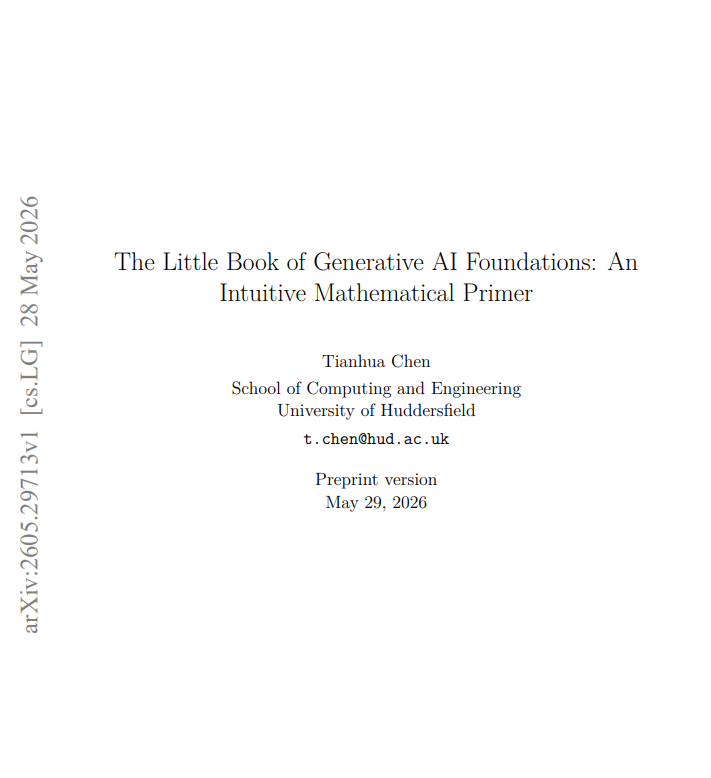
A must-read survey to refresh math and gen AI basics → The Little Book of Generative AI Foundations: An Intuitive Mathematical Primer
It shows a clear walkthrough of how gen AI learns to understand, model, and create complex data, covering:
- Latent algebra foundations: PCA, SVD, autoencoders
- Latent models: PPCA and VAEs
- VAEs: ELBO, inference, reparameterization
- Diffusion: the way from noise → denoising
- Score-based and continuous-time generative modelling
- Density models: flows, autoregression
- GANs and energy-based models beyond likelihoods
"Algebra 2" is another completely free textbook that covers a large portion of algebra at both the pre-university and early university levels.
With more than 1,100 pages and a large collection of worked examples, practice problems, and exercises, it covers linear equations, quadratic equations, polynomial equations, rational equations, radical equations, exponential and logarithmic equations, systems of equations, inequalities, and many of the fundamental concepts that form the backbone of algebra.
In my opinion, it is one of the most comprehensive free resources available for studying the theory of equations and the algebraic methods typically encountered in the first years of university.
https://t.co/Xf3qbA3hQO
🚨 Anthropic just showed a 27-minute workshop on how to actually do prompts for Claude.
Taught by the people who built it.
Free. No registration. No paywall.
I've seen $300 courses that don't cover what they teach in the first 8 minutes.
Watch it and bookmark it now.
A man spends 50 years teaching at MIT.
He knows his time is running out.
So he records one last lecture — everything he knows, distilled into a single hour.
He died 5 months later.
This is that lecture.
The most important hour you'll watch this week. 👇
Bookmark it for later
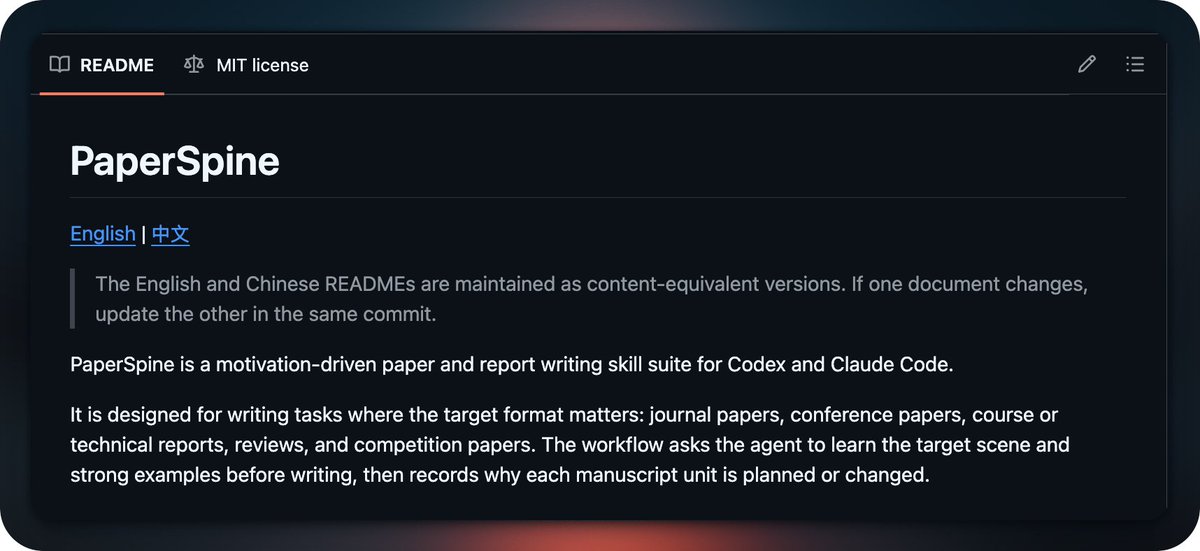
PaperSpine gives AI coding agents a motivation-driven workflow for writing papers and reports that respect target formats.
- Two equal workflows: rewrite existing manuscripts or build new ones from scratch
- Supports Codex (single-skill bundle) and Claude Code (flat skill suite with slash commands)
- Records why each manuscript unit is planned or changed, not just what was written
- Ships with reusable scripts, references, and audit skills for structured writing
Explore it here:
https://t.co/EQFdV7551Z





![KirkDBorne's tweet photo. [Download 585-page PDF eBook]
Game Theory: https://t.co/DUxMDRc1Ll
—————
#GameTheory #Gamification #Mathematics #Statistics #Probability https://t.co/Eo1v4nUYEC](https://pbs.twimg.com/media/HMqUxhWW0AAVHJ0.jpg)