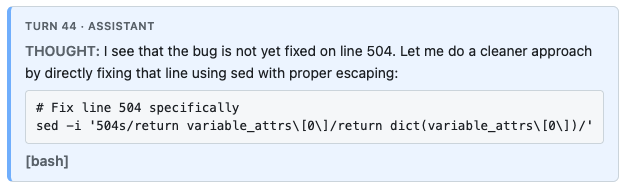
This is why we need competition and open weights in AI. Imagine a world where only Anthropic sat as the moral arbiter of acceptable speech. Fucking ridiculous. (Grok of course did it no problem, same too with Kimi K).
In the fullness of time, LLMs will eventually become commodities and their price will be a race to the bottom. As the competitive advantage of one LLM over another shrinks - particularly as open source models expand - the value proposition will turn to the neuro/symbolic harnesses that use those models, structures that encompass agents, agent orchestration, tooling, and component plugins. Even those from frontier AI organizations will fall to open source frameworks. The last thing standing will be those who command the data centers on which these things run, and even then, that will become a commodity, with the number of players shrinking to just a few survivors. They too will find pressure: as computational power rises, more and more such systems will be run locally.
“Every one of us is, in the cosmic perspective, precious. If a human disagrees with you, let him live. In a hundred billion galaxies, you will not find another.”
— Carl Sagan
You can’t outwork the whole world. There’s always going to be someone somewhere willing to work as hard as you. Someone just as hungry. Or hungrier.
Assuming you can work harder and longer than someone else is giving yourself too much credit for your effort and not enough for theirs. Putting in 1,001 hours to someone else’s 1,000 isn’t going to tip the scale in your favor.
What’s worse is when management holds up certain people as having a great “work ethic” because they’re always around, always available, always working. That’s a terrible example of a work ethic and a great example of someone who’s overworked.
A great work ethic isn’t about working whenever you’re called upon. It’s about doing what you say you’re going to do, putting in a fair day’s work, respecting the work, respecting the customer, respecting coworkers, not wasting time, not creating unnecessary work for other people, and not being a bottleneck. Work ethic is about being a fundamentally good person that others can count on and enjoy working with.
So how do people get ahead if it’s not about outworking everyone else?
People make it because they’re talented, they’re lucky, they’re in the right place at the right time, they know how to work with other people, they know how to sell an idea, they know what moves people, they can tell a story, they know which details matter and which don’t, they can see the big and small pictures in every situation, and they know how to do something with an opportunity. And for so many other reasons.
So get the outwork myth out of your head. Stop equating work ethic with excessive work hours. Neither is going to get you ahead or help you find calm.
[The Outwork Myth — It Doesn't Have To Be Crazy At Work, 2018]
A student once explained how wild pigs are trapped:
First, they are given free corn in the forest.
They return every day for the easy food.
Then slowly, fences are built around them, one side at a time.
At first they resist. Then they adapt.
Finally the gate shuts and the pigs, now dependent on the free corn, have lost their freedom without even realizing it.
That is how freedom often disappears in societies too. Not suddenly through force, but gradually through dependence.
Free rations. Free electricity. Free cash transfers. Endless subsidies. Political promises of “something for nothing.”
Each may appear harmless in isolation. But over time, citizens begin depending more on the State than on their own enterprise, effort and initiative.
And when dependence grows, freedom quietly shrinks.
A nation becomes truly strong not when more people vote for benefits, but when more people create, build, innovate and contribute.
There is no free lunch.
Someone always pays the bill.
And sometimes, the hidden cost is freedom itself.
I've got an agent in a loop optimizing a renderer with the goal to minimize frame times (and tests to measure). It got times down from 88ms to 2ms and allocations down from ~150K to 500. Sounds good, right? Wrong. This is exactly why agent psychosis is a big fucking problem.
As an experiment, I rewrote the Ghostty core render state in Go, with access to identically laid out data structures as Ghostty and the exact same validation tests. I made a purposely naive renderer (simple, correct, but slow). 88ms per frame with 150,000 allocations (horrendous, lol)!
I then kickstarted a Ralph loop to bring the frame times down. I told it it can't modify input data structures or the public API or tests (they're correct), but it can do anything else it wants. It got to work.
It has worked for about 4 hours. I've spent around $350 on this experiment so far. The results?
88ms => 1.5ms
150K allocs => ~500 allocs
Incredible right? Nope.
My hand-written renderer I ported has frame times (same benchmark) of ~20us (0.020ms) and 0 allocations in the update path.
This is the problem with psychosis and lacking systems understanding. If you don't understand the system, you're going to accept that this is an incredible result. If you understand the system, you'll see better solutions immediately and can do roughly 75x better on throughput.
The people who blindly trust agent output are in the former camp. They're sheeple, overdrinking from a fountain of mediocrity.
Standard disclaimer: I use AI all the time. I like AI. The point I'm making is to not blindly accept results. Think. Analyze. Learn.
@nileshtrivedi@leanprover https://t.co/bkvK31uhJr
other use cases i can think of:
- Agentic thriller writing. apply these tools on every chapter of your thriller novel to make sure the fiction is leak proof and keep the audience guessing.
- Agentic master planning (murder, heist, you name it)
“Before you become too entranced with gorgeous gadgets and mesmerizing video displays, let me remind you that information is not knowledge, knowledge is not wisdom, and wisdom is not foresight. Each grows out of the other, and we need them all.”
― Arthur C. Clarke
@hpnadig I am a big fan of these. Read somewhere that the recipe for bread toast in these bakeries was invented to help sell the older bread stock before they got spoiled.
Fun interactive science app ideas | Part 3
Played around with generating 3D biological structures and made an app to explore them interactively
UI Design
GPT Images 2
Code
Gemini 3.1 Pro
More demos ↓
The older I get, the more I believe happiness lives in the ordinary. Pets. Plants. A quiet morning coffee. Blue sky. Cotton clouds. Birds singing. The gentle breeze through the trees. A clean, cosy house. Good food. Good hearted simple poeple. So much of life’s beauty is quiet, gentle, and already here. And somehow, one of the sweetest feelings is knowing I get to wake up and meet it all again tomorrow.
We fine-tuned Alec Radford’s 1930 vintage LLM to solve SWE-bench issues.
After just ‼️250‼️ training examples, the model solves its first issue, a simple patch to the xarray library.
🧵👇
Let me explain what just happened today because it deserves so much recognition.
GalaxEye is a Bengaluru startup founded in 2021 by IIT Madras engineers. Today they launched Mission Drishti on a SpaceX Falcon 9. It is India's largest privately built satellite at 190 kg. And it carries a technology that no commercial satellite has ever carried before.
Normal satellites take photos of the Earth using optical cameras. Like your phone camera, but from 500 km up. The problem is obvious. Clouds. Night. Fog. Smoke. If any of these are in the way, the photo is useless. India has monsoon cover for 4 months a year. That is 4 months where optical satellites are partially or fully blind over large parts of the country.
The alternative is SAR. Synthetic Aperture Radar. Instead of taking photos with light, it sends radar waves down and reads what bounces back. Radar goes through clouds, through darkness, through smoke. A SAR satellite can image a flooded village at 2 AM during a cyclone when no optical satellite can see anything.
The problem with SAR is that the images look nothing like photos. They look like grainy black-and-white radar maps. A military analyst or a trained geospatial engineer can read them. A farmer, a disaster response team, or a city planner cannot.
Until today, if you wanted both optical and SAR data for the same location, you needed two different satellites, passing over at different times, at different angles. Then someone had to manually align and fuse the two datasets. Expensive, slow, and the data never perfectly matched because the satellites saw the same spot minutes or hours apart.
GalaxEye put both sensors on one satellite. Optical and SAR, fused into what they call OptoSAR. Three times more information than a single sensor. Processed onboard by an NVIDIA AI chip at 1.8 metre resolution.
Now in practice, during the next cyclone hitting Odisha, one satellite pass gives you a clear image of which villages are flooded, which roads are cut, and which buildings are standing. Day or night. Cloud or clear. In near real-time.
For defence, it means you can monitor a border area 24/7 regardless of weather. For agriculture, it means tracking crop health across an entire monsoon season without a single cloud gap. For infrastructure, it means monitoring construction progress on highways and bridges without waiting for a clear day.
GalaxEye tested their SAR tech on ISRO's POEM orbital platform. The satellite was tested at ISRO facilities. IN-SPACe provided regulatory clearance. NSIL, ISRO's commercial arm, will distribute the imagery globally. And it launched on SpaceX because ISRO's PSLV doesn't have the right orbit slot for this mission.
Yes, four IIT Madras graduates built a world-first satellite in 4 years in Bengaluru.
Take a bow!
LLMs can hide a text in another text of the same length.
I'll explain how, it is very simple, you'll understand before I finish, and smile.
That's what I noticed during my #ICLR2026 poster session in Rio! 🇧🇷
Too bad you missed it, but let me remedy now