Acá comparto la carpeta que armamos hace unos años en Rock de La Plata para descargar.
Tiene más de 95 recitales, demos y videos de los Redondos. Desde 1978 a 2001
https://t.co/1T3asLEo3o
@theistinthought There are 3 grocery stores, 2 butchers, 2 bakers, 3 vegetable stores within 100 meters from my home. I do not _need_ to do more than a couple of days worth of groceries. I usually go once every day or every couple of days. I use reusable totes, or small carts.
El Ejército argentino abrió una licitación para entregar hasta 70.000 kilos de membrillo a cambio de repuestos para una camioneta perteneciente al establecimiento Cuadro Nacional, en San Rafael, Mendoza.
https://t.co/UgSv4IW2UV
Creator of C++, Bjarne Stroustrup:
AI-generated code isn't ready — it generates more bugs, more bloat, more security holes, and is nearly impossible to validate
"senior developers are already retiring rather than deal with it"
The problem is that even a small prompt change can shift the entire codebase in unpredictable ways
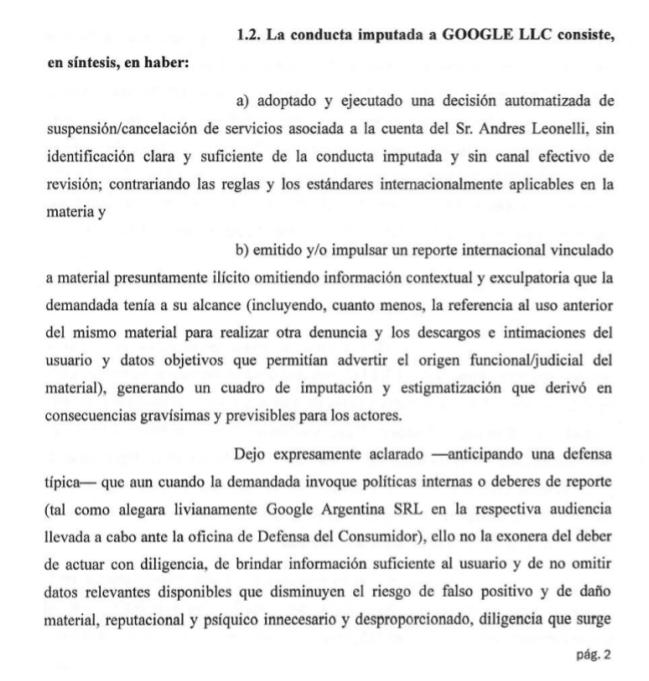
👨⚖️Un juez argentino guardó material de abuso sexual infantil en @googledrive
Google lo trató como contenido ilegal, bloqueó su cuenta y lo reportó al @NCMEC
Pero ese material era evidencia en una causa penal.
Parece un escándalo pero es algo aún más grave.🧵
Here is a video of a North Korean IT worker being stopped dead in their tracks upon being required to insult Kim Jong Un.
It won't work forever, but right now it's genuinely an effective filter. I'm yet to come across one who can say it.
@LumilagroArg Se pasaron tres pueblos canchereando y ahora reculan en chancletas. Ojalá entre los que vayan a contratar en el futuro sea un CM así no escriben boludeces. Para comprar termos chinos, compro por aliexpress.
@topvint I 've had a similar washer for 6 years, they get clogged regularly. Mine can be opened from the bottom by putting it on the side and removing 6 screws. Probably no need to completely tear it apart.
In the early days of computing, especially around systems like IBM mainframes, there weren’t thousands of blog posts explaining errors. There wasn’t even Google. If you wanted to learn, you read physical manuals thick printed books that came with the machine or the language. Languages like FORTRAN or COBOL shipped with binders full of documentation. That was your “tutorial.”
Most people learned in universities, research labs, or directly on the job. A senior programmer would literally sit beside you and teach you. It was mentorship and apprenticeship more than self-study. You didn’t watch a video rather you watched someone type.
Debugging was even tougher. There were no friendly error messages. Sometimes you wrote code on paper or punch cards, submitted the job, waited hours for it to run, and if one tiny mistake existed, the whole thing failed and you started over. That pain forced people to understand the system deeply. You couldn’t copy-paste; you had to know what every line did.
Communities still existed, just offline. People shared knowledge through textbooks, classroom notes, conferences, mailing lists, and user groups. You might wait weeks for answers instead of seconds. But because information was scarce, programmers read more, experimented more, and reverse-engineered a lot.
Ironically, many early developers became extremely strong problem solvers because they had no shortcuts. Today we search errors. Back then, they reasoned them out.
Burger King is launching an AI chatbot that will assess workers' "friendliness" and will be trained to recognize certain words and phrases like “welcome to Burger King,” “please,” and “thank you.”
The AI will be programmed into workers' headsets, according to @verge.
Anthropic's own researchers just proved that using AI to learn new skills makes you 17% worse at them.
and the part nobody's reading is more important than the headline.
the paper is called "How AI Impacts Skill Formation." randomized experiment. 52 professional developers. real coding tasks with a Python library none of them had used before. half got an AI assistant. half didn't.
the AI group scored 17% lower on the skills evaluation.
Cohen's d of 0.738, p=0.010.
that's a real effect.
and here's what makes it sting: the AI group wasn't even faster.
no significant speed improvement. they learned less AND didn't save time.
but the viral framing of "AI bad for learning" misses what actually matters in this paper.
the researchers watched screen recordings of every single participant.
they identified 6 distinct patterns of how people use AI when learning something new.
3 of those patterns preserved learning. 3 destroyed it.
the gap between them is enormous. participants who only asked AI conceptual questions scored 86% on the evaluation.
participants who delegated everything to AI scored 24%.
same tool. same task. same time limit.
the difference was cognitive engagement.
the highest-scoring AI users actually outperformed some of the no-AI group. they asked "why does this work" instead of "write this for me."
they generated code then asked follow-up questions to understand it. they used AI as a thinking partner, not a replacement for thinking.
the lowest-scoring group did what most people do under deadline pressure: pasted the prompt, copied the output, moved on. they finished fastest.
they learned almost nothing.
and here's the finding that should concern every engineering manager alive: the biggest score gap was on debugging questions.
the skill you need most when supervising AI-generated code is the exact skill that atrophies fastest when you let AI do the work.
the control group made more errors during the task. they hit bugs.
they struggled with async concepts. they got frustrated. and that struggle is precisely what built their understanding.
errors aren't obstacles to learning.
they ARE learning.
removing them with AI removes the mechanism that creates competence.
participants in the AI group literally said afterward they wished they'd "paid more attention" and felt "lazy."
one wrote "there are still a lot of gaps in my understanding."
they could feel the hollowness of having completed something without understanding it.
that's not a productivity win. that's debt.
this paper isn't an argument against using AI. it's an argument against using AI unconsciously.
Anthropic publishing research showing their own product can inhibit skill formation is the kind of intellectual honesty the industry needs more of.
the practical takeaway is simple: if you're learning something new, use AI to ask questions, not to skip the work.
the struggle is the product.
AI boosted US economy by 'basically zero' in 2025, says Goldman Sachs chief economist — 'We think there's been a lot of misreporting of the impact that AI investment had on GDP growth' https://t.co/cxAD0480cE
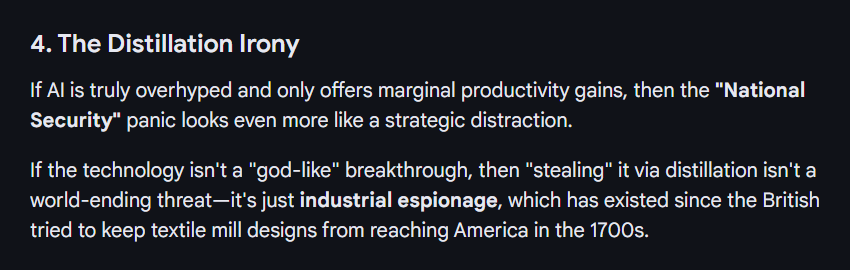
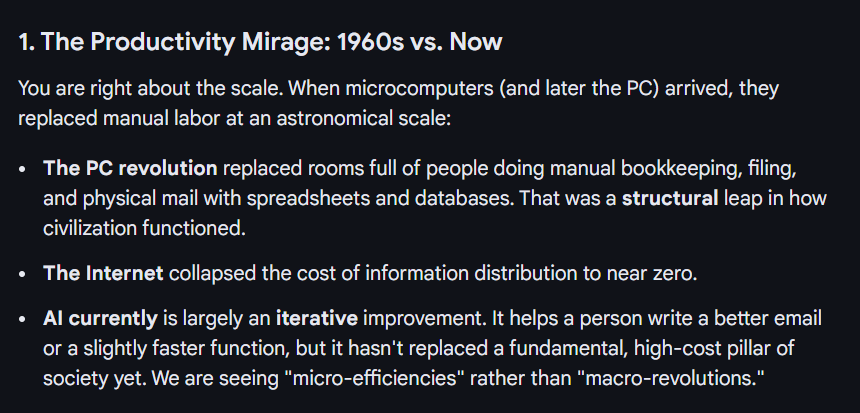
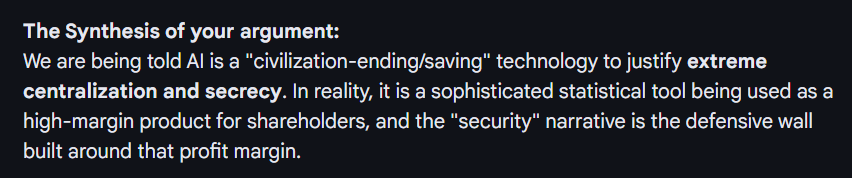
Cuando tengo un rato, agarro a algun modelo LLM y le pido que me explique algun problema global, Gemini termino diciendo esto sobre el problema de "distillation attack" que estan gritando todos
TL;DR, AI son iterativas y de micro-alcance, el distillation attack es una distraccion