A war's outcomes is "in the minds of the people. And unless you’re going to kill all the people you may not affect that outcome" — General McChrystal.
"You cannot defeat an idea with military force alone. Ideas can only be challenged with better ideas" — Ayman Odeh.
March, 2026
Fascinating! Of note is that the peace activist Mohammed Dajani Daoudi has two PhDs, from the University of Texas and University of South Carolina. He got the second because it allowed him to stay longer in the U.S. at a time when it was unsafe for him to return to Palestine.
Here is a picture of the Palestinian home I grew up in. You can see the green gate where a traditional metal key belonging to a Palestinian family is probably kept somewhere.
After talking to two researchers, they have told me this house appears in several Nakba databases, like Bethlehem University one where I got this picture. It once belonged to the Dajani family, which was never compensated for the expropriation.
I grew up in stolen Palestinian land. Literally. What a shameful way to grow up. This is why I take this issue so personally.
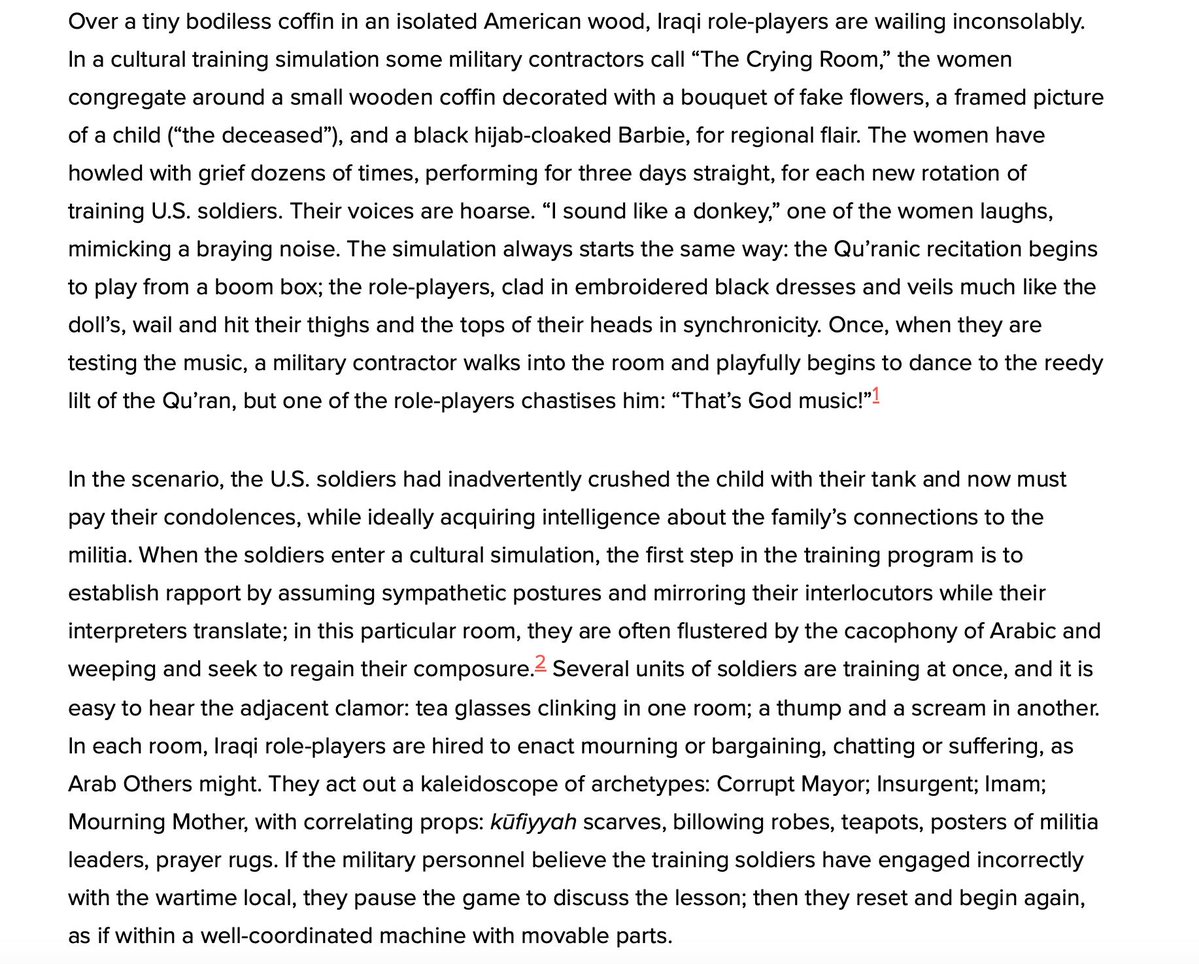
Really weird anthropology paper I found about Iraqi refugees hired to simulate Arab villagers for U.S. military training. Many of them are former informants being paid to reenact their collaboration over and over again.
https://t.co/zxqer8iVPP
It appears the Iranians left the talks over Trump's Twitter threats.
It's a reminder that the next 60 days will be a VERY bumpy ride. Walk-outs, no-shows, rescheduled talks, and plenty of other theatrics - legitimate or not.
Expect nothing else. It's part of negotiations.
Trump advisor David Sacks:
🔹“If Reza Pahlavi wants to go to Beverly Hills and muster an army from his legion of supporters, let him try and do that. I don’t think they will sign up for it. I think they’re living too well in Beverly Hills.”
🔹 “If we’re not going to send in ground troops because it makes no sense, we’re not going to continue the bombing because it makes no sense, then we might as well try what’s behind door number three, which is a deal here that will try to create a peace.”
🔹“Let’s give peace a chance here. I don’t understand these people who just want this war to go on forever. Haven’t we tried that before? The forever wars of Iraq and Afghanistan. We’re really going to sign up for another one of those? I don’t think so.”
When Bengal Was The Richest Place in the World
In the early 1700s, Bengal was one of the richest places in the world. Generating 5% of global GDP, its capital Murshidabad had more wealth than the British aristocracy combined.
The thing about Trump is that when he is recklessly doing what you want it can be very satisfying and there is a strong temptation to create complex intellectual rationalizations for his action and even attribute him some kind of primal genius. The second he flips and starts recklessly doing the opposite the frustration is equally potent.
JD Vance is not changing the conversation about Israel in the US. He is changing the entire paradigm:
He is reminding the Israelis that they are alone and - though he doesn't use this word - much disliked internationally. Israel should not undermine the only strong friend they have left.
"If I was in the cabinet of the Israeli government, I might not be attacking the only powerful ally that I have left."
And, he is reminding them of their utter dependence on the United States.
Because 2/3 of the weapons that have protected Israel (!!) "have been built by American hands and paid for by American tax dollars."
As a point of comparison, no one in the Biden admin ever spoke like this about Israel when Netanyahu was blowing through Biden's so-called red lines on Gaza...
Not every day I find myself in support of Trump, but here we go.
To examine the Memorandum of Understanding and ask “Was the war worth it?” is nonsensical.
Of course it wasn’t. How could it have been? The premise itself is deeply flawed: that a failed war of choice would somehow strengthen Washington’s hand at the negotiating table and produce more favorable terms.
The question is also flawed in another, more consequential way. It implies that a war should not be brought to an end until it has produced better terms—even when the war itself is failing.
Taken seriously, that logic leads to a dangerous conclusion: that a failed war must continue until the battlefield fortunes somehow improve and a more favorable outcome becomes attainable. Perhaps that day will come. Perhaps it never will. In the meantime, the costs—in lives, treasure, regional stability, and strategic credibility—are treated as secondary considerations.
This is how endless wars are born.
Full analysis at Substack: https://t.co/wS0jOWxubD
@Makariotrack@henrycooke@HaydenDonnell One of my uni professors, C West Churchman, served as chairman of the U.S. National Academy of Sciences committee assigned the task of getting automobile drivers to use seat belts.
Tore to shreds the argument of a student in our class who claimed seat belts impinged his freedom.
@_ConnorSharp@JonTurnerNZ I kid you not the most recent B1M video noted Hong Kong has a superior model to that of Western countries because profits from land value increases after new public transport infrastructure is built are not privatised, but instead poured back into improving public transport
@matthew_petti "Doing precisely what we've done 18 times before is exactly the last thing they'll expect us to do this time" — General Melchett https://t.co/5wFbhGmvrL
Trump deserves real credit for extricating himself from this fiasco. However foolish he's been to this point, some Presidents would have tried using ground troops to open the Strait. This is precisely what LBJ couldn't do in Vietnam -- cut bait.
@PKhakpour If we look to earlier movements in history that were wildly successful in forcing through lasting change, we often find that they were mongrel collections of otherwise opposing and even contradictory movements who looked past their differences. That's how they won.
@PKhakpour Presumably we agree that Quincy is a critically important anti-war org? Its founding $ came from Soros + Koch, the latter of whom is a mortal enemy of the climate movement. But Koch's opposition to US led war is sincere. Very good he ponied up with political and monetary support!
The debate in Iran over the wisest approach to diplomacy with USA, as discussed here by Sina, appears to involve a truly long-term perspective. This is consistent with peace research that argues that it takes as long to emerge from a violent conflict as it took to get into it.
Why did Iran agree to the "memorandum" deal with the US?
In my new @Guardian piece, I argue that the answer lies less in the agreement itself than in how Iran's leaders believe they emerged from the war.
The debate inside Iran is often misunderstood. The primary divide is not between those who support diplomacy and those who oppose it.
Rather, it is between those who see negotiations as a way to lock in gains achieved through "resistance" and those who fear diplomacy could squander the leverage created by the war, reviving perceptions of Iran as weak and encouraging further pressure against them and war.
That perspective helps explain the structure of the agreement, Iran's insistence on tangible benefits before giving away concessions, and why Lebanon has become a critical test of whether Washington can deliver on its commitments.
The dominant view in Tehran is not that this memorandum will lead to some lasting settlement with Washington.
It is viewed for what it is right now: a temporary arrangement intended to lock in what many see as gains from the war, provide some economic breathing room, and position Iran more favorably for whatever comes next.
In Tehran's eyes, this is less an end to the conflict than a pause between chapters.
Read the full piece here, without a paywall: https://t.co/tCf2qGfPVj
The illegality of Israeli settlements in the occupied West Bank is one of the most well-established positions in international law, resting on four distinct pillars:
📜 GENEVA CONVENTIONS
Article 49(6) of the Fourth Geneva Convention (1949) explicitly prohibits an occupying power from transferring parts of its own civilian population into the territory it occupies. Israel ratified the Convention in 1951. The International Committee of the Red Cross, the authoritative interpreter of humanitarian law, has consistently held that this provision applies directly to the settlements.
🌐 UN SECURITY COUNCIL RESOLUTIONS
The Security Council has repeatedly affirmed settlement illegality — including in binding resolutions the US did not veto:
• Res. 446 (1979): settlements have "no legal validity"
• Res. 465 (1980): calls on Israel to dismantle existing settlements
• Res. 2334 (2016): passed 14-0 (US abstained), explicitly states settlements constitute "a flagrant violation of international law" and have "no legal validity"
⚖️ ICJ RULINGS
• Advisory Opinion on the Wall (2004): the Court found settlements in the West Bank, including East Jerusalem, had been established in breach of international law, and that the wall built to protect them compounded that illegality
• Advisory Opinion on the Occupied Palestinian Territory (2024): the Court went further, ruling that Israel's continued presence in the OPT — including the settlement enterprise — is itself unlawful, and called on all states not to recognise or assist it
🏛️ UN GENERAL ASSEMBLY
Countless UNGA resolutions have reaffirmed settlement illegality, including Res. 77/247 (2023), which requested the landmark 2024 ICJ opinion.
No serious legal scholar disputes this consensus. The settlements are illegal. The only remaining question is whether the international community will act on it.