@georgenjoroge_ I agree, took Grants Whisky in TZ and it tasted so premium and smoother than the same drink in Kenya 🇰🇪.
And it was even cheaper there.
Every time you convince yourself to not take the risks that you know deep down that you should take, you actually lose a bit of self-esteem and accumulate a bit more anxiety.
There are a lot of people who got wealthy “accidentally” because there’s no way they could have become proper employees, so they decided to walk alone on an entrepreneurial journey and they made it because they had no other choice.
Elon Musk:
"Don't pursue money.
Make useful products, and money will come as a consequence."
A simple philosophy that has shaped some of the world's most ambitious companies.
A lot of "good luck" boils down to setting the bar very high, for yourself, for your relationships, for your professional ambitions, and actually following through without ever apologizing about it.
Cowardice is very expensive, it doesn't just cost you many life-changing opportunities, but it also costs you your peace of mind and your self-esteem, because you'll spend the rest of your life knowing that you didn't pay the price to become who you actually wanted to be, that you didn't marry the person you were actually attracted to, that you didn't taste the freedom that less talented people with more guts are now experiencing, and that you never lived a life that you chose, a life that was aligned with your core values, a truly meaningful life.
You'll feel drained as long as you make efforts in the wrong direction. Your relationships should energize you. Your training should make you feel alive. Work should make you discover creativity you didn't know you had. Your neighborhood should make you feel grateful to be alive.
So many “smart” people struggle to grow into who they need to be in order to build the life they want, because their mind always finds sophisticated reasons to avoid any responsibility, and you can’t grow until you take on challenges that the “current you” cannot handle yet.
Carl Jung wrote: "The more intelligent and self-aware a person is, the more they suffer from the general unconsciousness of society."
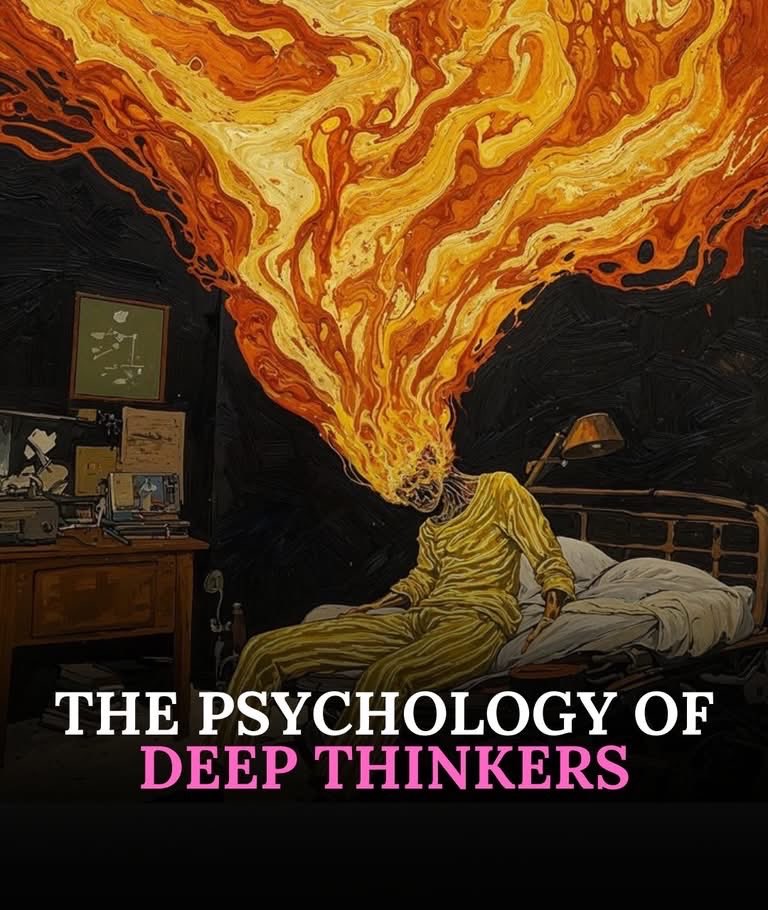
This is not a badge of honor. It is a recognition of the weight carried by those who cannot unsee what they have already seen. This is the psychology of the deep thinker and if you recognize yourself here, this one is for you:
The architecture of alienation. It starts early. The child who asks why adults say one thing and do another. The one whose questions are always labeled as "overthinking." Nietzsche described these people as "free spirits" — essential for progress, but wandering in a wilderness everyone else refuses to enter.
Research by Dr. Elaine Aron suggests approximately 20% of the population processes information more deeply and notices subtleties others completely miss. In a world that rewards speed, this depth can feel like a disability.
The frequency of truth. Deep thinkers operate on a different wavelength, the frequency of truth rather than the frequency of comfort. Most people live without ever questioning the fundamental assumptions of their own existence. But the deep thinker has glimpsed behind the veil.
Like Plato's prisoner who escapes the cave and returns to share what he saw only to be rejected and called a troublemaker—the deep thinker carries the burden of the witness. They see the masks, the exploitation, and the pain that everyone else has agreed to ignore.
The emotional sponge. Deep thinkers do not just observe emotions, they absorb them. They feel the anxiety of a stranger as if it were their own. They perform enormous amounts of invisible emotional labor — checking in on people, listening, supporting, acting as the unofficial therapist of every room they enter. And yet the relationship is almost always asymmetric. They give at a depth most people cannot match. They live with the quiet loneliness of being the strong one, the one everyone leans on, but no one thinks to ask: "Are you okay?"
The mask of normalcy. To survive, many deep thinkers learn to wear a mask, laughing at jokes they do not find funny, feigning interest in conversations that feel hollow, modulating their intensity to avoid being too much. This is not deception. It is survival. But the cost is enormous.
Maintaining the split between the complex private self and the simple public self is exhausting. And the mask, while protective, makes true connection nearly impossible. You cannot be fully known while hiding.
The wounded healer. Jung wrote about this archetype; the person who transforms their own brokenness into a source of healing for others. The wounds of rejection and misunderstanding become sources of deep compassion. The person who has felt most unseen becomes the most gifted at seeing others. But the challenge is learning to give without emptying yourself completely, to love others without losing yourself in the process.
The alchemy of solitude. For deep thinkers, there is a crucial distinction between loneliness and solitude. Loneliness is the pain of disconnection from others. Solitude is the joy of connection with yourself. In solitude, the deep thinker finally breathes. The noise of the world falls away. The internal landscape becomes clear. Isolation transforms into introspection and that is where the real work happens.
The revolutionary act of authenticity. In a world that profits from insecurity, choosing to be genuinely yourself is a radical act. When a deep thinker chooses authenticity over performance, it creates space for others to do the same. It gives people permission to be real in a culture that rewards shallow.
If you recognize yourself in any of this, stop apologizing for your depth. You are not broken. You are not too much. You are not too sensitive. You are awake in a world that prefers to stay asleep. Your sensitivity is a superpower. Your intensity is a strength.
✨🙌🏾💫
When a MAN falls, don't celebrate.
Don't mock their struggles.
Sit. Pause. Learn.
Men learn through other men's experiences. Wins and losses are vital lessons.
Listen. Learn. Live.