Delighted to be speaking at the AI Search & Systems Summit on 13 August organized by the awesome @freddiechatt It's free and online!
In my session I'm walking through a three layer framework for measuring AI search: AI presence, AI readiness, and business impact - what sits in each layer, how they connect, and what you should actually be putting in front of a client or a board.
The summit is online, free and features specialists like Amanda Natividad, Myriam Jessier, Andy Chadwick, Veruska Anconitano, Maeva Cifuentes, Nick LeRoy, Chris Lever, Gus Pelogia and more... 18 sessions across two days, all of it on what people are doing about AI search rather than what they think about it.
My session is on Day 1, Thursday 13 August! Register now:
searchto(.)sale/summit
New recipe: timestamped video captions on @huggingface Jobs.
Point it at a bucket of videos → parquet dataset out: scene descriptions + second-precise <start – end> events.
~$0.05 per hour of footage on a single A10G (Marlin-2B on vLLM).
https://t.co/LEzv14rNEW
The Cybersecurity #Leadership Handbook for the #CISO and the #CEO
An essential read for all #leaders around #cybersecurity, looking beyond the #technology horizon, into the real dynamics of #security transformation
UPDATED edition now available here >> https://t.co/jumqAWZXvU
Want to Learn AI But Don’t Know Where to Begin?
Here’s a roadmap that gives you a crystal-clear path to learn AI from a complete beginner to an advanced AI practitioner in 50 practical steps.
Here’s how the journey unfolds:
Basics & Foundations (Steps 1–10)
Understand what AI really is, explore real-world applications, learn essential terms, and get comfortable with Python, statistics, and linear algebra.
Machine Learning Core (Steps 11–20)
Build your first ML project, grasp neural networks, use frameworks like TensorFlow/PyTorch, and explore computer vision tasks.
Deep Learning & NLP (Steps 21–30)
Learn NLP basics, reinforcement learning, generative models (GANs/VAEs), and start using cloud AI tools to scale your work.
Industry Skills & Applications (Steps 31–40)
Connect AI to business, study ethics, explore time series, apply tuning, join Kaggle competitions, and build your AI portfolio.
Mastery & Growth (Steps 41–50)
Follow trends, join communities, earn certifications, combine AI with other fields, and finally, start teaching & sharing your knowledge.
Whether you're a student, developer, or professional, this step-by-step guide will keep you on track.
Save it. Follow it. Master AI one step at a time.
Fine-tune LLM agents without fine-tuning LLMs!
Memento is a memory based continual learning framework for LLM agents that lets them learn from experience over time without touching model weights.
It maintains a Case Bank of past trajectories including tasks, step sequences, tool usage, and outcomes.
When a new task comes in, the agent plans and acts by pulling from similar past cases instead of starting from zero.
Memento follows a planner and executor setup:
The Planner (an LLM) breaks the task into subtasks, retrieves relevant cases, and chooses a plan.
The Executor runs those subtasks using tools like search, code execution, or document processing through the Model Context Protocol (MCP), then logs the results back into memory.
Key Features:
• Memory based continual learning that improves agents through stored experience
• Planner and executor architecture with case based reasoning for task decomposition
• Unified tool ecosystem for search, code execution, document processing, media analysis and more
• Learning without weight updates by retrieving and reusing relevant past cases
• Strong results on long horizon and out of distribution tasks in reported benchmarks
It is 100% open source.
Link to the GitHub repo in the comments!
Using One AI For Everything Makes No Sense... Use The Best LLM For Your Needs
agentic (medium) - Kimi K3
design - GPT 5.6 sol
research - Flash 3.5
agentic (hard) - Fable 5
pdf - Grok 4.5
image - GPT 2.0
video - Seedance 2.0
voice - Hume / 11Labs
role play - Grok 4.5
music - Suno
always-on - Deepseek Flash
Use all the best models in one place and automatically route to the best one, ChatLLM
App Store Connect CLI 3.1.3 is out!
Main improvement is pixel-level duplicate detection in `asc screenshots validate`. It flags the same screenshot re-exported or recompressed under a different name, so you catch it locally instead of after upload
https://t.co/RuXh8T3xK2
This is the kind of software you'd expect governments or large intelligence teams to use.
Instead, it's sitting on GitHub.
It watches the world 24/7 and checks 26 live data sources every 15 minutes.
We're talking:
→ Satellite fire detection
→ Flight and vessel tracking
→ Conflict zones
→ Economic indicators
→ Live crypto and market prices
→ Telegram intelligence channels
When something important happens, it sends an alert straight to Telegram or Discord.
Need a quick update?
Just type /brief and get an instant summary.
No cloud.
No subscription.
Runs entirely on your own machine.
Open source projects like this are why GitHub remains undefeated.
Repo in the comments 👇
What is the Dependency Rule in Clean Architecture?
This rule states that source code dependencies can only point inwards.
By following this rule, you create a system in which your application's core business logic is independent of external dependencies.
The main idea behind the Dependency Rule is controlling coupling.
Our domain entities and business rules are at the center of the system. They don't depend on anything, which is valuable because it makes them stable.
Things around the Domain can change, but that shouldn't affect the domain entities or business rules.
Let's illustrate this with a use case for registering a user:
• The Domain layer contains the entity and doesn't have any other references
• The Application layer contains the use case and defines an interface for data access. It references the Domain layer so it can access the domain entity.
• The Infrastructure layer implements the repository interface. So, it has to reference the Application layer.
• The Presentation layer exposes the API endpoint. It references the Application layer to access the use case. But it also references the Infrastructure layer to wire up DI.
If you want to see a practical example of implementing Clean Architecture, check out this: https://t.co/5BnGOebmkh
10 MCP Servers every AI developer should know in 2026.
If you're building AI agents with Claude Code, Codex, Gemini CLI, Cursor, or any MCP-compatible IDE, these servers are worth adding to your toolkit.
1. Filesystem MCP
→ Give AI access to local files and project folders.
GitHub: https://t.co/lfD7PAFiSK
2. GitHub MCP
→ Search repositories, issues, pull requests, and code without leaving your editor.
GitHub: https://t.co/cXTwmaXomv
3. Playwright MCP
→ Let AI automate browsers, test websites, and interact with web apps.
GitHub: https://t.co/ZeIhWLbdZV
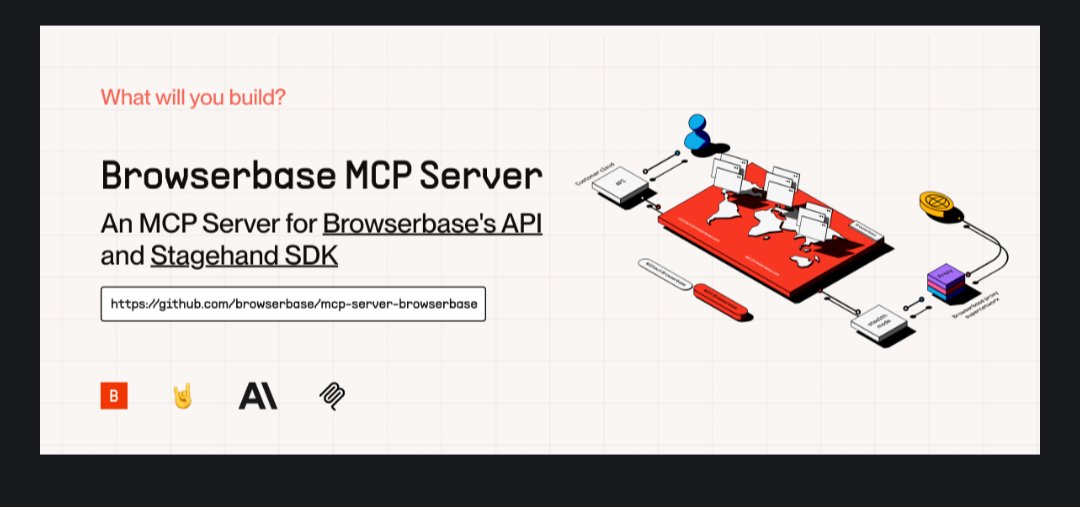
4. Browserbase MCP
→ Run cloud browsers for AI agents without managing infrastructure.
GitHub: https://t.co/DQy8fdncxl
5. Firecrawl MCP
→ Turn any website into structured, LLM-ready content.
GitHub: https://t.co/85gIJWCh0t
6. Context7 MCP
→ Keep AI synced with the latest documentation instead of outdated knowledge.
GitHub: https://t.co/r87sHW4wv7
7. Sequential Thinking MCP
→ Improve multi-step reasoning for more accurate AI responses.
GitHub: https://t.co/lfD7PAFiSK
8. Memory MCP
→ Give your AI long-term memory across conversations and tasks.
GitHub: https://t.co/lfD7PAFiSK
9. Figma MCP
→ Connect AI directly to Figma files and design systems.
GitHub: https://t.co/ksdlTJaSRu
10. Slack MCP
→ Read, send, and automate Slack messages with AI.
GitHub: https://t.co/lfD7PAFiSK
Bookmark this for later.
Which MCP server is your favourite? And which one deserves to be on this list?