Solana's read layer 2.0 is now open source: Superbank (history) and Cloudbreak (accounts), marking the end of vendor lock-in for chain access.
Querying @solana should feel like calling a real database, so we built exactly that.
🟣Lightning-fast account reads with dynamic indexes from your query patterns
🟣Your own queryable copy of Solana history, with no indexing logic to write
🟣More performant than Agave, while running on commodity hardware
Fork it, run it, improve it. It's yours 🌊🧵https://t.co/uvnhFjUceE
Almost every team indexing @solana history starts with the default approach: JSON-RPC polling loop.
But it's also the slowest and most expensive one.
Rate limits cap you below your actual bandwidth, you can't detect coverage gaps, and every block is a paid call that scales with the indexing scope🧵👇
We've been working on this for a while, and it's finally here.
A better, faster way to query @solana history.
If your wallet history lags or your explorer spins on lookups, the bottleneck is usually the storage layer. Bigtable is used across most of the industry, but was never designed for how Solana actually gets queried.
It's slow for random access, nearly impossible to adapt, and hasn't meaningfully evolved since its genesis. And the egress costs? Don't get us started.
We couldn't patch it.
So we rebuilt it from scratch.
Hydrant is Triton's new Rust backend running on ClickHouse with:
→ columnar storage physically sorted for each query
→ materialised views created at write time
→ dedicated routing for hot addresses like USDC
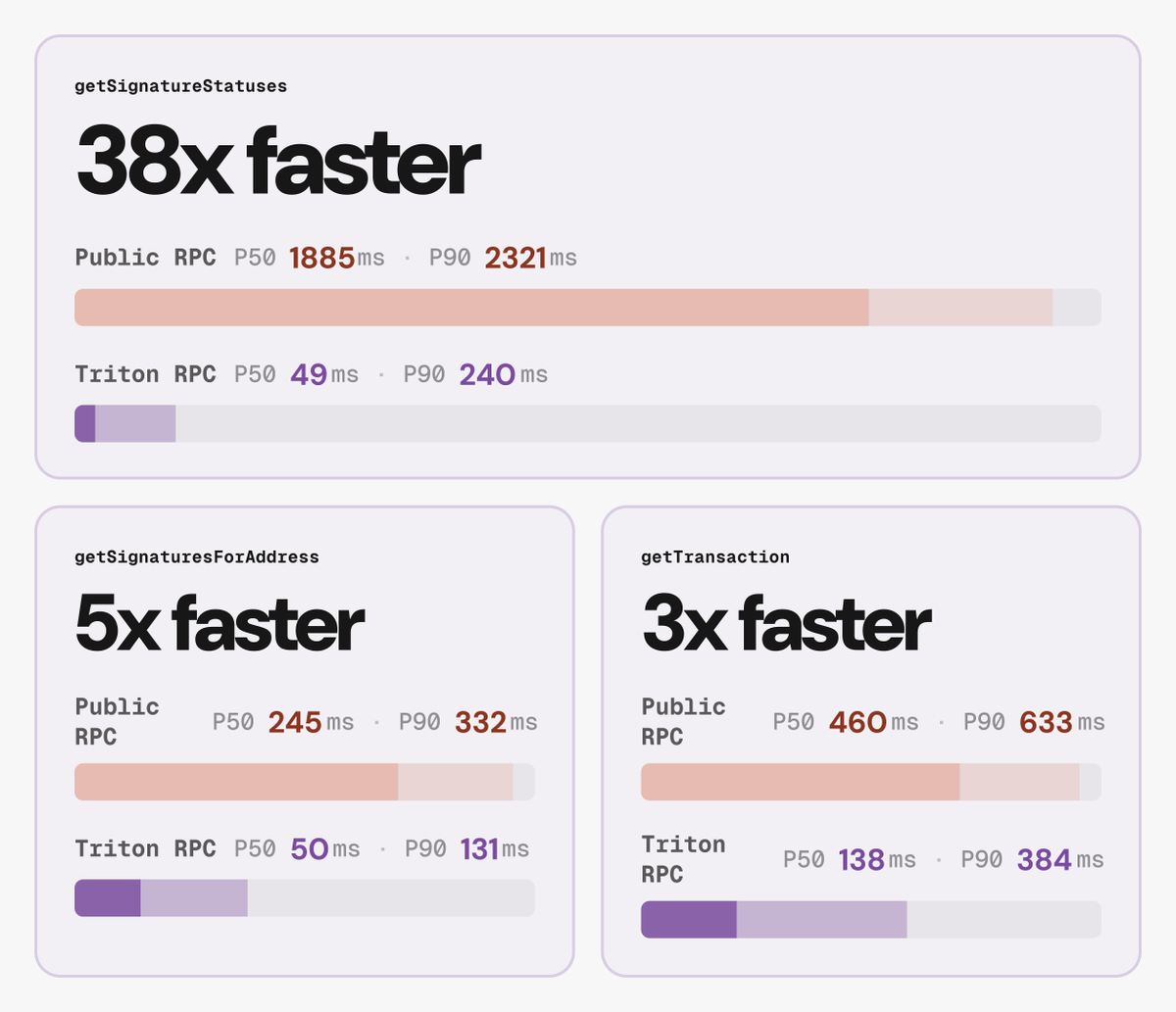
→ head cache that serves recent data at 0.57 ms P50
Three methods live, dramatically faster and more cost efficient.
Pricing is flat across the entire ledger: $0.08/GB + $10/M requests, genesis to tip, same as any standard RPC request.
And as if that wasn't enough, it's soon going open-source under AGPL!
Full breakdown: https://t.co/i0srt9gimJ
Closed source companies love to extract value from ecosystems they didn’t help build.
Open source companies create the ecosystem- tooling, infra, and communities that unlock everyone else.
One captures value.
The other creates it.
If you’re not contributing, you’re just capitalizing.
Long live open source. @solana gets it.
All Triton WebSocket traffic for shared subscriptions now runs on Whirligig, a high-performance, drop-in replacement for Solana's standard WebSocket API built on top of our Dragon's Mouth gRPC streams.
Your existing WS code works exactly as before, now backed by an ultra-performant gRPC layer. What that means for you:
- Faster and more reliable subscriptions
- Higher subscription limits per connection
- blockSubscribe support out of the box
- jsonParsed encoding support
Deep dive coming soon!
Excited to share that Metis API is now live on Triton! 🪐
If you’re building wallets or payment flows, you want the heavy lifting done for you. Metis brings the power of @JupiterExchange 's routing engine directly to our bare-metal infrastructure.
We love the ExactOut feature — perfect for when you need precise settlement amounts.
Read more: https://t.co/1z2IVrlK3A
Here is an excellent thread from one of the most experienced developers on Solana. Take some time to learn from a guy who chewed a lot of glass 🍸. Adding my two cents — the Solana RPC API is a lowest-common-denominator interface. Designing for that API will leave you with a lowest-common-denominator application. For richer business logic and a more sophisticated user experience, consider the other techniques that Noah describes. Full-stack devs have plenty of job opportunities in Web3.
This week, we have five new hires for @triton_one, and we're still hiring! Join us if you want to work on the next generation of Solana infrastructure. See the link below for a Junior Vue.js Software Developer role and other opportunities.
This weekend on X, I learned that @linuskendall wrote Linux; he's been on Twitter so long that I think he's actually Jack (I've never seen them in the same room); and at this point, I'm convinced he's also Satoshi. Somehow, he also had time to be a co-founder at @triton_one RPC.
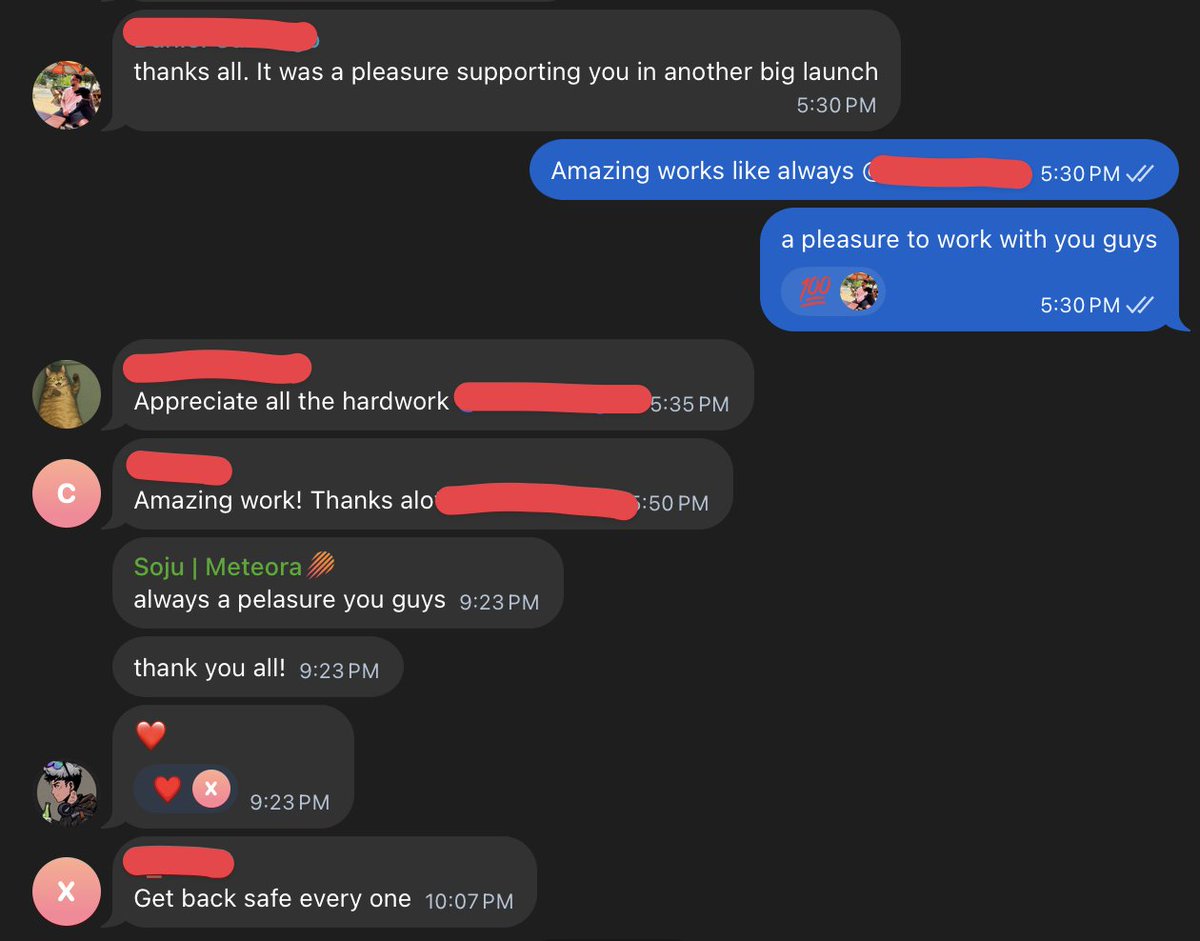
after seeing how smoothly the MET airdrop ran from an infrastructure standpoint, i want to highlight that if you’re planning one soon, you should seriously consider working with @triton_one. they were our main partner, and @dancamarg0 went above and beyond with incredible support.
there are 3 prices for each swap, quoted price, simulated price, and executed price.
quoted price is what you see when a router shows you what is the price you will get when you do a swap.
simulated price is what the price the router may simulate with the latest state of the data when a price is presented. some routers fuzz this to show that they are always the “best” simulated price.
executed price is what the price you will eventually get if you decide to do the swap. this may change since it takes a few seconds from what you see on quoted price to when you sign and execute the actual executed price.
out of the 3 prices during your swap journey, executed price is what really matters and that is something that we are optimizing for.
with Predictive Execution and Ultra Signaling, we make sure that executed price is what is best for our users. users will get the best executed price.
i will be sharing more what really matters over the next few tweets over the next few days.
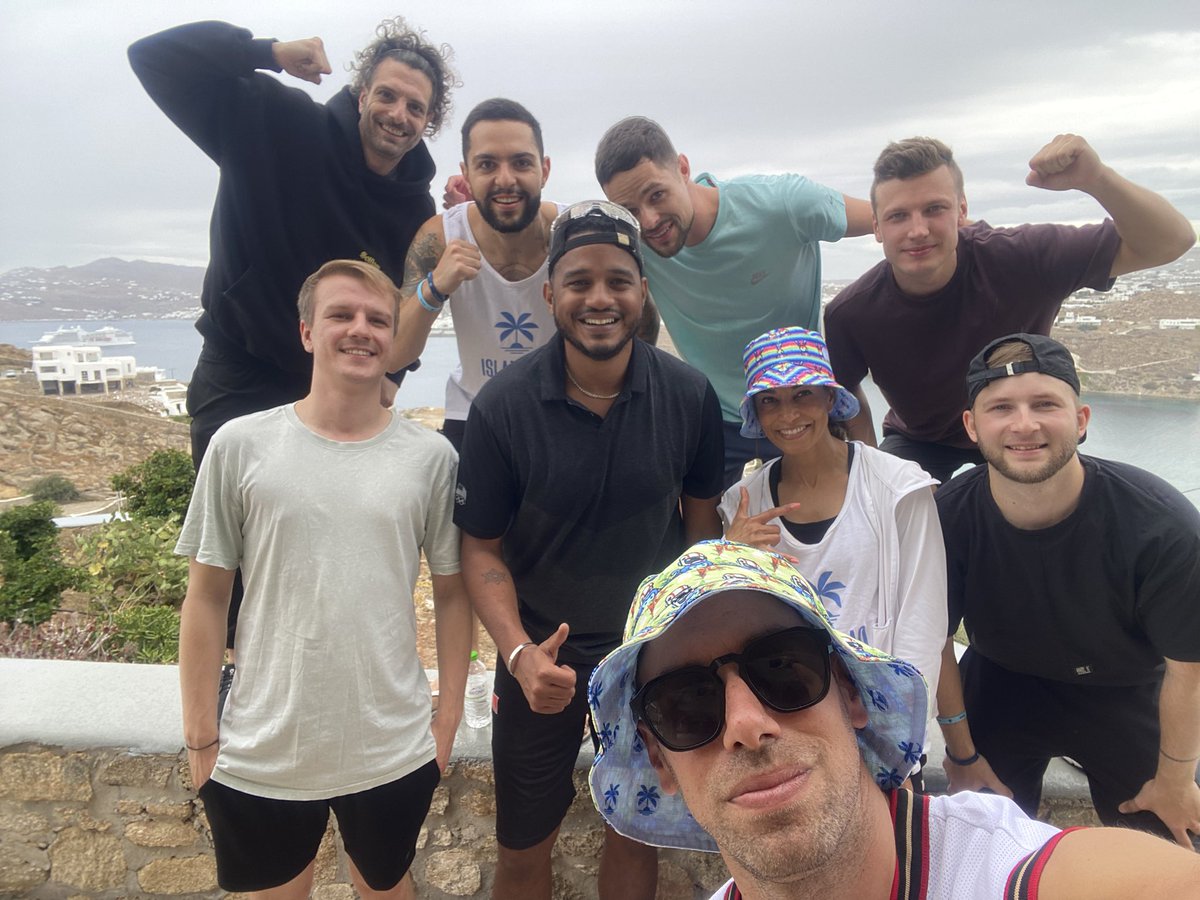
Can't believe I made it! I'm officially part of the @islandDAO v3 crew 🚢
From proposal to production, I'll be building alongside 100+ devs in Greece.
@solana@solanaconf
SOLANA SUPERNIGHT IN RIO!
Para fechar o Blockchain Rio com chave de ouro rolou uma mega celebração com os maiores projetos da Solana que vieram para o Brasil - @Backpack@triadfi@KASTcard@triton_one@Ledger e todos community partners.
Foi absolutamente incrível reunir as comunidades e projetos da rede para um último encontro carioca.
Obrigado a todos que compartilharam esse três dias com a gente.
Agora é hora de acelerar com Superteam Brasil.
At @triton_one, we're open-source advocates who enjoy contributing to other teams' work in addition to our own. Together with @ABKLABS, we've been pushing hard on the @metaplex Digital Asset Standard API project. We've got the DAS API in a great place, and I'd like to share a status update.
For background, over three years ago, I was contacted by the Metaplex team and my friend @_austbot about supporting their ambitious API project. We naively said "Yes," not realizing what we had just committed to. 😉 In the early days, our role was limited to operational support -- Austin would prepare a new release, and we would deploy it to give feedback. There was a lot of glass chewing in those days. Many times, the feedback was, "This doesn't work," but Austin persisted until the project was ready for the next steps.
After the DAS API was deployed into production, it became apparent that it required additional developer love, so our team stepped up to contribute code and pull requests to the Metaplex repository. @linuskendall, @espiKnwldgBmbs, @_fanatid, and others all made significant contributions. After three years, we have DAS API supporting a notable amount of our Triton production RPC traffic.
The DAS API isn't just for NFTs; it also supports fungible tokens in a format compatible with the @solana JSON RPC API token methods. The performance is fantastic -- we've got heavy queries, such as getTokenLargestAccounts (gTLA), running in under 100 milliseconds! DAS API is an integral part of our RPC 2.0 stack. Did I mention it is open-source?
Notably, we've removed the dependency of running a dedicated RPC node to feed the index. By using our widely supported Yellowstone gRPC interface, any team can run their own DAS API instance by connecting to any of the RPC vendors that offer gRPC. Running an index in the cloud is also feasible for many apps. It's worth repeating -- "any team can run their own DAS API instance!"
I mention that because Solana applications are becoming increasingly feature-rich, to the point where they've outgrown the standard JSON RPC API. Sophisticated apps often require custom indexes, and the Metaplex DAS API can serve as a great starting point. Developers can customize the code with the confidence that it will perform well in production.
Triton has contributed a significant amount of time and money to DAS API without receiving grants or other financial compensation. In return, I hope the ecosystem will benefit from our contribution by building better apps.
Finally, we're always happy to work with other teams on our Yellowstone open-source projects. For example, we have almost thirty contributors to our Dragon's Mouth gRPC Geyser plugin. Thanks to everyone who helped!
Here are links to the mentioned repositories:
Metaplex DAS API: https://t.co/D0J9OWXIFm
Triton Fork of DAS API (we contribute all changes upstream): https://t.co/h4u2HySMci
Yellowstone gRPC Contributors: https://t.co/AYM2pWJjlG