Patrick is the consummate interviewer.
I watch / listen to every major tech / investing podcast. No one is in the same league.
He strikes the perfect balance of asking incredibly evocative, well-researched, unique questions while also knowing when to just listen. 10/10
My conversation with David Vélez (@velez_david), founder and CEO of Nubank.
The last time we did this was five years ago, and Nubank had 35 million customers. Today it has over 140 million, and it has just announced it's coming to the US.
David now talks about expanding to 100 countries and reaching a billion customers.
We discuss:
- State and future of global banking
- Agents as a customer segment
- Going from one direct report to 20
- How he's rebuilding the company with AI
- Where fintech opportunities remain
- The end of cash
- Founder v CEO, great leadership, and finding the right mission
Enjoy!
TIMESTAMPS
0:00 Intro
1:25 Banking's $10 Trillion Disruption
5:54 AI's Impact on Banking
14:40 Building Moats in the AI Era
23:29 The Future of Money
36:01 Nubank's Global Expansion
48:24 Reinventing Nubank with AI
59:47 Founder Mindset and Leadership
1:13:18 Nubank's Future and Entrepreneurship
We need to recognize that the pro-Palestinian protests are fundamentally protests against the West, and their ambitions are much greater than eradicating Israel from the river to the sea.
We need to take these threats seriously.
iqmaxxing is very simple. Just do what Napoleon did. He would read everywhere he went. He had a custom traveling library built so he could take books with him on campaign. When a book became boring he would throw it out the window. He read while on boat across the sea. He read while in the bath. Every chance he got he had a book in his hand. Before every campaign he would read about the enemy's army structure, their religion, and the terrain they would fight on. He read for practicality, not just for fun. His secretary said he could read on abstruse subjects for 12 hours straight. His mind was like a cupboard. He could focus anywhere. And because of it, he learned everywhere. Through experience and in books.
Alexander Hamilton was 21 years old at the founding of this nation. He was Washington's aide-de-camp, led an assault at Yorktown in 1781, wrote 51 of the 85 essays in The Federalist Papers, became the first Treasury Secretary, and founded the First Bank of the United States, all before dying in a duel at age 47.
Never fall for this geriatric propaganda. Life is short. Be great now.
Andrej Karpathy makes a good point: as AI does more of the work, more of your job becomes reading what it produces.
His first tip caught my eye. Ask the model to explain things in ASD-STE100.
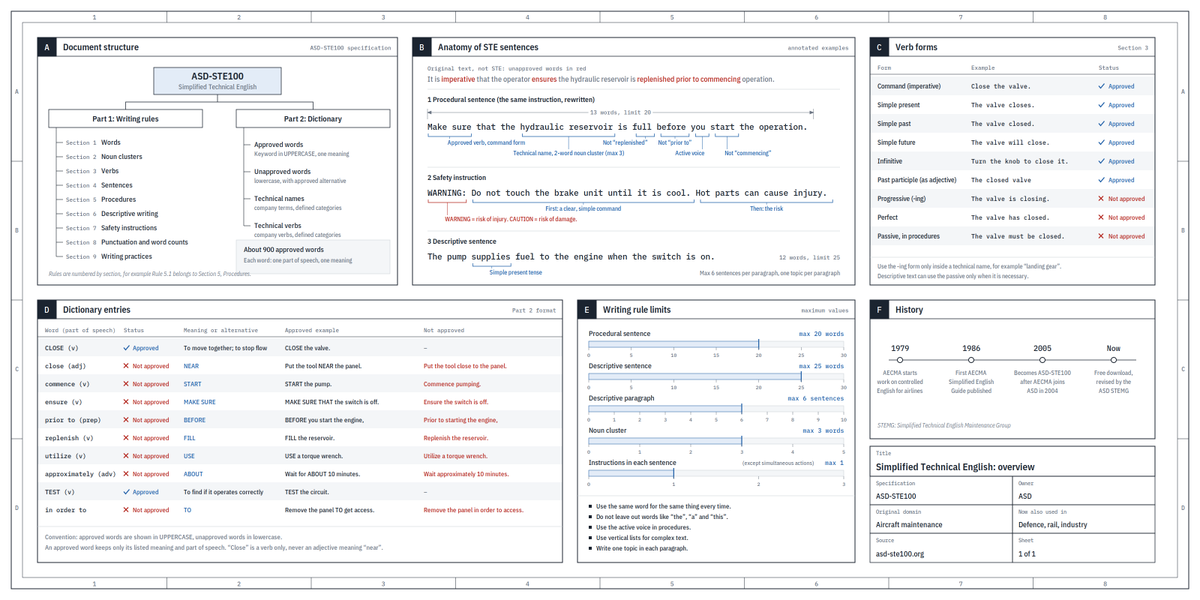
ASD-STE100 is a controlled English standard built for aircraft maintenance manuals. A mechanic anywhere in the world should read a step once and get it right.
The core rules:
1. Keep sentences short
2. One action per step
3. Say who does what
4. Give each thing one name and stick to it
AI output breaks that last rule all the time. It says "worker," then "agent," then "executor," and you can't tell if it means one component or three.
The full spec is strict. Karpathy asks for "80% of the way," and that works for daily use.
Someone turned it into an open-source skill:
https://t.co/FFqEehqVl2
We'll be spending a lot more time trying to understand the outputs of language models. A few thoughts, tips & tricks:
Writing. Something I've had success with: Ask your LLM to explain something in ASD-STE100, it's a controlled language specification originally developed for aerospace maintenance documentation. LLMs well-versed in this language and it comes with heavy constraints on clean writing style that I often find a lot more readable. Sometimes I've tried to soften it a bit e.g. ask for "80% of the way to ASD-STE100" because the spec is quite stringent. But even better:
Diagrams / images. Instead of writing, ask your LLM to create a diagram. These can be a lot easier to process, parse, and understand. But even better:
Web pages. Ask for output "in HTML" to get a beautiful, interactive webpage. LLMs are getting really good at frontend and can create beautiful experiences, animations, etc. But even better:
Explainer videos. The output format I am most bullish on is fully custom / bespoke explainer videos generated on any arbitrary topic. Experiment with things like "Create a 3b1b style video explainer on X. Use my ElevenLabs API key for audio narration". (you'd need an API key for the latter or you can ask your LLM to find you decent free alternatives that use your local compute). This is actually starting to work!
In summary:
- As LLMs get better, they will do more and more of the legwork autonomously, and a lot more of our work will rise up the abstractions into oversight and understanding.
- Luckily, LLMs can help here too because as intelligence and code are increasingly abundant, you can ask for large, custom, discardable software artifacts (e.g. web apps, video explainers) that would have never made sense to create before. Push the boundaries here and you'll be surprised.
This is so Trump.
He never allows himself to be visually identified as one of many.
In this situation, he is a tiny box in the corner, and I bet his instinct told him to turn it off.
He doesn't allow himself to be in a situation where he isn't the main character.
That's why Trump is one of a kind; everybody else is forgettable.
I bet this drives those other leaders mad 😂
The fastest way to achieve career growth is to join a company that's growing so quickly that promoting you into an impossible scope is a better option than hiring from the outside. Then, all you have to do is the impossible.
"Don't just sell airsoft guns. Make real guns. Sell them to the countries that share Taiwan's commitment to freedom and make those countries depend on you for advanced capabilities the way the world already depends on TSMC for commercial capabilitie."
https://t.co/C8jGGw02am
“We have a meaningful life when we do something that if we didn't do it, it wouldn't get done. That’s extremely meaningful and you should always aim for that”
— Peter Thiel