#FactFriday The sciatic nerve can be irritated at its interface with the piriformis, as it emerges through the greater sciatic foramen, either under, through or over the muscle. All radiating leg pain is not radicular. It may be #DGS#sciatica
https://t.co/RuEfp3yP1d
Does collagen strengthen connective tissue in muscle? Protein ingestion can increase the synthesis of contractile proteins, but does the same hold true for connective proteins? https://t.co/u9zEScZQpB
Should we ice injuries?
A review finds:
-Icing can impair the inflammatory and regeneration process over the long term
-It can reduce sensation of pain
-If you decide to ice, do so in the acute phase (first few hours) and not 12hr+ post injury.
Your knee is a living, biologically active organ. Cartilage is maintained by cells that respond to their chemical environment, and the primary driver of OA progression is not mechanical grinding.
It is chronic, low-grade inflammation that poisons the environment in which those cells are living.
So we need to stop thinking mechanically and start thinking more biologically. Our cartilage responds favorably to the same stimuli that improve our overall health and wellness.
This is precisely why high intensity exercise in moderate OA (grade 3 of 4) decreases pain and actually increases cartilage thickness.
What if high intensity exercise actually grew cartilage?
I have to walk folks off the ledge of fear almost daily in my office. Far too many think that exercise is grinding away their cartilage.
The paper we discuss today says the exact opposite.
Biology ftw…
https://t.co/HAOuWU0hwj
CAN WE MASTER DIAGNOSTIC ULTRASOUND IN JUST 1 YEAR??
The Physio Matters Team are following 6 guinea pig clinicians and @JackAChew to find out if they can develop Diagnostic Ultrasound competency in just 1 year!
This is episode 2 where we ask the educators what the issues are with weekend courses and non-formalised training PLUS we check in with the clinicians/guinea pigs who are partaking in our experiment. We ask them how they have found learning the skill so far, the time commitment and whether they have found a mentor yet.
This is part 2 of 4 in this documentary, part 3 is planned for release around August 2026.
Further episodes will cover all aspects of Diagnostic Ultrasound so if you have questions fire them at us, lets build a conversation around the pros (and cons) of the explosion of accessibility!
If you want to explore Diagnostic Ultrasound Machines then discuss further with the documentary sponsor Physiquipe without whom we would not be making this projext happen! They will help you get the right tech!
Plus if you mention us when you get a machine, they will provide you with 3 YEARS of Physio Matters Premium Access!
When 14 of the world's most prominent muscle scientists like @mackinprof@BradSchoenfeld and @AbigailMackey1 gather to present their findings… I think it’s worth writing about what they shared.
Two people walk into the same gym. They follow the same program, lift the same weights with the same intensity, eat about the same amount of protein, and sleep about the same number of hours. Six months later, one has added meaningful muscle, and the other has barely moved the needle. Why?
Do Z lines split? How do muscles grow?
How many sets do I need?
How much should I rest?
How often should I work out?
This consensus report gives us solid guidance on why adaptations occur and how we should train to maximize them.
Link in reply...
Wearables. I wish I had a guide like this when I started wearing them 🤣. For years I paid attention to the wrong stuff …
@altini_marco started my education. @Alan_Couzens has been the brakes on the enthusiasm around the noise that most of the black box algorithms are.
Hopefully I learned something and created a useful guide.
On Substaaaak
Link in reply.
I've been a shoulder surgeon for close to 30 years... It's pretty clear now that most rotator cuff tears do not require surgery. Some do. Most don't.
Why is that? Why can a shoulder with a cuff tear function normally?
Well... check the first reply and find out.
A high heart rate while lifting doesn't mean you got your cardio in.
Sure... there's some benefit. It's not all or none. Yes, there's nuance... But if you want to develop an aerobic athlete's cardiac adaptations (and for the most part, you do), you need cardio each week.
High pressure vs low pressure remodeling... it matters.
I hear this every week in my office:
"Doc, my heart rate hits 150 during squats — that's cardio, right?"
No. And if your cardiologist hasn't explained why, keep reading. 🧵
It’s been a few years since I shared this
But I’ve been continuing to update my ACLR protocol.
Added some commentary on op v non-op, graft types, & concomitant procedures.
Feel free to share & critique. It’s long. But lots of good research out there🙃
https://t.co/VSbeNpLw14
Are you confident surface marking the fat pad? Take a look at this short video to check the exact location - you may be surprised!
#Knee#FatPad#Physiotherapy
I want to clarify my point better:
In normal physiology and conditions, creatine supplementation shouldn’t be blamed for causing whole body cramps that require hospitalization.
We also have to be careful of the difference between creatine and creatine kinase.
Creatine kinase (CK) is a biomarker of muscle damage and is different than creatine. CK is released into the blood with muscle breakdown and then it can damage the kidneys and cause death. This is caused rhabdomyolysis and you’ve seen it in the news with other athletes.
Rhabdo occurs in athletes with intense bouts of exercise. Medical conditions and supplements can contribute to the risk of rhabdo, but creatine does not directly cause rhabdo. There have to be a lot of other contributing factors that lead to full body cramps and hospitalization.
So blaming a very concerning health event on taking too much creatine means either he was taking SIGNIFICANTLY more than the label recommended AND wasn’t hydrating well AND had an intense workout.
Creatine is just piece of what was probably a far more involved episode and brushing it off like it was a simple creatine dose issue puts unfair blame on what’s a very safe and well studied supplement.
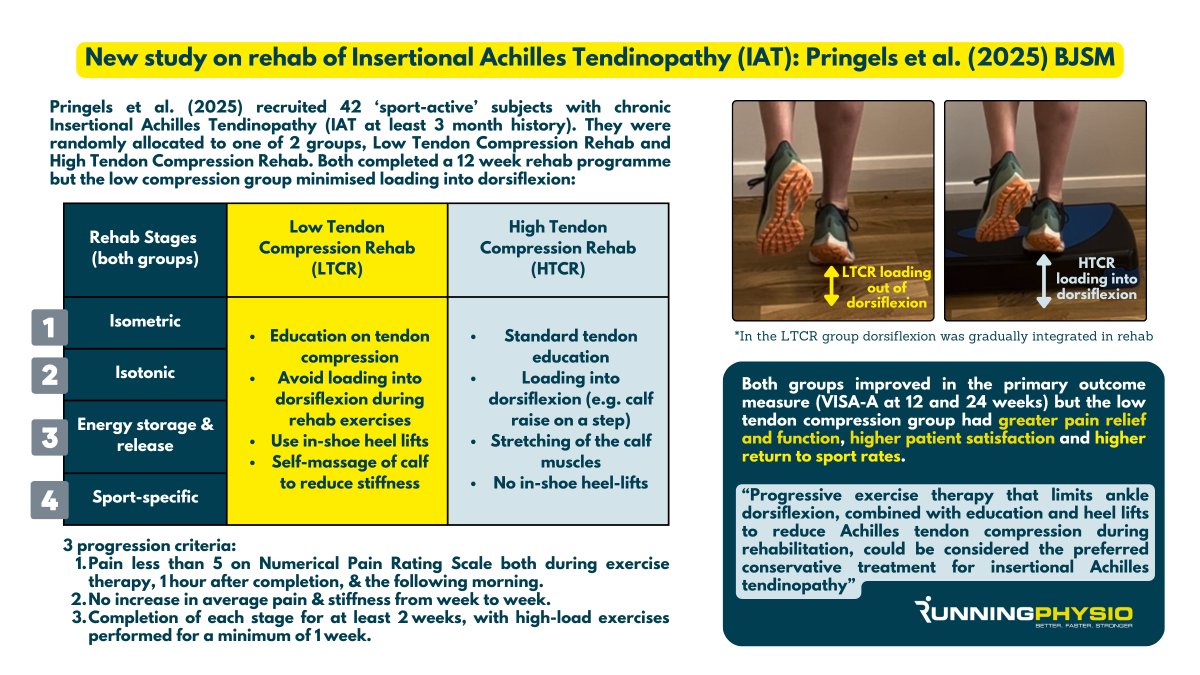
A great study from @LaurenPringels et al. in @BJSM_BMJ has found that reducing tendon compression (by limiting ankle
dorsiflexion during rehab) leads to better outcomes in Insertional Achilles Tendinopathy. See full paper for details: https://t.co/OIWfcxiD3z