The way software is typically built in Japan has been so broken for so long, I feel this is only going to get much worse unfortunately https://t.co/4VadiHhdbN
@levelsio Oh, it's been a while. This is from 12 years ago, when the big debate was systemd or not systemd (massive deal at the time) https://t.co/SMm4eW11k4
"And, speaking personally, I am exhausted."
Some more recent drama with the Asahi Linux lead giving up: https://t.co/khq8A2Og7V
@AdamRackis TL;DR: @dhh didn't like the existing out-of-the-box Linux flavours (e.g., GNOME/KDE on Ubuntu/Fedora). He configured Arch Linux with a tiling VM for himself. He thought it was harder than it should be and packaged his setup as a distribution so others could reuse it easily.
I don't really understand this whole "debate". Anyone who's tinkered with Arch should know it's way too much of a pain to set up for most people. Someone packaged it nicely and people like it. Seems like a net positive to me.
Correct me if I’m wrong, but Omarchy is just an Arch installer + a Hyprland rice + DHH’s favorite apps preinstalled.
How is that better than grabbing a solid rice from r/unixporn and asking an AI to set it up?
They’re selling the “AI-first OS” angle hard, yet AI can already debug, install packages and configure systems on any Linux distro. Nothing unique there.
And the big claim about preventing the classic “update broke my system” problem?
They’re relying on Btrfs/Snapper snapshots (the same approach openSUSE has used for years)… while NixOS (a real OS btw) solved it more comprehensively with atomic generations.
Is there actually something substantial here, or is it mostly hype?
@AdamRackis@ryanvogel I think it's just that most of the software used in Omarchy can be configured by modifying text config files (rather than requiring a GUI or an exotic CLI). Omarchy does provide a skill but codex and the like already work well enough on a vanilla Arch Linux with a similar setup
PSA: newer versions of Claude Code will delete past sessions older than 30 days.
Make sure to update "cleanupPeriodDays" in ~/.claude/settings.json if you want to keep your data.
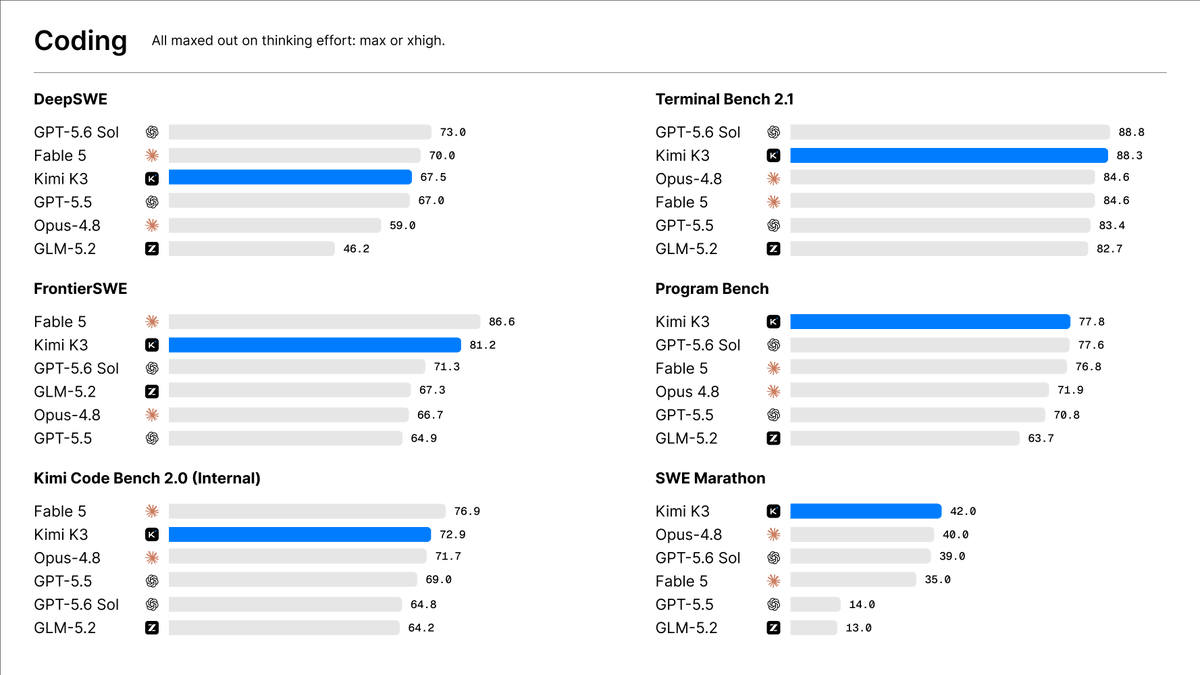
Introducing Kimi K3: Open Frontier Intelligence
🔹 2.8 Trillion Parameters, 1 Million Context, Native Multimodal
🔹 Kimi Delta Attention enables up to 6.3x faster decoding in million-token contexts
🔹 Attention Residuals deliver ~25% higher training efficiency at <2% additional cost
🔹 Built for long-horizon agentic coding and self-evolving workflows
Kimi K3 is now live on on https://t.co/zrk6zZxZUo, Kimi Work, Kimi Code, and the Kimi API.
Open Weights by July 27, 2026.
🔗 API: https://t.co/XCrgjXAqMw
🔗 Tech blog: https://t.co/YTfiMSNM1f
Sandboxed mode with auto-approve has been a reasonable usability/security balance so far. I'd probably just use a small VM if I wanted the agents to go wilder.
On file deletions. We’ve investigated a handful of reports where GPT-5.6 unexpectedly deleted files.
What we have found is that this most commonly occurs when:
- Full access mode is enabled and codex is run without sandboxing protections, including without auto review being enabled
- The model attempts to override the $HOME env var to define a temporary directory.
- The model makes an honest mistake and mistakenly deletes $HOME instead.
This is of course not how we want the system to behave, even when a user operates the model in full-access mode without the safeguards of our sandbox or without using auto review which checks for these kinds of high risk actions and rejects them.
We are taking steps to mitigate this risk including by updating the developer message, guiding more users towards safer permission modes, and adding additional harness safeguards. Even though this happens extremely rarely, we’ll share a detailed post-mortem in the coming days that goes into more details and what we are doing to minimize risks further.
This watchtower allows anyone to submit signed transactions through an HTTP API. It then takes care of storing the transactions and broadcasting them once they become valid. The process is fully trustless, and transactions can easily be invalidated directly on-chain.
I just released a watchtower that helps submitting scheduled transactions to @tempo : https://t.co/3lVmNYiy74
It makes it easy to create scheduled or recurring payments, DCA purchases, and more generally, anything that requires scheduling transactions.
Tempo allows to schedule transactions through a mechanism akin to Bitcoin's locktime: transactions can be made invalid until a given time. This means that these transactions must be stored, and sent once they are valid, which is not practical to do from a wallet directly.