@chanmeng666 Done: https://t.co/gx1Qol8VdG (stairs), #363 (L-shaped/open rooms), plus #364–#370. Full disclosure: Claude wrote them, I only skimmed them and they look fine to me. Apologies if some are slop, it's been a long day :D
@chanmeng666 Also checking right now to combine the declarative praradigm with Christopher Alexander‘s ideas on Pattern Languages in architecture. I think this might be a good fit ☺️
@chanmeng666 I was yesterday already preparing some issues, but realized that several shortcomings where due to agent not fully knowing archlang‘s capabilities. I will push them today to GitHub. Most obvious have been creating zones in open rooms and having stairs that are not straight.
“Look at my incredible new factory!”
Yo that’s cool, what do you make?
“It’s highly optimised, fully automated, zero tolerance for defects and with a continuous feedback cycle”
Cool cool, so what do you actually make?
“I can interact with it on my phone, laptop, messenger, completely async, and the shared context means it’s always learning how to get better”
Very impressive, but what do you make?
“Every agent has full context, can spawn other agents, review their work, fix defects, and ship continuously.”
yes yes. WHAT DOES IT MAKE?
“Software.”
Oh nice. What software?
“Well right now we’re mostly using it to improve the factory.”
Improve it to make what?
“Anything!”
Such as?
“…a better factory.”
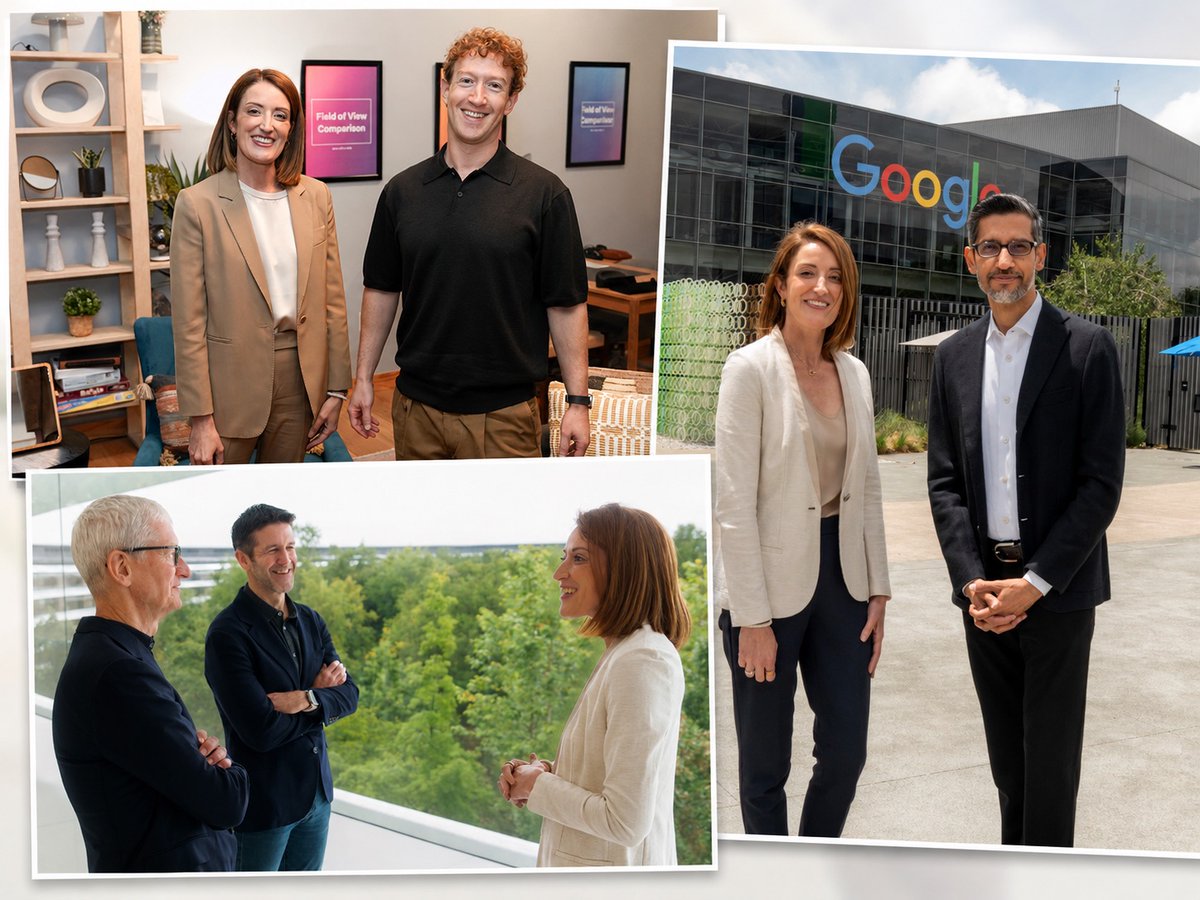
Falls sich jemand fragt, wie Parlamentspräsidentin Metsola auf die fixe Idee gekommen sein könnte, die Chatkontrolle für heute, 12 Uhr, (rechtswidrig) noch einmal auf die Tagesordnung zu setzen - hier ein paar Schnappschüsse von ihrer Kalifornienreise Ende Mai... Smiley!
Im Bild: US-Tech-Bros Zuckerberg, Tüp von Google, Tim Cook, Roberta Metaxa
Your Knowledge Graph Is the One Thing That Should Survive a Harness Switch
Models are commoditizing fast. Harnesses already have. Paul Iusztin makes the case that the knowledge graph sitting underneath your agent memory is the real asset worth owning, and everything else — the harness, even the model — should be disposable on top of it.
The graph he's building for the Tree project fuses a POLE+O ontology (Person, Organization, Location, Event, Object) with vector and keyword search inside a single unified memory. Typed nodes, traversable relationships, and lineage back to the source document on every entity extracted.
Three reasons a graph-anchored memory matters:
* Switch harnesses and every entity, relationship, and learned preference the graph has captured stays intact — you don't start over
* Skills and workflows built on top of the graph don't inherit one harness's quirks, so they don't quietly break when you move
* The graph is what gives you lineage for free - where each node was extracted from, who owns it, how it connects to everything else
On implementation, the piece makes a strong case against splitting memory across a graph DB, a vector DB, and a document store. A single database like MongoDB that indexes text, vector, and graph together beats stitching three specialized ones — one query joins across all three instead of paying a cross-database sync tax.
Try your best to build your unified memory on top of a single database that supports text, semantic, and graph search. Start simple and add complexity only when your use case demands it.
The RAM finding is the sharpest part: a knowledge graph has two snapshots, an append-only ingestion log and a materialized, queryable view. Vector-indexing both inflates memory footprint roughly 4x. Index only the materialized graph, leave the log on disk, and it collapses back down — same data, a quarter of the RAM.
For deep multi-hop traversal or graph-native tooling, a specialized graph DB like Neo4j still earns its place — sync production data to it for exploration and visualization when 2-3 hop queries aren't enough.
Get the ontology and the graph right, and swapping the harness on top becomes a one-line config change.
By Paul Iusztin
https://t.co/HWMriBjw99
#AgenticAI #GraphRAG #Ontology #AgentMemory #POLE #EmergingTech
--
Connected Data London 2026 | 11–12 November | Leonardo Royal Hotel London Tower Bridge
🎤 Share your work with the world's most passionate data community. The Call for Submissions is open.
https://t.co/LYWPyNlfy1
🎟 Tickets on sale now. Advance rate discounts up to 15%. https://t.co/A5DC4llVKv
📺 Sponsorship opportunities available. Contact [email protected] for details.
#KnowledgeGraph #GraphRAG #Ontology #Graph #AI #DataScience #GraphDB #SemTech
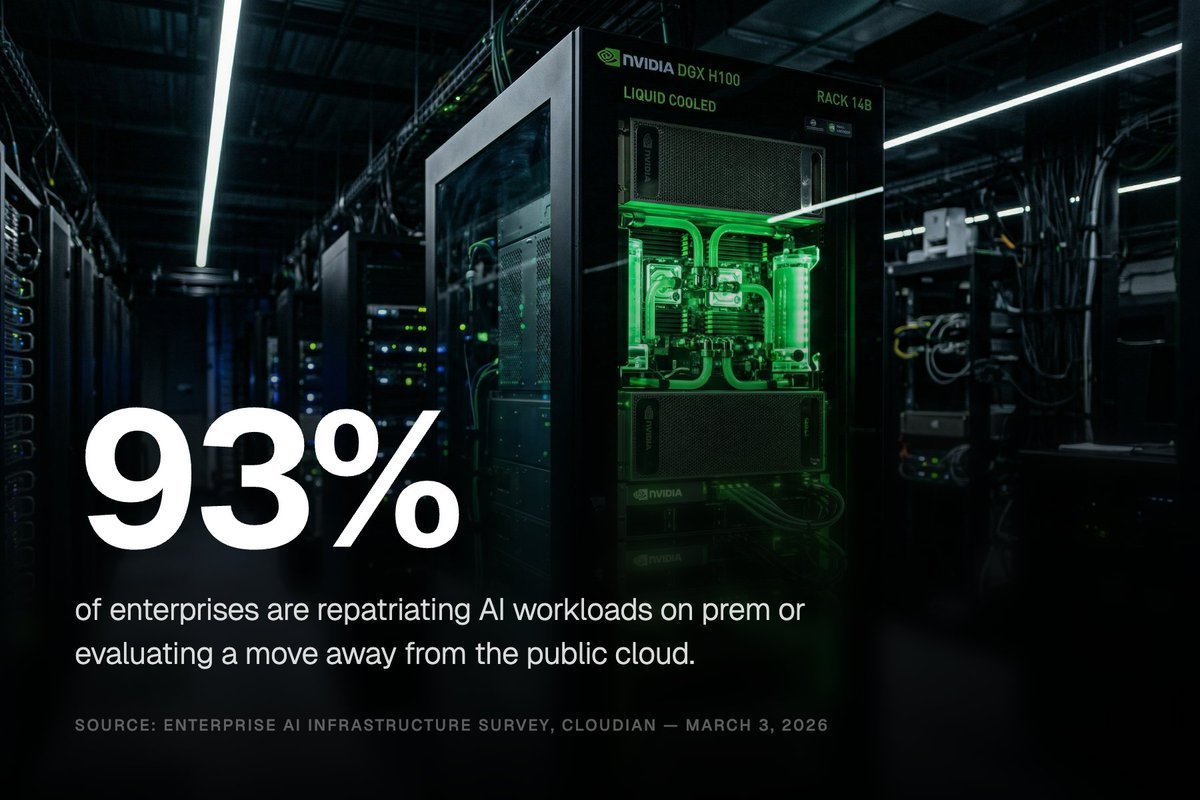
On-prem is the new cloud
@chamath called this 2 months ago.
Now it's everywhere:
On-prem - ideal
VPC - okay
SaaS / public cloud - 👎
The cost of setting up infra is decreasing fast.
Agents can configure anything in a matter of hours:
Firmware, LAN, VMs, k8s, Terraform - you name it.
Many companies are running open-source LLMs in-house for simple workflows.
And pseudonymize data for cloud models.
CFOs love it!
They hate everything that is per-seat or per-token.
Way more focus on what's defensible:
data
policies
ontology
know-hows
decision chains
New motto:
Data sovereignty
Zero vendor lock-in
Headless OSS stack
On-prem / hybrid infra
Centralized governance
Context graph ownership
Bearish on rent
Bullish on own
The comparison sounds clever on an Accenture slide. It falls apart the second you check the history.
Edison spent years studying gas lamps, arc lamps, and every existing illumination technology before building the lightbulb. His key breakthrough, a carbonized bamboo filament that lasted 1,200 hours, came from testing 3,000 materials across 14 months of continuous iteration. He didn't skip the candle. He studied every candle ever made and then built something better.
The iPhone was a continuous improvement of the Palm Pilot, which was a continuous improvement of the Newton, which was a continuous improvement of the Psion Organizer. Google was a continuous improvement of AltaVista. Tesla was a continuous improvement of the GM EV1.
The consulting version of innovation sounds like "think different and skip the boring work." The actual version is "study every existing solution until you understand the constraints so deeply that the next step becomes obvious."
Accenture charges $500/hour to show this slide to Fortune 500 executives. The companies that actually build the next electric light are in the lab running experiment 2,999.
Vibe Coding Is the New Product Management
“There’s been a shift—a marked pronouncement in the last year and especially in the last few months—most pronounced by Claude Code, which is a specific model that has a coding engine in it, which is so good that I think now you have vibe coders, which are people who didn’t really code much or hadn’t coded in a long time, who are using essentially English as a programming language—as an input into this code bot—which can do end-to-end coding.
Instead of just helping you debug things in the middle, you can describe an application that you want. You can have it lay out a plan, you can have it interview you for the plan. You can give it feedback along the way, and then it’ll chunk it up and will build all the scaffolding.
It’ll download all the libraries and all the connectors and all the hooks, and it’ll start building your app and building test harnesses and testing it. And you can keep giving it feedback and debugging it by voice, saying, “This doesn’t work. That works. Change this. Change that,” and have it build you an entire working application without your having written a single line of code.
For a large group of people who either don’t code anymore or never did, this is mind-blowing.
This is taking them from idea space, and opinion space, and from taste directly into product. So that’s what I mean—product management has taken over coding. Vibe coding is the new product management.
Instead of trying to manage a product or a bunch of engineers by telling them what to do, you’re now telling a computer what to do. And the computer is tireless. The computer is egoless, and it’ll just keep working. It’ll take feedback without getting offended.
You can spin up multiple instances. It’ll work 24/7 and you can have it produce working output.
What does that mean? Just like now anybody can make a video or anyone can make a podcast, anyone can now make an application. So we should expect to see a tsunami of applications. Not that we don’t have one already in the App Store, but it doesn’t even begin to compare to what we’re going to see.
However, when you start drowning in these applications, does that necessarily mean that these are all going to get used or they’re competitive? No. I think it’s going to break into two kinds of things.
First, the best application for a given use case still tends to win the entire category. When you have such a multiplicity of content, whether in videos or audio or music or applications, there’s no demand for average.
Nobody wants the average thing. People want the best thing that does the job. So first of all, you just have more shots on goal. So there will be more of the best. There will be a lot more niches getting filled.
You might have wanted an application for a very specific thing, like tracking lunar phases in a certain context, or a certain kind of personality test, or a very specific kind of video game that made you nostalgic for something. Before, the market just wasn’t large enough to justify the cost of an engineer coding away for a year or two. But now the best vibe coding app might be enough to scratch that itch or fill that slot. So a lot more niches will get filled, and as that happens, the tide will rise.
The best applications—those engineers themselves are going to be much more leveraged. They’ll be able to add more features, fix more bugs, smooth out more of the edges. So the best applications will continue to get better. A lot more niches will get filled.
And even individual niches—such as you want an app that’s just for your own very specific health tracking needs, or for your own very specific architectural layout or design—that app that could have never existed will now exist.”