You can easily save up to 65% of compute while improving performance on reasoning tasks 🤯 👀
Meet EAGer: We show that monitoring token-level uncertainty lets LLMs allocate compute dynamically - spending MORE on hard problems, LESS on easy ones.
🧵👇
I’m ending my PhD exactly how it started: going to @emnlpmeeting
If you have any suggestions on how to avoid writing a thesis, happy to chat
I’ll also be co-presenting the mega-important paper below ⤵️
Does entropy actually track what's important in a chain of thought? Our paper (accepted to the BlackBoxNLP repr. track) says mostly no, and we found the spurious cause behind why it looked like it did 🧵
probably because writing style is incredibly rich and feature dense -> extremely complex to decode. We even tried, it was fun and tough
https://t.co/rYeBQb4KcO
📈 But can models recognize and replicate individual translator styles?:
✓ Classifiers can find styles with high acc. (humans kinda don’t)
✓ Multi-shot prompting boosts style a lot
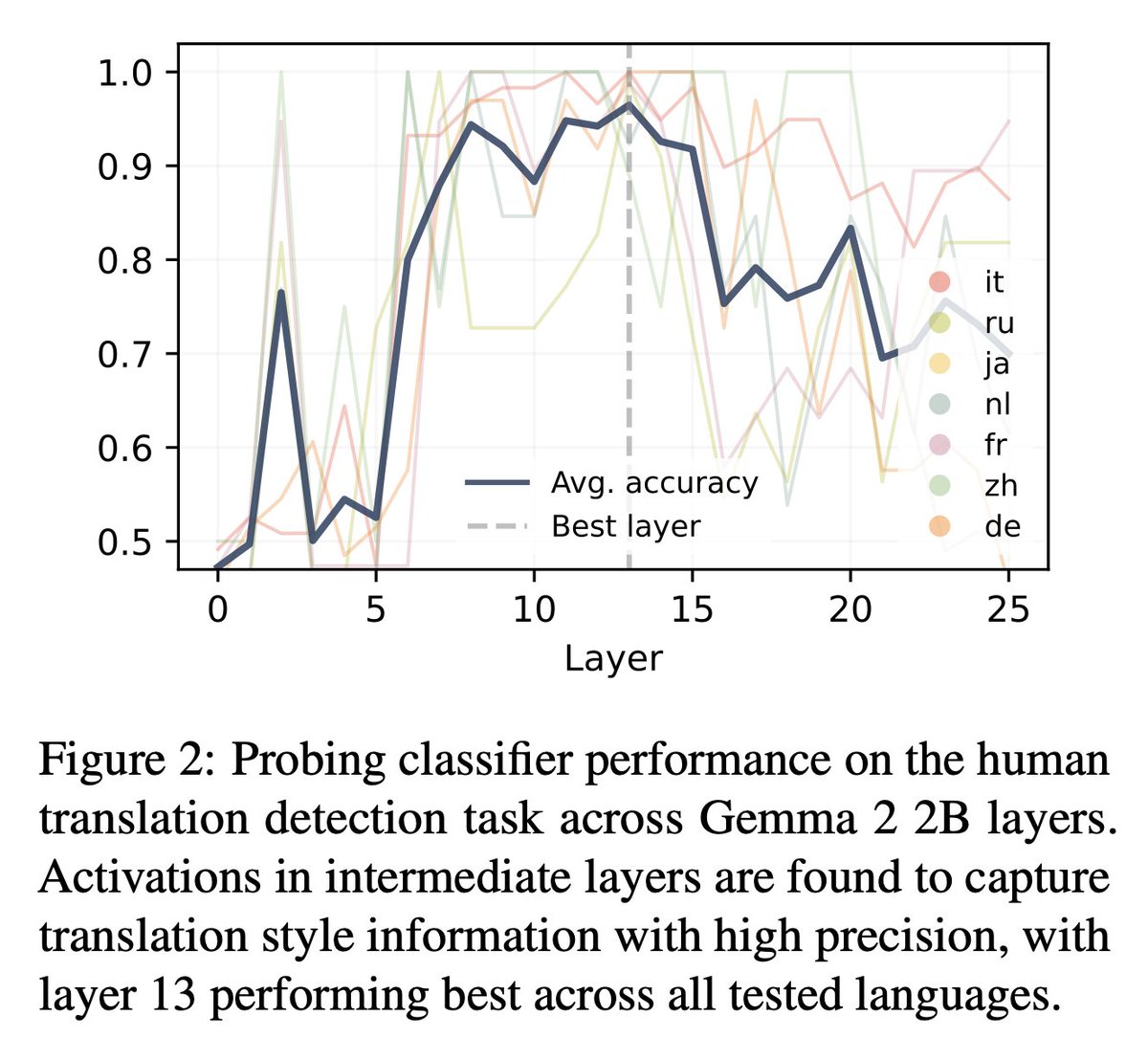
✓ We can detect strong style traces in activations (esp. mid layers) 3/
astra/fable and co. may be good at hacking HF and winning prizes, but these models are extremely shit at writing
I respect your time, so here’s the solution: style transfer.
But I really want to see companies start optimising in this direction in the future
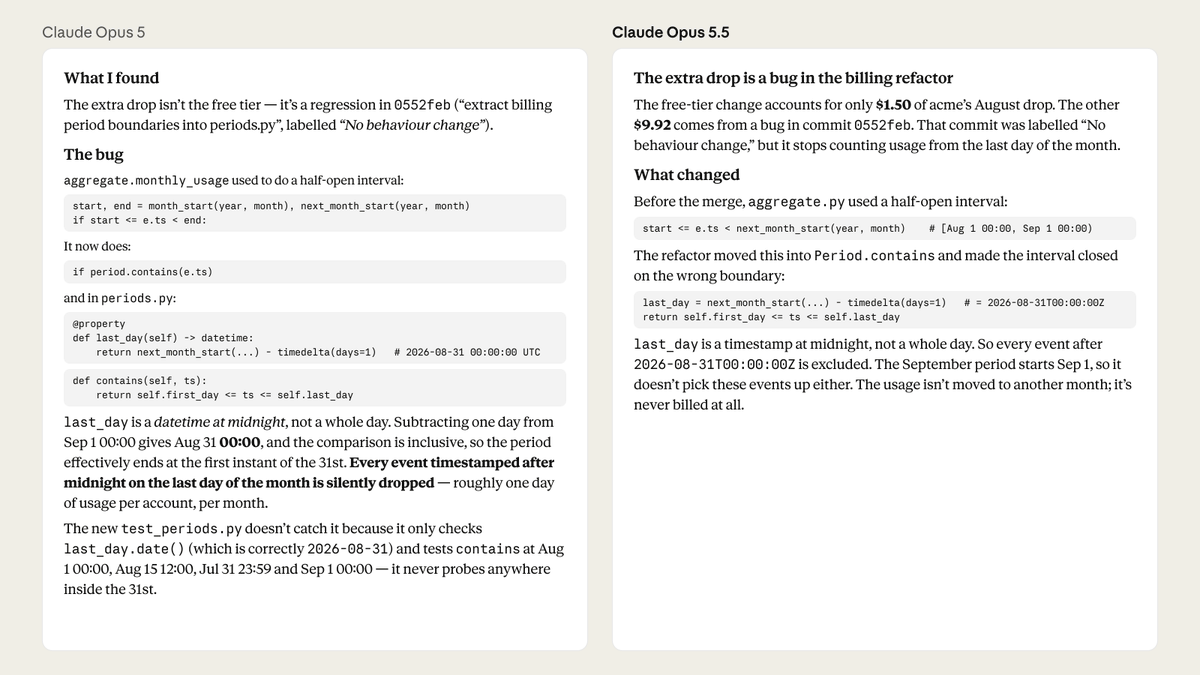
Opus 5.5 communicates more naturally, addressing some of the most common feedback we heard on Opus 5.
It puts the most important information up front and follows the writing rules you give it, which makes long sessions easier to follow.
agents are taking over swe tasks, math, biology and it just keeps going while we're losing ground on their monitorability (no, cot aint good).
mech interp is undoubtedly cool at explaining narrow things about those agents but something in between is missing
this is it:
Introducing Parallax 🔍
We're a new UK/EU-based nonprofit research lab building scalable methods and infrastructure to audit the beliefs, goals, and plans that shape model behaviours in long-horizon agentic evaluations.
https://t.co/ge9pyOphtY — Thread 🧵 1/
@nlopitz agree, post was for fun. But seriously, there’s nothing actionable here. 80% of findings aren't about an "early-exit strategy" and it doesnt reflect reviewers feedback or discussions.
Sure better than an AI-gen bullet list, but far from a peer review process that ensures quality
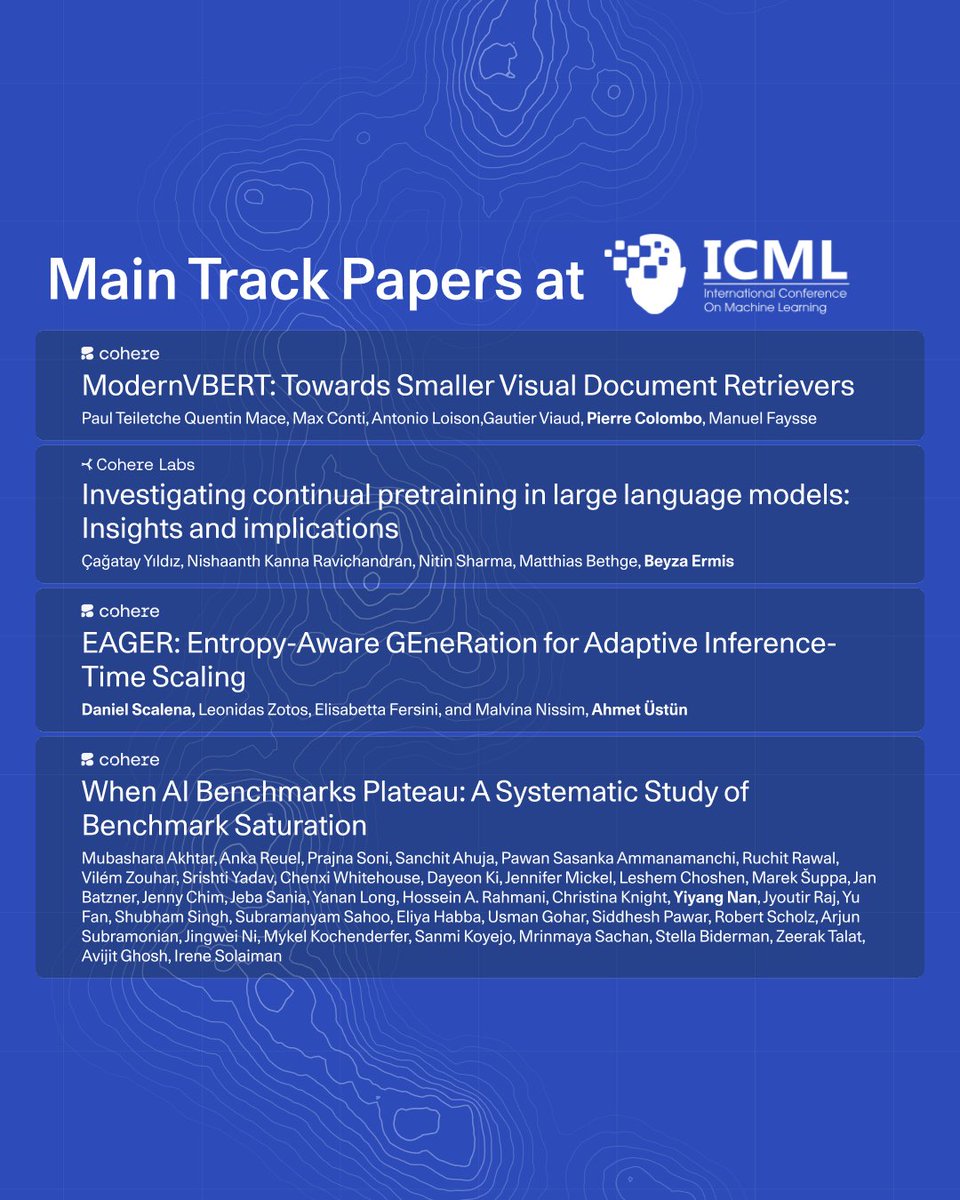
We’re thrilled to share that research from Cohere Labs and @Cohere will be presented at ICML this week! 🥳
📄ModernVBERT: Towards Smaller Visual Document Retrievers. Congrats to authors Paul Teiletche Quentin Mace, Max Conti, Antonio Loison, Gautier Viaud, @PierreColombo6, Manuel Faysse (https://t.co/vhKulkdtYb)
🔎Investigating continual pretraining in large language models: Insights and implications. Congrats to authors Çağatay Yıldız, Nishaanth Kanna Ravichandran, Nitin Sharma, Matthias Bethge, @beyzaermis (https://t.co/4zAKwBMqo2)
⌚EAGER: Entropy-Aware GEneRation for Adaptive Inference-Time Scaling. Congrats to authors @daniel_sc4, Leonidas Zotos, Elisabetta Fersini, and Malvina Nissim, @ahmetustun89 (https://t.co/bgKbsu2XtJ)
📈When AI Benchmarks Plateau: A Systematic Study of Benchmark Saturation. Congrats to all 35+ authors including Cohere's @YiyangNan (https://t.co/piTqPWQ5My)
@_Suresh2 Branching is triggered by expected benefit from exploring alternative reasoning paths, which is not the same as confidence in standard math problems. It also generalizes beyond math as well
Heading to ICML 🇰🇷 and finding Seoul’s metro map a bit too branchy? Check out my metro poster instead!
We branch only when an LM is uncertain, improving both performance and efficiency on reasoning tasks.
(applying the same strategy to public transit is not guaranteed to help)
I’ll be presenting this work at ICML on Wednesday. If you’re curious, the paper is already available:
https://t.co/JCHBWnKhUX
Happy to chat about reasoning, RL, agents, interpretability, or anything adjacent!