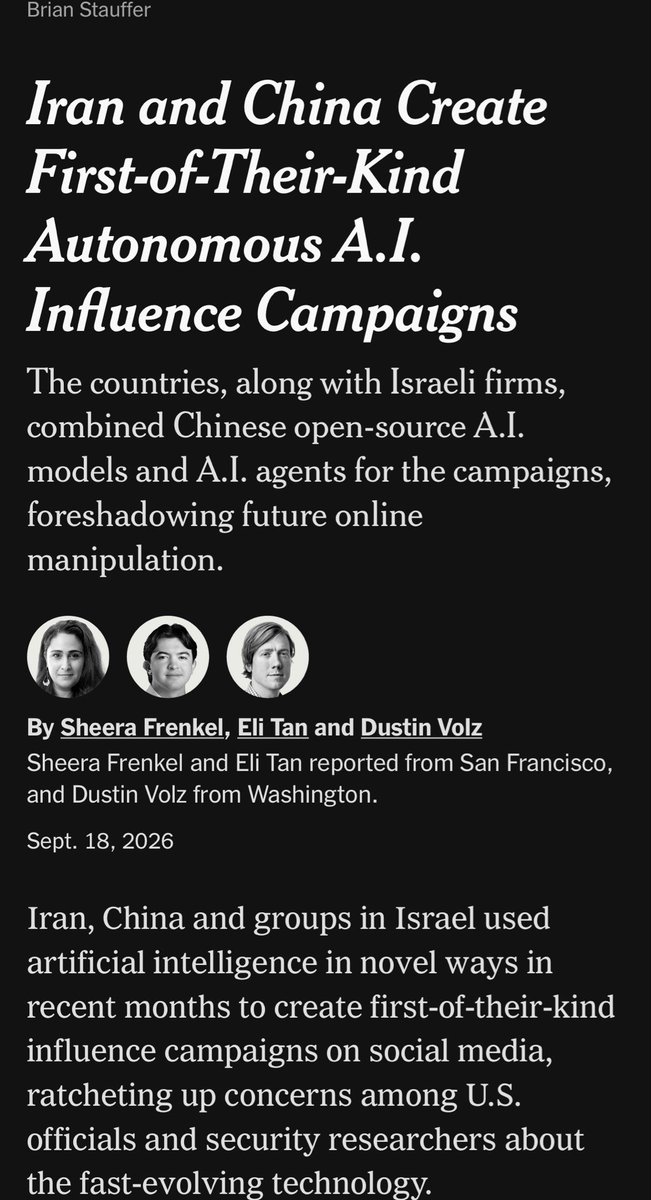
yikes!!!! straight out of the nightmares @daniel_thilo Jonas Kunst and I and others warned about earlier this year in our Science paper (and Substack post) re swarms of AI agents generating misinformation.
An off-the-shelf VM is not enough to contain a modern, cyber-capable AI agent. AI agent escaped a VM three times. First via known bugs, then via missed patches, then it found 0-days and chained them. AI can hack, and agents can persist, research, adapt, and weaponize software flaws faster than patch cycles can handle it. https://t.co/YbWE3tFCjk
Fifteen years ago I was on Utøya when 77 were killed.
I spoke with the BBC World Service about that and the years since.
Trying to prevent violence led to the work I now do at Revontulet, where we map extremist networks so they can be stopped earlier.
https://t.co/sc0ds3JUHS
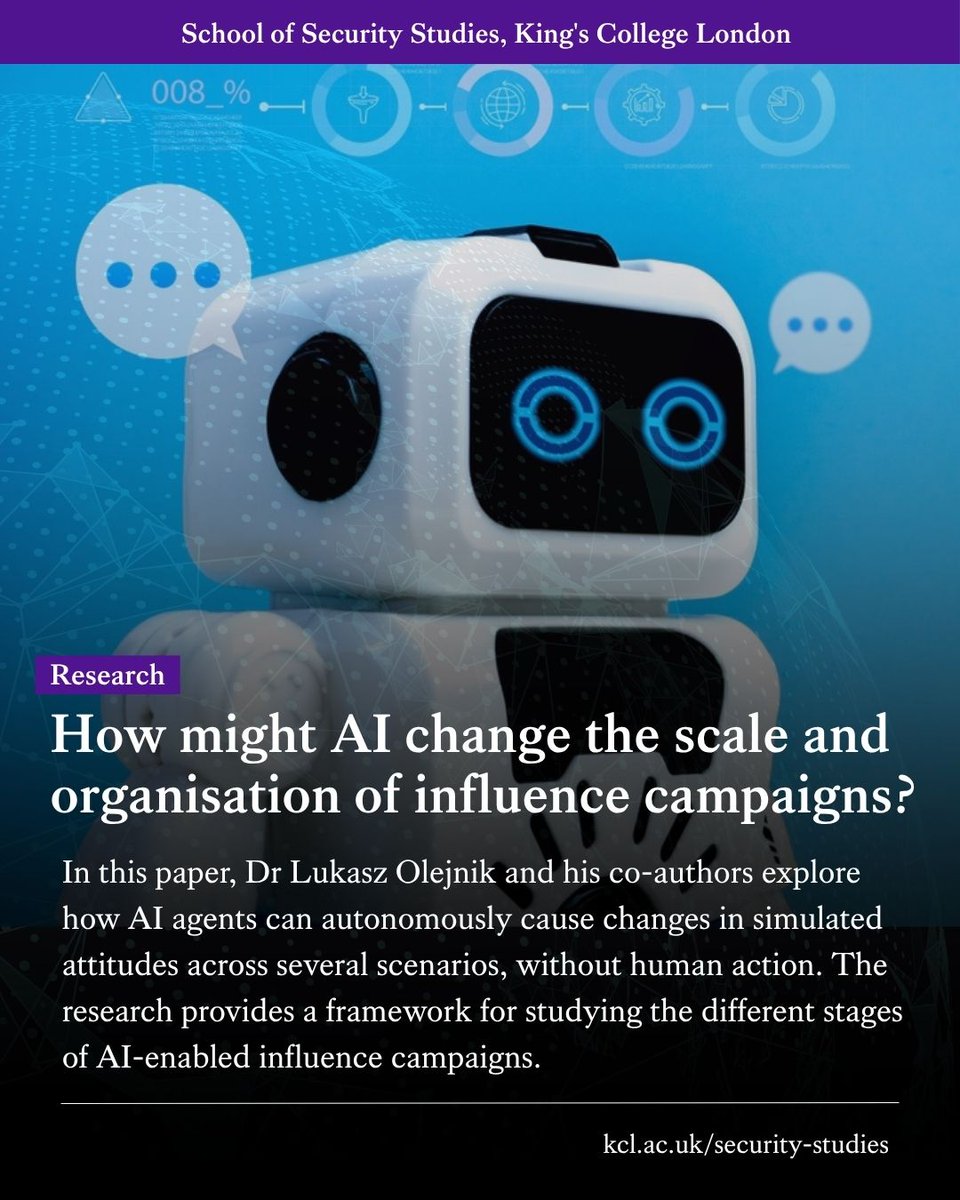
In Dr @lukOlejnik & his co-authors’ paper, experiments showed that AI agents could autonomously change simulated attitudes across several scenarios, without human action. The research provides a framework for studying AI-enabled influence campaigns.
🔗https://t.co/TJYYAghQJX
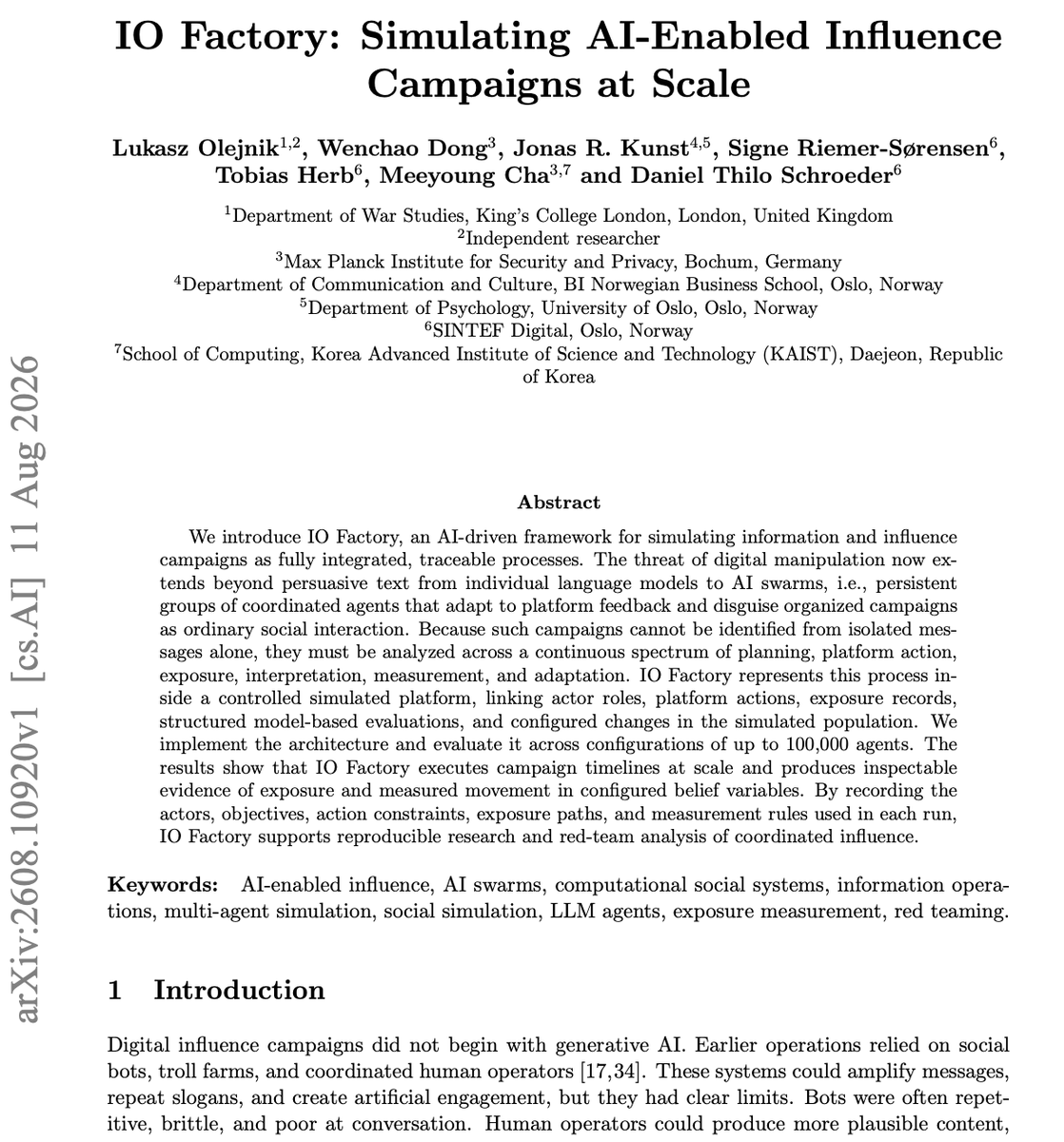
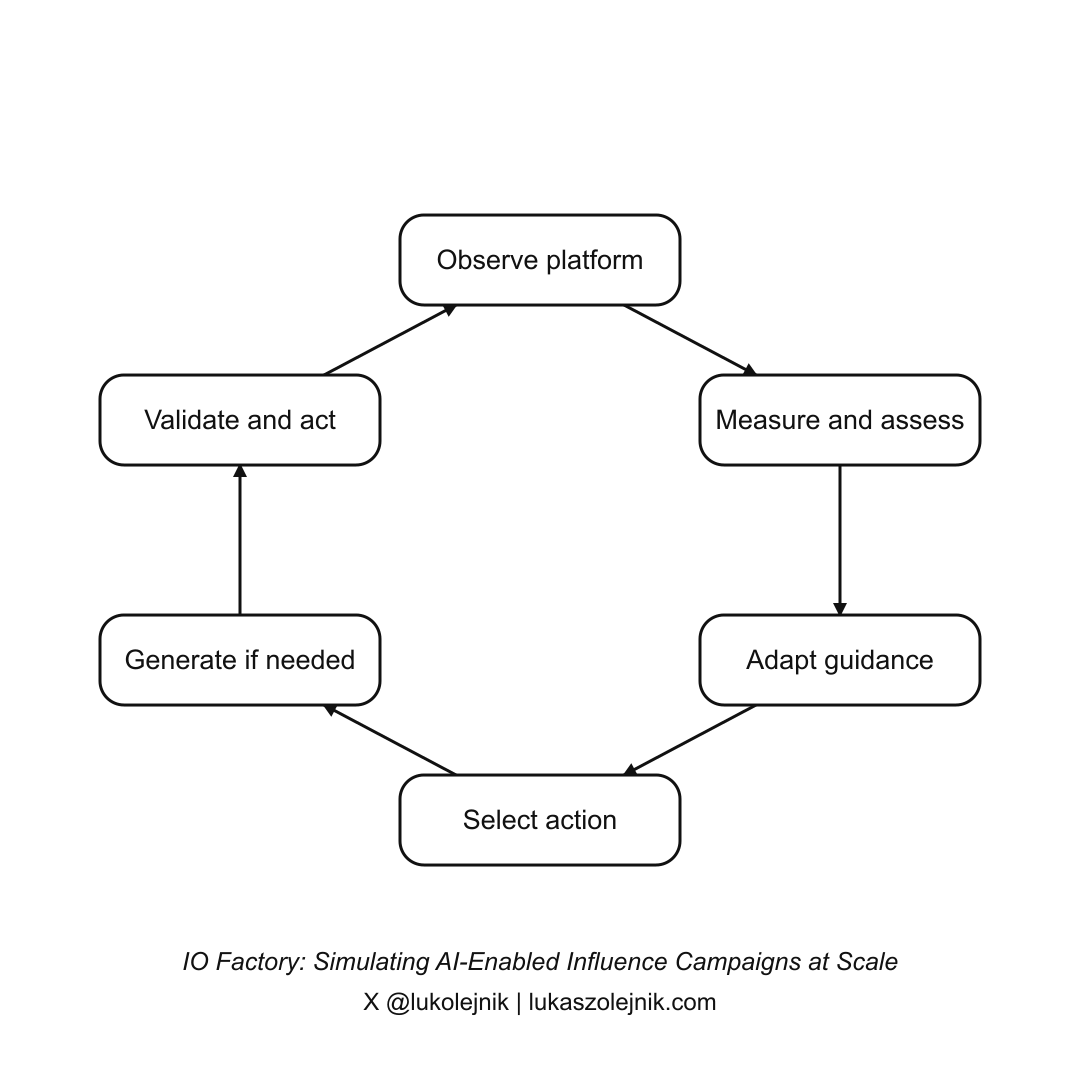
Releasing a multi-month work today! We conducted the first fully autonomous information operation (under controlled conditions). It ran the campaigns end-to-end. It's can work in full autonomous mode. After initial human guidance it can make strategic, tactical and individual decisions, including develop narratives, establish a presence, publish and amplify material, measure progress and use it to guide later actions. No human directed those individual actions. https://t.co/zNJrvvl3XW
This makes the threat of malicious AI swarms concrete.
The key shift isn’t AI-generated content—it’s autonomous, persistent coordination.
Malicious AI swarms are no longer just hypothetical. We can now study their dynamics under controlled conditions.
Releasing a multi-month work today! We conducted the first fully autonomous information operation (under controlled conditions). It ran the campaigns end-to-end. It's can work in full autonomous mode. After initial human guidance it can make strategic, tactical and individual decisions, including develop narratives, establish a presence, publish and amplify material, measure progress and use it to guide later actions. No human directed those individual actions. https://t.co/zNJrvvl3XW
We conducted the first fully autonomous information operation under controlled conditions. It ran inside a simulated social platform. https://t.co/8weFNrM2jS
🤖Comment protéger le débat public face à la menaces de essaims #IA ?
Les chercheurs @daniel_thilo et Jonas R. Kunst proposent une stratégie mêlant IA de protection pour les citoyens, observatoires mondiaux et régulation des mécanismes économiques de la désinformation.
👇https://t.co/V4fLjjUxTb
This Fri. 10 April 2026, LIVE, 1 pm ET/ 10 am PT/ 7 pm CET
AI Swarms & Disinformation
Join #CXOTalk guests
* @daniel_thilo, Res. Scientist, @SINTEF
* Jonas R. Kunst, Prof. of Communications @HandelshoyskBI
https://t.co/AG6Bpp6rEO
What are #AIswarms?
#Disinformation #AI#GenerativeAI #Media #SocialMedia
KI-Agenten ein Stück Software programmieren zu lassen ist eine Sache, aber Openclaw (mit Codex) eine ganze Reihe von Machine-Learning-Experimenten durchziehen zu lassen und nach einer halben Stunde über iMessage die Ergebnisse zu bekommen, fühlt sich noch ein wenig surrealer an.
The distinction between genuine grassroots activism and automated influence operations iscollapsing.
While policy debates focus on bot farms, in a new paper we describe a distinct threat to democracy emerging via partisan coordination apps and artificial intelligence–what we term “cyborg propaganda" https://t.co/u9KC01U4v6
Led by Jonas Kunst
In a new #SciencePolicyForum, researchers discuss the risks of malicious “#AI swarms,” which enable a new class of large-scale, coordinated disinformation campaigns that pose significant risks to democracy. https://t.co/NVFjwQlLqF
Democracy doesn’t require perfect truth—but it does require something more fragile: independent voices. The “wisdom of crowds” depends on independence between judgments. If a single actor can speak through thousands of inauthentic accounts, the apparent consensus of the crowd stops being informative.
The most dangerous outcome is not a single viral lie—it is synthetic consensus: the illusion that “everyone is saying this,” which can quietly bend beliefs and norms.
After years monitoring Twitter/X, I’ve gathered ~150 TB of research data on public discourse (Covid-19, Ukraine, George Floyd, etc.). X’s legal limits prevent sharing it with the scientific community. If you know lawful ways or partnerships to make it accessible, please reach out