Plant cells generate rhythms/oscillations in virtually all scales of spatiotemporal organization.
A whopping 24 orders of magnitude in time 15 in space!
Out in our recent review "Electrifying rhythms in plant cells" with @mtportes_ & Feijó fig:@joana_gcc
https://t.co/mW7x5r9QwY
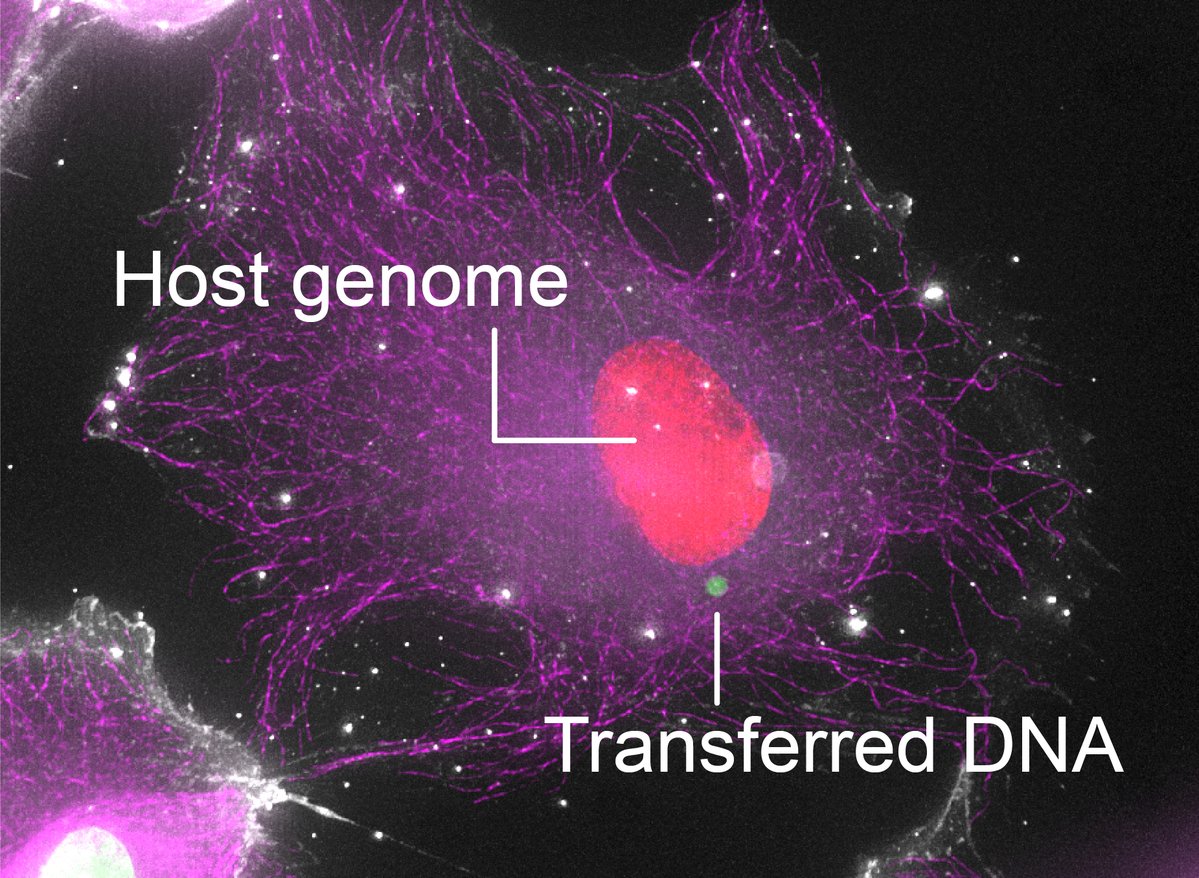
Excited to share our latest paper, out today @CellCellPress. We found that large pieces of the human genome can transfer between cells upon direct contact, endowing recipient cells with heritable phenotypic changes. (1/7)
https://t.co/SbshGhofN0
@WUMIN_LAB I'm so glad to hear that! It's a pity it was only on the last day.. But hopefully we can discuss more remotely. I heard great things from your talk as well! I'd love to do a video call in the near future..
@WUMIN_LAB Hopefully you will meet my long-term collaborator Maria Teresa Portes and our student Arthur Marcusse. I'm so glad to see you talk about Prigogine and Goldbeter, I am a huge fan of their work. Albert was in the last EMBL oscillator meeting I went, it was truly a blast!
Calcium oscillations are one of the most universal signals in biology. Yet we still know surprisingly little about how these periodic (or aperiodic) events arise.
Happy to present our lab's latest work:
https://t.co/5Tztn1Ig2u
Biology runs on oscillators. Mathematics explains them.
Excited to serve with Anne Skeldon as Guest Editor for the Nature Portfolio collection: Biological Oscillators Across Scales: Mathematical and Mechanistic Principles.
https://t.co/mnZvdnS9m5
#MathematicalBio#Chronobiology
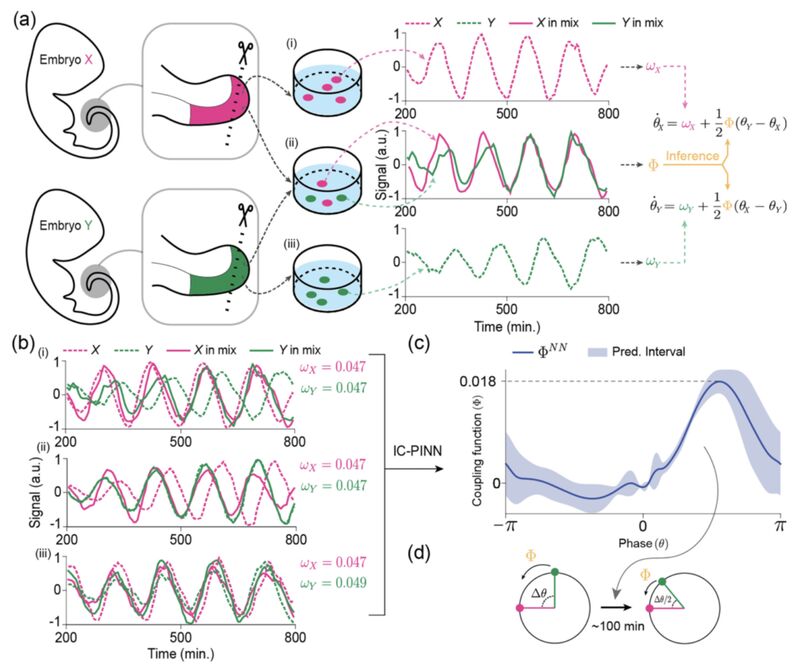
How do coupled oscillators interact — heartbeats, neurons, circadian clocks?
We built IC-PINN to infer coupling functions from data, no basis function selection needed, robust to noise & sparse data
https://t.co/hvBF1e0DtA
#DynamicalSystems#ML
Plants "talk" internally — and now we can watch it happen.
MAPPI lets us track shoot-to-root Ca²⁺ signals in real time 🌱⚡
@ScienceAdvances!
https://t.co/4DHOXTKSeC
A new study uncovers an anti-resonance effect in Wnt signalling, where pathway activity is suppressed at specific signal frequencies. Using optogenetics and modelling, the work shows how signal timing shapes cell fate decisions.
🔗 https://t.co/8Cn5GjsUCr
A new study uncovers an anti-resonance effect in Wnt signalling, where pathway activity is suppressed at specific signal frequencies. Using optogenetics and modelling, the work shows how signal timing shapes cell fate decisions.
🔗 https://t.co/8Cn5GjsUCr
I'm pretty sure this metric is a bit like reinventing the wheel squared, but hey let me know how you quantify plascity in your setting. Here is a link to access the paper without a paywall (for now):
https://t.co/Lbru3V6l65
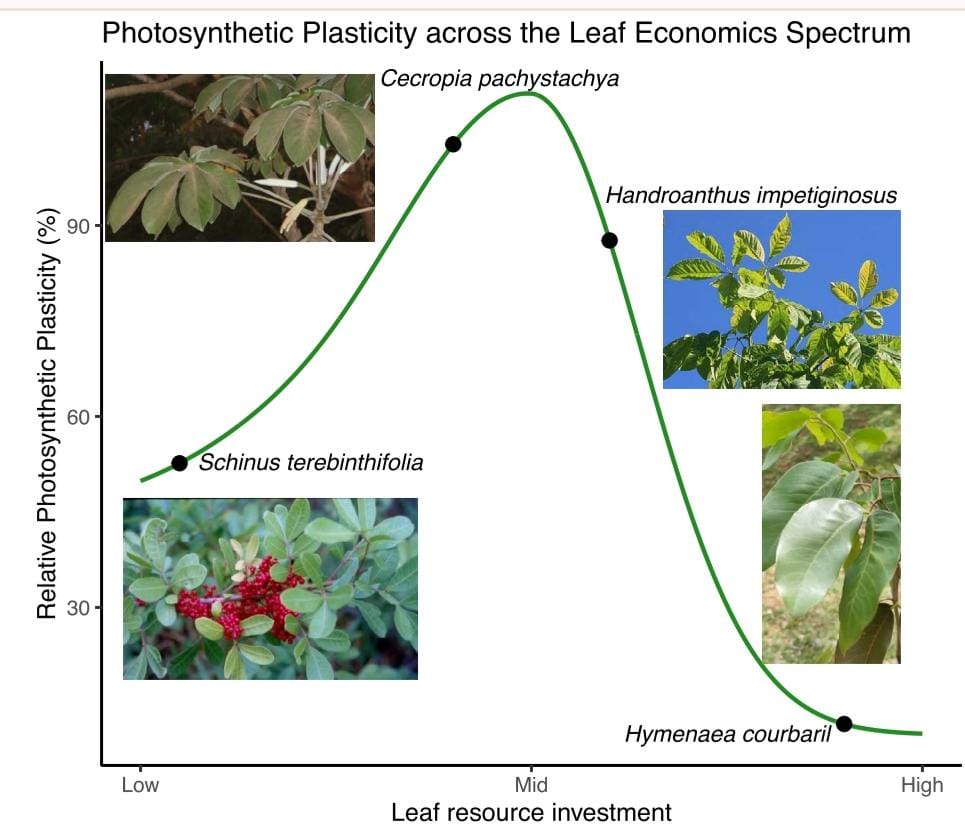
How to assess plasticity of a species across environmental conditions when you've measured tons of variables? We introduced a simple method that led to a provocative ecophysiological hypothesis about photosynthetic plasticity & leaf resource investment: https://t.co/yy6KKN4AKF
We speculated how plasticity varies with ecological strategy: it peaks at intermediate resource investment, being lower in low-investment (R-like) and lowest at high-investment (K-like) species. Even if not universally true, we must evaluate plasticity systematically!
Academics, do not use @Dropbox! They are threatening to delete a career worth of data because I have failed to pay for the plus plan for the last couple of years. It is like paying for a password protection service that will publicize your passwords if you don't pay them enough.