We'll be spending a lot more time trying to understand the outputs of language models. A few thoughts, tips & tricks:
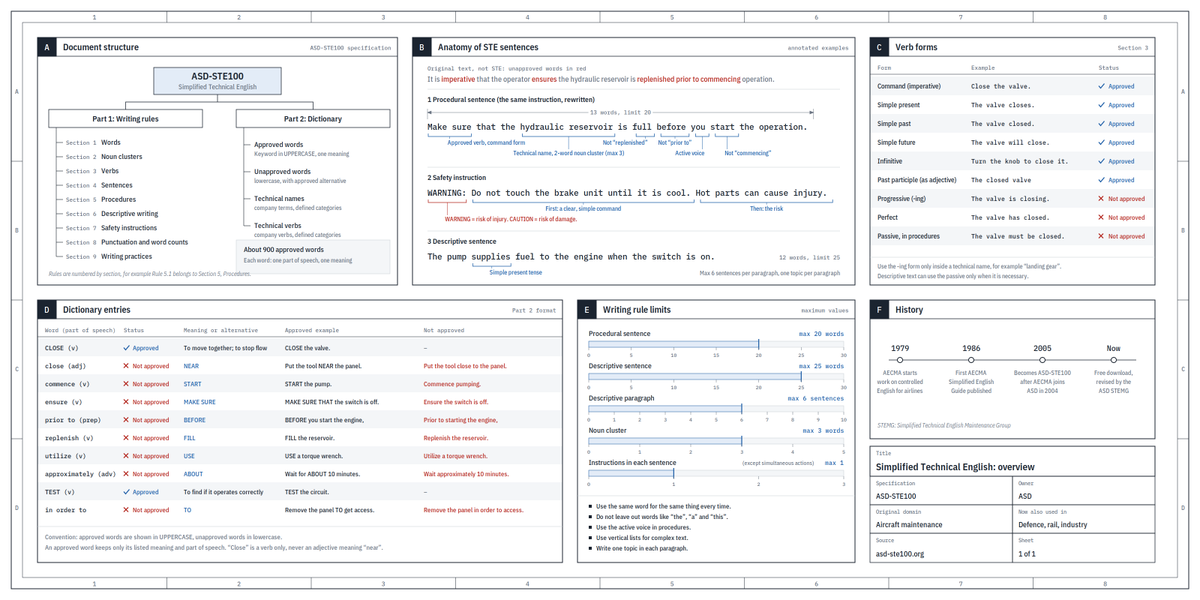
Writing. Something I've had success with: Ask your LLM to explain something in ASD-STE100, it's a controlled language specification originally developed for aerospace maintenance documentation. LLMs well-versed in this language and it comes with heavy constraints on clean writing style that I often find a lot more readable. Sometimes I've tried to soften it a bit e.g. ask for "80% of the way to ASD-STE100" because the spec is quite stringent. But even better:
Diagrams / images. Instead of writing, ask your LLM to create a diagram. These can be a lot easier to process, parse, and understand. But even better:
Web pages. Ask for output "in HTML" to get a beautiful, interactive webpage. LLMs are getting really good at frontend and can create beautiful experiences, animations, etc. But even better:
Explainer videos. The output format I am most bullish on is fully custom / bespoke explainer videos generated on any arbitrary topic. Experiment with things like "Create a 3b1b style video explainer on X. Use my ElevenLabs API key for audio narration". (you'd need an API key for the latter or you can ask your LLM to find you decent free alternatives that use your local compute). This is actually starting to work!
In summary:
- As LLMs get better, they will do more and more of the legwork autonomously, and a lot more of our work will rise up the abstractions into oversight and understanding.
- Luckily, LLMs can help here too because as intelligence and code are increasingly abundant, you can ask for large, custom, discardable software artifacts (e.g. web apps, video explainers) that would have never made sense to create before. Push the boundaries here and you'll be surprised.
🚨 Anthropic just showed a 25-minute workshop on how to actually use Claude properly
Taught by the people who built it
Free. No registration. No paywall
I've seen $300 courses that don't cover what they teach in the first 8 minutes
Watch it and bookmark it now
Einops simplifies and clarifies array/tensor manipulation. 👍
You really have to try it out, you'll love it: https://t.co/XzbSunPj4S
Plus it supports NumPy, TensorFlow, PyTorch, and more.
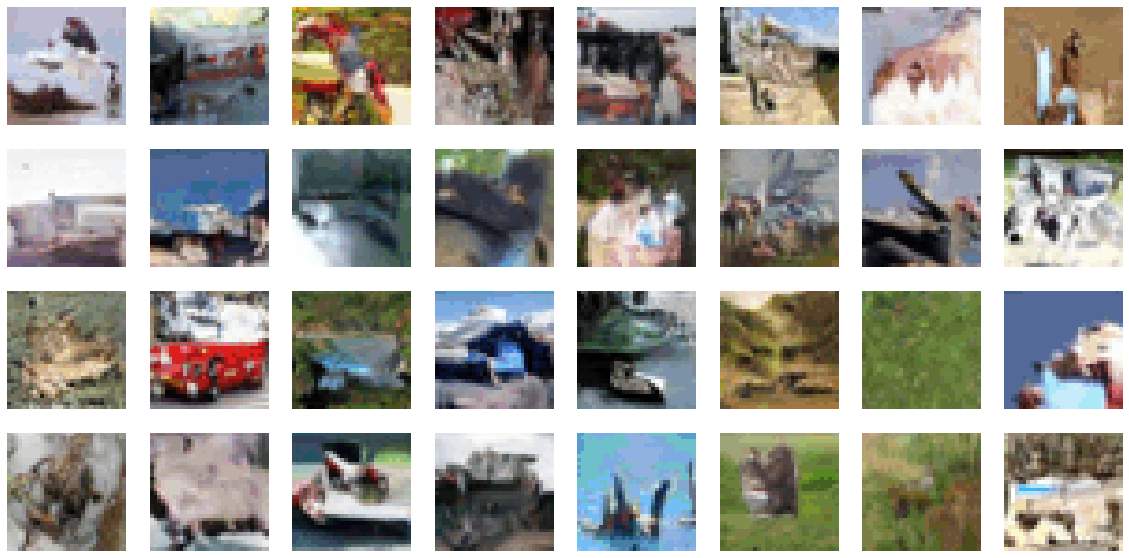
Added a new demo to minGPT that trains a GPT on pixels of CIFAR-10 images instead of text. Quite powerful that one can run the same training code/model on both domains. Notebook: https://t.co/nAt9VWXnrG . Produced reasonable samples after ~only 30 minutes on an 8-GPU V100 node:
I wrote a minimal/educational GPT training library in PyTorch, am calling it minGPT as it is only around ~300 lines of code: https://t.co/79S9lShJRN +demos for addition and character-level language model. (quick weekend project, may contain sharp edges)
An in depth @FastCompany article with @schrep and @ylecun about @facebookai’s progress using self supervised learning to identify hate speech https://t.co/e0Cfoa2DJl
Gated Linear Networks (GLNs) are backpropagation-free neural nets designed for efficient online learning via local convex optimisation. We show their performance, interpretability & robustness to catastrophic forgetting on classification tasks - read here: https://t.co/8NTNDkXZDT
Super happy to receive my author copy of 2nd ed of my High Performance Python, blog post with details will follow. Now available online/print. Please RT :-) Inc Pandas, GPUs, more profiling, async and more
Batch normalization is a technique that normalizes layer outputs to accelerate neural network training. But new research shows it has other important effects too. Its trainable parameters alone can account for much of a network's accuracy: https://t.co/ufE5vpbf9z
I wrote a Matplotlib tutorial notebook:
https://t.co/v9H3peLDmh
You'll learn how to make beautiful plots and animations, including, most importantly, XKCD-style plots:
iResNet: Improved Residual Networks for Image and Video Recognition in #PyTorch
- improving ResNet performance w/o increasing parameters & computation
- more effective in training very deep models: >400 layers (on ImageNet) & >3000 layers (on CIFAR-10/100)
https://t.co/mFqHKFUGcZ
Captum is a library for model interpretability. Its algorithms include integrated gradients, conductance, SmoothGrad and VarGrad, and DeepLift. Learn more: https://t.co/IVdye9smGi
New post: Augmented Reality 😎
- What hardware and algorithms do we use to precisely track position
- How do we do light estimation and object occlusion
- What are the biggest challenges and where it all goes
- ARKit vs ARCore holywar is also there
https://t.co/zsd5Ljqp1R
This is awesome! To be as explicit as possible: working through the examples and problems in this text is probably a strict superset of the training received in the grad-level intro to classical ML sequence at any top-caliber university.