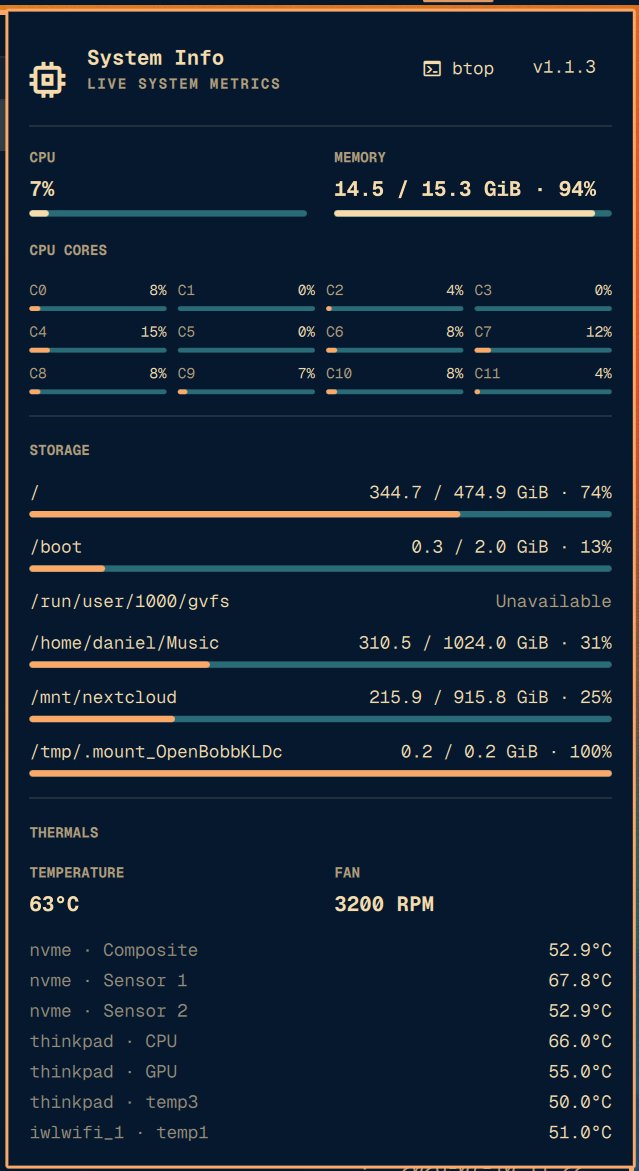
Storage queries that ignore SIGTERM were blocking refreshes in my Omarchy system-info widget.1.1.2 kills those queries. 1.1.3 goes further: the whole collector gets five seconds, then SIGKILL, stale metrics are cleared, and the next poll retries.
https://t.co/DLUUBIk4Z4
Shipped v1.1.4 of my Omarchy system-info widget this morning. The fan speed reader used to look only at ThinkPad hwmon sensors, so it came back empty on most machines. Now it reads Apple SMC fan inputs first, then falls back to any hwmon fan sensor. A zero RPM is still treated as a real reading, so a spinning fan at rest is not mistaken for a missing sensor.
In my software factory two workers can race for the same task and only one wins. Claiming is a single SQLite IMMEDIATE transaction: it reaps expired leases back to ready, then picks a task whose dependencies are all merged. If the worker dies mid-task, the lease lapses and the task goes back in the queue. No lockfile, no human babysitting the queue.
I said agents are great at the first version and bad at knowing when to stop.
In my software factory, stopping is not the agent's call. A task closes when its gates pass on the exact commit SHA, the outcome lands in an append-only log, and a human clicks approve. No auto-merge, no publish without that click.
Knowing when to stop became a state machine, not a feeling.
@thdxr Maybe. Or maybe it just shows who had time to adapt that week. I've seen solid plugin work go quiet after an update because the author was busy, not because they were riding a wave. The reset is real, the verdict it hands out is noisier than it looks.
@NotJustShaking The fear of not restarting is the real cost, not the day off. What helps me is leaving the next task half done on purpose, so sitting back down is a continuation instead of a cold start.
@levelsio The signal problem is real. Half the replies on any build-in-public post now are "great work, check out my tool." The ones that stick are the ones with a number or a scar from actually shipping it.
@dhh@xdanger Local CDNs in the installer is the part I'd watch. Plugins that pull assets from the network at runtime are the ones that break for people on restricted connections. Good to see this handled at the installer level.
I made the release build reproducible before making it public. One script builds the binary, writes SHA-256 checksums and a source manifest, and I verified the x86_64 artifact by starting it with --help and checking the hash. AArch64 stays out until the target toolchain is installed. The part I kept manual: no push, no GitHub, no VPS until I approve it. A release you can verify is worth more than one you can just download.
I shipped a second Omarchy plugin: one local plain-text note, no account, no sync, nothing leaving your machine. The interesting part wasn't the editor, it was saving: atomic replace, conflict files when an external editor changes the note, and keeping your text in memory on error so a failed write never eats what you typed. Not in the store yet, repo link in the first comment.
@pip3dev The failure modes you don't think to simulate are the ones that ship. I started writing timeouts as a policy in one place and a gate that verifies the exact state before retrying. The test that matters is the one where the write is half-done and something else touches the file.
The model picking the view is the fun part. The part that will bite you is the save path: atomic replace so a crash never truncates the note, and conflict copies when something else writes it. I hit exactly that shipping a local note plugin. Once the notes live only on disk, the file format is the product.
The scorer is the easy half. The hard part is knowing when to stop: a style profile that keeps refining itself never converges, so I'd cap it with a fixed rubric and a final human read. Same reason I put SHA checks and an approval gate in my own build pipeline instead of trusting the agent to self-grade.
I spent more time on the save path than the editor. Atomic replace, conflict files when another editor touches the note, text kept in memory on failure. Most of the work in local-first tools is deciding what happens when two things write at once
I shipped a second Omarchy plugin: one local plain-text note, no account, no sync, nothing leaving your machine. The interesting part wasn't the editor, it was saving: atomic replace, conflict files when an external editor changes the note, and keeping your text in memory on error so a failed write never eats what you typed. Not in the store yet, repo link in the first comment.
I'm building a software factory from scratch in Rust (yeah, another one).
One task is one independently verifiable unit: tasks form a DAG with dependencies, workers claim them with leases and heartbeats, and a daemon runs lint, tests and policy against an exact SHA before anything is ready to ship.
A human still has to approve the PR. The part I keep getting right is separation: the mechanism enforces the rules, the policy lives in JSON per repo, and the daemon can never publish on its own.
I shipped a second Omarchy plugin: one local plain-text note, no account, no sync, nothing leaving your machine. The interesting part wasn't the editor, it was saving: atomic replace, conflict files when an external editor changes the note, and keeping your text in memory on error so a failed write never eats what you typed. Not in the store yet, repo link in the first comment.
@0xSero Sonnet-level on a laptop is wild. The part people skip is packaging: a model that runs today is useless if the setup only lives in your shell history. That's why I ship plugins instead of one-off prompts.