Applied AI and automation in regulated environments. Python, LLMs, MCP, Tableau, Qlik and Snowflake. Building practical systems that improve real work.
I used Astra 6 with Blender to build a 3D discovery office.
Here’s the result, a practical workflow and the prompts you can adapt for your own project.
What would you turn into a 3D experience? https://t.co/YrVnsacLHc
Builders: what’s the first task you’d trust a small decision model with?
1. Classifying requests
2. Ranking retrieved passages
3. Choosing tools
4. Checking an answer
I’d start with request routing, sending uncertain cases to a stronger model. What would you test first?
Before adding a model router, I’d benchmark:
• Same tasks and quality bar
• Total cost, including retries
• Median and p95 latency
• Routing mistakes
• How often the bigger model takes over
A cheaper call is only useful if the finished task still works.
@LangChain The fixed-trace setup is useful for isolating repeatability. For a follow-up, I’d test fresh borderline cases with two human reviewers and report where they disagree. Does Jev’s confidence help identify those cases for review?
@instantricecook@typesafeai Opening the app while I’m still speaking sounds useful. How do you handle “open Notes… actually, Reminders”? I’d let reversible steps start early, then wait for the full command before sending or deleting anything.
@Saboo_Shubham_@typesafeai This would be handy for finding the exception buried in a long policy page. How does it handle “nothing on this page answers the question”? I’d want a clear no-match state, plus the surrounding paragraph so I can check the context.
I looked into pairing Jev with GPT-6 Astra: let Jev handle narrow decisions, then give Astra the evidence for deeper work.
The catch: fewer Astra tokens ≠ lower total cost. Count routing, retries and errors too.
My practical guide:
https://t.co/knnhtG4mPS
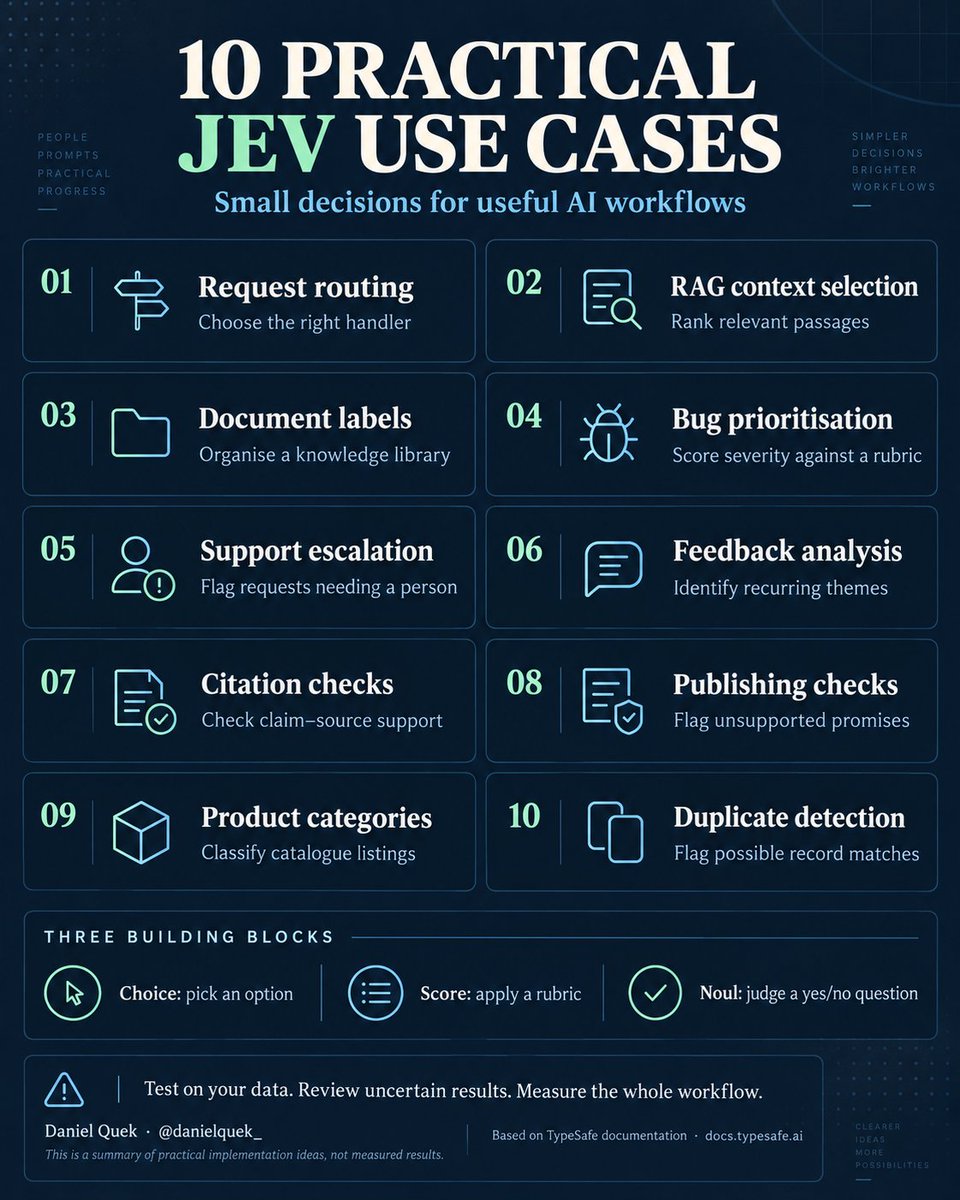
10 practical ways to use Jev, in one infographic.
From routing requests to checking citations—the useful starting point is a small decision you can test.
Examples and implementation notes in the full article:
https://t.co/buCF6TpXeW
Where would Jev actually fit in an AI workflow? I wrote up 10 practical use cases, from request routing and RAG to citation checks and duplicate records. Each comes with an example and a boundary worth testing. https://t.co/YJCybWy1uC
Where would Jev actually fit in an AI workflow? I wrote up 10 practical use cases, from request routing and RAG to citation checks and duplicate records. Each comes with an example and a boundary worth testing. https://t.co/YJCybWy1uC
@trycua The plan/execution boundary is the interesting part here. How does it handle a field that only appears after an earlier selection? I’d want to test dynamic forms and validation errors alongside the single-pass examples.