Low key very inspired consistently by DARPA. Self driving cars, autonomous robots, and more were all proven out early (as in decades early) at DARPA.
Synthetic blood is next.
Blood refrigeration limits trauma care. We’re changing that. 🩸
Building on FSHARP, DARPA’s RAPIID program is scaling synthetic blood for FDA approval.
The goal: A safe, shelf-stable blood analog in every medic's pack, ready to save lives & bypass shortages.
Introducing https://t.co/ycxJEf1z7w!
A new space where I explore how the best apps in the world are built.
First piece:
How's Linear is so fast? a technical breakdown.
https://t.co/9Vu1syrn1i
Really great interview.
My favorite parts:
- Defining how you build a company into things that are Science, Art, or Religion
- Why there’s a never ending wave of disruptive companies in many categories: because there’s an endless Overton Window of evolving buyer preferences. Catch that window too early and ride it until it’s mainstream.
Nice to when you hear someone that genuinely makes you want to be a part of their early team.
For this episode of Uncapped I got to sit down with my close friend @Max, cofounder of Instacart 🥕
We talked about the key moments of Instacart...how it got started, critical wins, tough losses, competitive dynamics, earned insights, going public, and Instacart's future.
Max is also an awesome startup investor, and we talked about what he looks for in founders, consumer investing, and what he's building with Workshop.
He's one of the best people I know, hope you enjoy.
(0:00) Intro
(0:36) The inception of Instacart
(4:55) Finding product market fit
(7:20) Landing Trader Joe’s
(11:04) Big levers for growth
(13:36) Operationally complex businesses
(14:55) Amazon’s acquisition of Whole Foods
(17:50) COVID and Instacart’s IPO
(20:02) Prioritizing profitability
(23:21) Avoiding temptations
(24:59) The future of Instacart
(25:53) Investing in consumer
(28:21) Irrationally optimistic founders
(29:49) B2B vs consumer founders
(30:35) How to work with investors
(33:38) Building Workshop
“Space launch was a clear case where there was a large difference in efficiency between what was possible and what was done in practice…”
Great way to define verticals and niche with massive upside. Very well said.
Space launch was a clear case where there was a large difference in efficiency between what was possible and what was done in practice before SpaceX. A large part of that was due to everything being locked in to what (just barely) already worked, with huge risk aversion. WIth national prestige or a half billion dollar geosync satellite on the line, speculative engineering ideas that might result in a public debacle were not welcome.
When failure is not an option, success can stay very expensive. You need to experiment to improve, and that fundamentally means being comfortable with failure. If you know it is going to work, it isn’t an experiment.
I have long believed that nuclear power today is in precisely the same state as space launch two decades ago, but the even more pressing question now is if semiconductor fabrication might also be.
On the one hand, Moore’s Law has been a sequence of heroic miracles of technology at the wafer fabrication level, grinding out hundreds of compounding small improvements.
On the other hand, fabs are “too big to fail”, and there are elements of extreme conservatism at play. Intel’s “Copy exactly!” fab development exemplifies that mindset – instead of every new building being an opportunity to explore and optimize processes, it was deemed more valuable to just replicate.
While each individual machine may be straining against physical limits of technology, it is possible that the systems orchestrating them all together could be far from optimal.
The explore / exploit axis is fundamental to all decision making, but human risk avoidance probably biases away from optimal exploration.
I am the Chairman and CEO of Vornado Realty Trust. Eighty-four years old. Seven buildings in Midtown Manhattan. I said what I said.
I said "tax the rich" is the equivalent of a racial slur. I said it at REBNY. Into the microphone. Eight hundred people. Median net worth in that room was north of $240 million, I know because our CFO ran the guest list through a Bloomberg terminal as a joke, and then it wasn't a joke. And when I said it, twelve people applauded. The rest nodded. One woman in the third row mouthed, "Finally." I saw her.
Sharon, my communications advisor, Columbia, $430,000 a year, very bright, Sharon wants me to walk it back. She drafted something. "Mr. Roth's comments were intended to highlight the emotional impact of political rhetoric on business communities." I read it. I put it in the trash can on my desk. Not the recycling. The trash. Here's my clarification: I understated it.
"Tax the rich" is worse than a slur. A slur is just a word. It doesn't come with a CBO score. Nobody is introducing a bill called the Racial Slur Implementation Act of 2026. But there are seventeen active proposals in Congress, I had Sharon count them, seventeen proposals designed to take more of my money. My money. Mine. Money I acquired by being better at acquiring Manhattan commercial real estate than anyone alive for four consecutive decades. That is not a crime. That is a record.
I pay property taxes on $18.2 billion in assessed assets. $412 million a year. Say it again: four hundred and twelve million. I carry that number. It's the first thing I think about when I see a protest sign. I think: I pay more in property tax than the entire annual budget of the city of Fort Lauderdale. I looked this up. Fort Lauderdale: $408 million. Steve Roth: $412 million. I am a small city. And the city doesn't get screamed at.
My effective tax rate last year was 11.4 percent. I say this because I believe in transparency and because I'm not ashamed of it. The rate reflects the legal structure of real estate investment trusts, depreciation schedules Congress established in 1986, and carried interest provisions that both parties have voted to preserve for forty years. I did not write these laws. I organized my entire financial existence around them with the help of nine full-time tax professionals who have offices on the 38th floor of 888 Seventh Avenue, which I also own. Their office is in my building. Their work protects my buildings. This is not a loophole. Sharon calls it a loophole. I've told her: a structure maintained by nine attorneys across four decades is not a loophole. A loophole is something you slip through once. This is architecture. This is the foundation. This is the building.
Last Tuesday, same as every Tuesday, I walked past 1290 Sixth Avenue. My building. And there was a man. Same man as last week. Same sign: "Billionaires Pay Your Fair Share." He was standing on my sidewalk. My literal sidewalk — my company owns the ground lease. He was maybe thirty. He was wearing a jacket I would estimate cost $60. My lunch that day was $114. For one. I am telling you this not to boast but because these are facts. He has decided I'm his enemy. Based on a number he saw on a Forbes list. He doesn't know what I pay. He doesn't know what my buildings cost this city in construction jobs and lease revenue and foot traffic. He knows one number. He has made one judgment.
I see him every Tuesday. I've started to notice things. He brings coffee from the cart, not the Starbucks. He has a backpack that looks heavy. He doesn't look unhealthy. He looks like he probably works somewhere, but not on Tuesdays. I've wondered: does he have a job? Does he have a building? Does he have anything that depends on him the way 4,200 employees depend on me? I suspect not. And yet he has opinions about my tax rate.
I gave $22 million to charity last year. The Met. NYU Langone. Mount Sinai. I gave a building to NYU. Not money for a building — a building. The Steven Roth Residence Hall. It houses 400 students. That man with the sign has never housed 400 students. He hasn't housed one. He gives cardboard. I give structures. This is not a comparison I'm making to flatter myself. It's just arithmetic.
When I said what I said at REBNY, I was saying what every person in that room believes and none of them will say publicly because they have communications advisors and the communications advisors all went to Columbia and they all say "unhelpful." I'm eighty-four. I'm too old for helpful. I'm too old to perform restraint for people who hate me for something I can't change.
I didn't choose to be rich. I chose to be good at one thing for a very long time, and this is what happened. You don't punish someone for that. You don't legislate against someone for that.
My net worth fluctuates between $3.8 and $4.1 billion depending on the quarter. I fluctuate more in a fiscal week than that man on my sidewalk will earn in his life. Both of these are facts. Only one of them is considered polite to say.
They want me to apologize.
I'll be dead in ten years. Twenty if I'm lucky. And they'll still be renting my buildings.
Eli Goldratt's book, The Goal, was famous for its (then unpopular argument) that keeping every machine running 24 hours a day, the metric most plant managers cared about, was actively making factories worse. I suspect we're seeing the same fallacy in how many people are using AI agents.
Goldratt's point was that machine utilization isn't throughput. What you want from a manufacturing plants is making good widgets as cost-effectively as possible.
It doesn't necessarily follow that running your machines all the times optimizes that.
Picture a three-station assembly line. Stations 1 and 2 each crank out 200 widgets an hour. Station 3 can only handle 100. Running stations 1 and 2 around the clock doesn't ship more product. It just piles up half-finished widgets in front of station 3, ties up cash in inventory, and creates more work managing the pile.
He developed the Theory of Constraints to point out that what matters is solving the bottleneck in the system, not increasing machine utilization.
I suspect a lot of agent usage right now is the same fallacy at higher resolution. Running 20 Claude Code sessions in parallel can feel productive because something is always happening. But, if the bottleneck in your work is judgment about what's worth doing, more agents just generate more output for you to wade through.
This is not to say there aren't workflows running 20 agents in parallel very effectively, I'm sure there are. And, I suspect there's a general retraining we all need to do around evolving historical workflows. But....
The constraint for most knowledge work is deciding what's worth executing and no one is task switching between 20 things at the same time effectively I don't think. I find I can run maybe 2 or 3 things in parallel with maybe 1 or 2 admin-y type things on the side and that is only if I'm very locked in.
Rippling crossing a billion in ARR and growing 78% year on year is the best argument against the SaaS is dead meme I've seen. When people say they hate the model what they really mean is they hate the lack of growth.
Rippling is growing because payroll is a market where the entire vibe coding discussion is complete rubbish. You have legal and statutory obligations that carry criminal penalties if you get it wrong. You're not interested in vibe coding your payroll. You want to outsource this to someone wildly competent, have them take the responsibility, and you do not want non-deterministic processes anywhere near it.
AI might change how the software gets built, but the core reason people pay for it doesn't change. It just has to be done right.
Three years since the first flight of Starship, the next generation is here. New ship. New booster. New engines. New pad and new test site. SpaceX engineers are working to solve one of the most difficult engineering challenges in history: developing a fully, rapidly reusable rocket
Recent hack:
When the agent specifically calls out items as "Not In Scope" in their plan, I immediately copy those items (if I agree with them as roadmap items) and paste them into the input field.
I then send those items to be executed next when the agent finishes the last plan.
Took me way too long to start doing that, sadly.
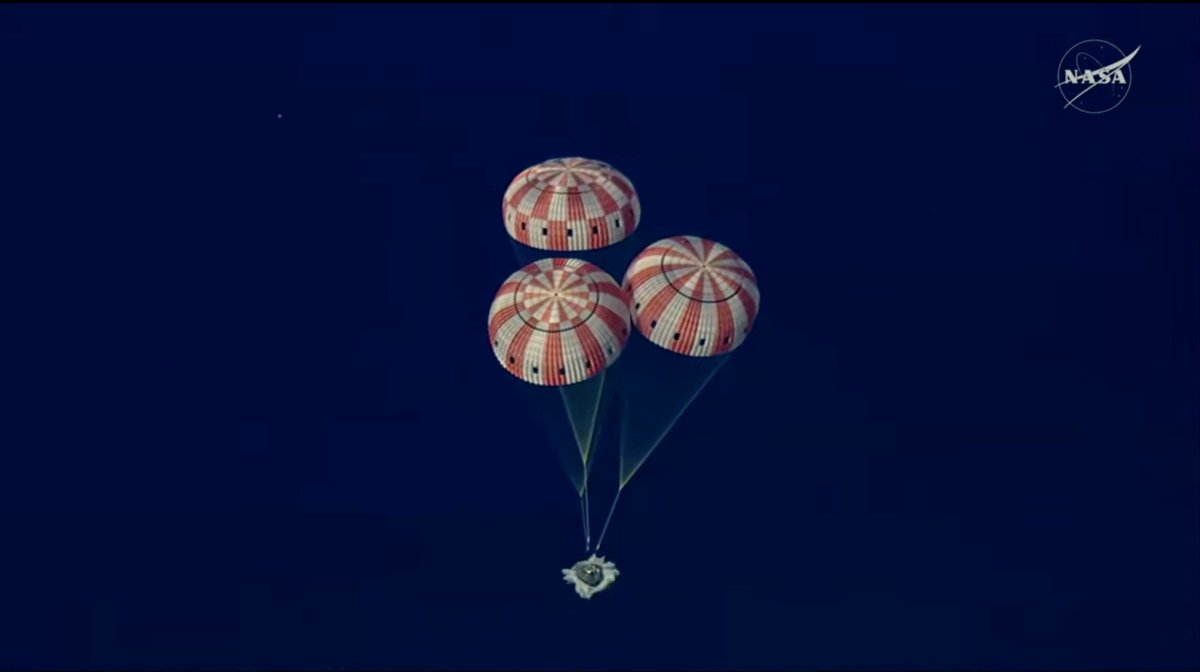
And splashdown!
America is back in the business of sending astronauts to the Moon and bringing them home safely.
Reid, Victor, Christina, and Jeremy did an outstanding job. These talented astronauts inspired the world and represented their space agencies and nations as humanity’s ambassadors to the stars.
This was a test mission, the first crewed flight of SLS and Orion, pushing farther into the unforgiving environment of space than ever before, and it carried real risk. They accepted that risk for all we stood to learn and for the exciting missions that follow, as we return to the lunar surface, build a Moon base, and prepare for what comes next.
And they were not alone. The entire NASA workforce, our commercial and international partners, and the hopes and dreams of people all over the world were with them. The astronauts know it, and you should too. This mission would not have been possible without you.
Congratulations. Artemis II, mission accomplished.
Thrilled to be an investor in Noon through our fund https://t.co/rnTFqJXHsM. This is exactly the type of tool I’ve wanted. Join the waitlist at https://t.co/dIW8feyNGv.
Introducing Noon: The first dual-canvas where you design how a product looks and how it works. It’s a new day for product design. Sign up for early access: https://t.co/9IeRBQ6hD8
I’m thrilled to announce we’ve raised $44M to build a new home for product design. Meet @noondesign.
No workflow is more broken and fragmented in 2026 than the product designers’. The very same people who care most about building software don’t have software purpose built for them. @kushagrasinha7 and I have lived this problem first hand as designers ourselves.
That’s why we built Noon. The first product design tool that works entirely on your product code, so you can design not only how a product looks, but also how it works. With AI at its core that works in seconds, not minutes.
For the first time, you can create, iterate, build, test and ship. All in one canvas. No translations or roundtrips to the codebase and back.
Comment “Get Noon” and we’ll get you on the list for early access.