Look closely. Between these two moments, our species has performed miracles. We have mapped the blueprint of life within our own DNA. We have built “brains” of silicon that can outthink their creators. We have pushed back the darkness of disease. Infant mortality has plummeted, and millions of children who would have been lost to the earth in 1972 are today alive, dreaming, and contributing to the global chorus. We have sent robotic emissaries to the edge of the interstellar dark and peered back at the beginning of time itself through mirrors of gold.
Technologically, we are a different species. We are more connected, more informed, and more capable than any ancestor could have imagined in their wildest fever dreams.
And yet, look again.
From this distance, the borders remain invisible. You cannot see the “holy” ground over which we spill the blood of our children. You cannot see the walls we build to keep our neighbors out or the ideological trenches we dig to bury our common humanity. Despite our leap from vacuum tubes to artificial intelligence, we remain haunted by the same ancient tribalisms. We use 21st century technology to prosecute Bronze Age grudges.
We have changed the climate of our world, but we have yet to change the climate of our hearts. We are still a toddler civilization, playing with matches in a library of irreplaceable wonders.
The contrast is our great paradox. We have the power of gods, but we still possess the temperaments of the territorial primates from which we rose. We have learned to fly between worlds, but we are still struggling to learn how to walk together on this one.
I spent 100 hours over the past week researching, writing and editing the piece we just put out.
It’s a scenario, not a prediction like most of our work. But it was rigorously constructed, dismissing it outright requires the kind of intellectual laziness that tends to get expensive.
And we’ve released it for free. Hopefully you enjoy it.
https://t.co/YK8E11GcDU
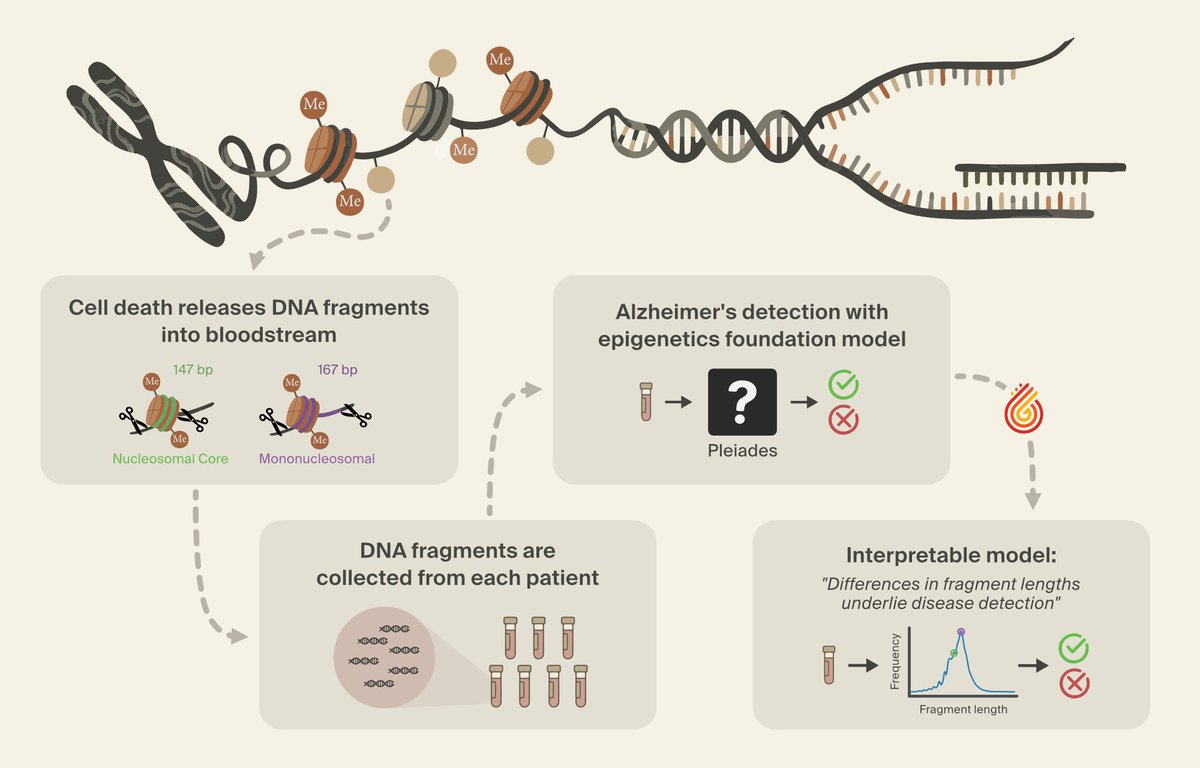
We've identified a novel class of biomarkers for Alzheimer's detection - using interpretability - with @PrimaMente.
How we did it, and how interpretability can power scientific discovery in the age of digital biology: (1/6)
@flowisgreat @levelsio@WHOOP@willahmed +1 on the API, I use another app (Strong) for powerlifting and i wanted to code something to push those workouts inside Whoop to get accurate tracking
The purest reason to make something is not to make money and not even to make the thing.
It’s to have the experience of making the thing - and no one can take that from you.
Most people will never get it. They’ll say you’re doing too much. You need to slow down. That you’ve become “too intense.” But that’s because they’ve never wanted something bad enough to bleed for it. They’ve never paid a price that emptied them out to do it all again. They’ve never stood at the edge and still had the audacity to say, “Fuck it, I’ll go further.”
@0xFar3000 @oggyxe based, people grinding leetcode every day but struggle to make a trade off. who the fuck cares about DSA when most of the code is crud slop where code is trash tier and their requirement is one request every 15 minutes. DSA is useful when you have scale, which is <5% the case