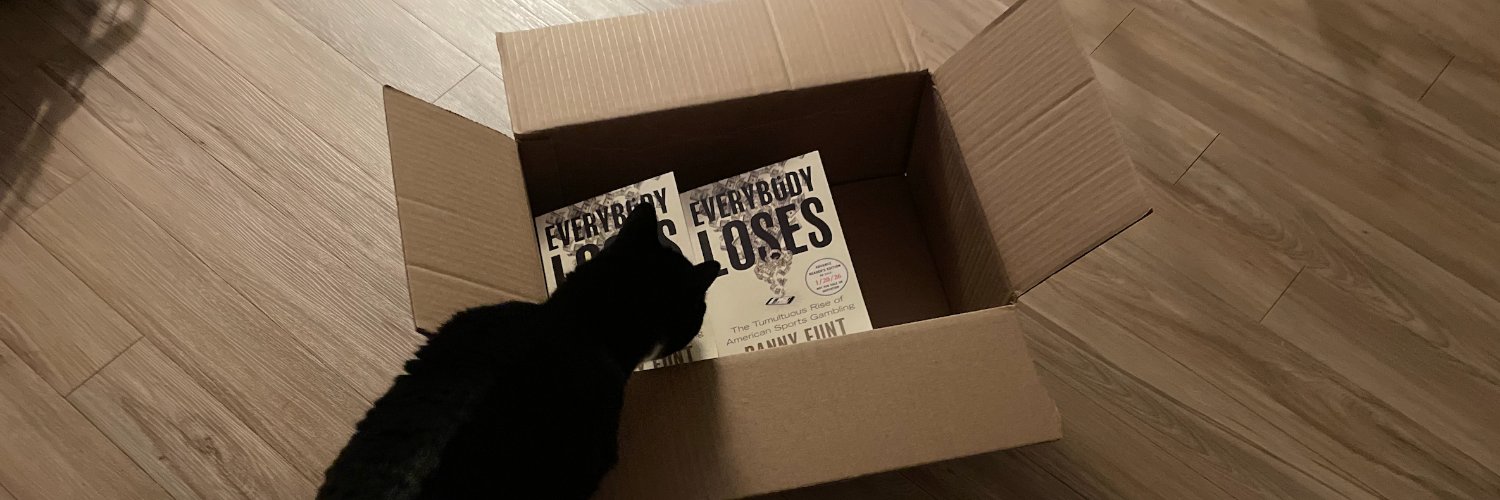
I wrote EVERYBODY LOSES (out today!) because I believe sports fans—and really all Americans—deserve answers to basic questions that the people behind the betting boom have largely avoided.
I was optimistic that I’d get to speak with sportsbook execs and league commissioners. But I was determined to shed light on how this industry really works, and how it thinks about customers, regardless.
A reporting trip to New York is illustrative of what ended up happening. One of the first people I met that week was Chris Jones, then VP of communications at FanDuel. I assumed we were meeting to plan various interviews that he’d help arrange. But over the next 45 minutes, Jones explained why FanDuel would not be participating in my book. (He asked that I not share his reasons.)
Afterward, I hustled across town to meet Nik Bonaddio, the former head of product at FanDuel. He was surprisingly reflective about his time there, conceding how “shitty” it was to offer misleading “risk-free” promotions and how he suspects that the vast majority of customers fail to understand that the house edge is considerably bigger on parlays, sportsbooks’ biggest moneymaker.
Two days later, I took the train to the commuter town of Mamaroneck, home of Nigel Eccles, FanDuel's founding CEO. He, too, spoke expansively, expressing dismay about the trajectory of the sports betting industry. “I think their advertising is untruthful,” he said of sportsbooks in the U.S., including his former company. “They’re selling that you can win, but you can’t.”
Toward the end of my trip, I met with Jessica Leeser, who had served as FanDuel’s director of brand and marketing insights. She shared revealing takeaways from internal customer surveys. For example, many of FanDuel’s customers said they were disinclined to recommend the app—not because they didn’t like the user experience, but because they were reluctant to admit they gamble. “Maybe there is some shame attached to it,” Leeser said, “or some embarrassment.”
Over the ensuing months, I spoke with many other former and active employees at FanDuel, as well as at all the other top sportsbooks. (DraftKings was similarly uncooperative. I wasn’t even granted an interview with the person appointed, to much fanfare, as the industry’s first chief responsible gaming officer.)
There are, to be sure, many people in the betting industry who insist sports gambling is perfectly safe and that customers are treated fairly. But the overall impression I gathered from interviewing more than 300 people is that sportsbooks are brazenly taking advantage of customers, and, in some cases, outright endangering them.
A cautionary note from a former sportsbook executive sums that up. “You can make good money,” he told me, “but you don’t feel good about it, that’s for sure.”
Americans have been cheated out of the sort of robust national debate that legalizing sports betting across the country would seem to warrant. I hope "EVERYBODY LOSES: The Tumultuous Rise of American Sports Gambling" forces people to engage in that conversation, including those who would prefer this book come and go quietly.
I could use your help. Anything you can do to spread the word is hugely appreciated. The link to the book is below 👇
"Everybody Loses has perhaps done more than any other account to disabuse fans of the industry’s tenuous narrative. Funt’s book illuminates the sports betting industry’s meteoric rise with fleet and command."
Thank you, @arvinalaigh of @nplusonemag for the generous review! 👇
This exchange between @tomhaberstroh and @dannyfunt on @bballilluminati explains a key factor which wasn’t discussed by many before sports gambling legalization and what needs to be considered going forward. Source in link below⬇️
DeMaurice Smith, the former 14-year executive director of the NFL players association, has said the league's growth is unstoppable--save for two things.
1) Gambling fraud causing fans to distrust what they're watching.
2) The ability to detect CTE in active players.
So, news of a potential CTE test in the living (vs. in autopsies) is a bombshell.
SO MUCH to unpack about Jontay Porter with @tomhaberstroh@CornPuzzle@DarthAmin
--Did FanDuel ever alert the NBA that a player was one of their biggest customers and an obvious gambling addict?
--Why did the NBA frame the fixing scandal as a simple issue of a low-paid player tempted to bet?
--Can anyone (Adam Silver, etc.) still argue that legal gambling strengthens the integrity of sports?
--Why didn't FanDuel answer @NickBerardini's questions?
--Is there any reason to believe the league is positioned to thwart the next Jontay?
🪬New @bballilluminati🪬
📲 Casino In Your Pocket
🎰 @dannyfunt helps us unfurl the New Yorker's devastating portrait of Jontay Porter's gambling addiction.
🤖 @tomhaberstroh@DarthAmin & @CornPuzzle wonder who's behind Beatline Sports AI podcast network
https://t.co/lfPAq7ha0k
If Jeopardy legend and pro sports bettor @James_Holzhauer learned a lot from reading "EVERYBODY LOSES: The Tumultuous Rise of American Sports Gambling" (link in bio), I have a good feeling you can, too.
Thank you, James, for reading it and letting me share your feedback.
@statnews was midway through publishing a tour de force about UnitedHealth Group, the country's largest health insurer, when the CEO of UnitedHealthcare was murdered.
@rickberke, STAT's executive editor, told me how they responded to that awful development, and how they'd managed to uncover shocking business tactics at a company known for being impenetrable.
Rick and his colleagues also explained their convictions for holding the powerful accountable, how they publish some of the splashiest healthcare stories around, and—just as remarkable—how they've managed to turn a profit.
Check it out in a new podcast from @commonshlthcare. See link below 👇
"You're worse than Hitler."
I had the honor this week of being invited to speak to Vanderbilt football and basketball players. When asked if anyone had been harassed by angry bettors, at least half the hands went up.
One player said he'd received that insane message after losing a game.
It's a plague in college sports. The purported fix is banning people from betting who are caught harassing athletes.
But I'm really skeptical of how that can be enforced. It's unreasonable, or at least unrealistic, to expect athletes to report everyone sending them hate mail and threats.
Braun's preface is so revealing:
"I might get myself in trouble with this one."
WHY? Stop and think: A college coach feels risky saying A) he's not paying attention to betting odds, and B) young people should be careful with gambling.
But he's not wrong to walk on egg shells, or at least not alone. For my book, then for the season of a @CBC podcast I hosted (out now!), it was striking how people in sports are so nervous about saying anything that might challenge the business of gambling.
When I tried to interview a university athletic director—who declined—word got back to me that he felt too nervous about upsetting the wrong person to answer questions about gambling policy and how it affects students.
This culture of intimidated silence is a real problem.
Northwestern University head football coach David Braun is the most recent prominent sports figure to spotlight the failure of legalizing commercialized sports gambling across the country:
"I’m telling you what, I got 11-year-old and 9-year-old boys at home and I am terrified of how addictive gambling is... It’s predatory. It’s messed up what’s going on. You look at 18-25 year old young men out there right now and the predatory nature of this stuff—it’s really scary."
I absolutely loved @Wesley_Morris take that the eggs were just yet another manipulation: she was doing an intentionally bad job in order to get Billy to do it for her.
But I don’t mean to bias the poll, below. Vote!