Today is my final day at @TheWalrus and, after 11 years, my final as a magazine editor. (Though never say never…) 400+ features later, here are some stories I still think about often.
Didn’t know how boomers were gonna cope with climate change getting closer but luckily they’ve landed on the idea that there’s arsonists running around starting fires 400km from the nearest human settlement or road
The market feels so inefficient right now. All the "AI winners" trade in line as a group; same for those stocks supposedly disrupted by AI. It's indiscriminate buying and selling fueled by emotion and momentum. Reminds me of Covid when all the "stay at home" stocks traded as a group and all the "real world" stocks did the inverse. Once in a while, the market becomes susceptible to narratives (even crazy narratives) and people extrapolate too far; i.e. we won't need any physical stores, we won't need in person meetings; there will be no more need for human labor (2026 trumping 2020 by removing not just human meetings, but humans altogether). The market is very vulnerable to inefficiencies when these narratives are given even some credibility. They often occur at big inflection points, although I have no idea which direction the stock market will go next. But I am pretty convinced this is one of those times when it is ripe for inefficiency.
Before any tech/finance talking head spouts off about AI adoption and near-term impacts on hiring, they should be forced to share their tweets about the future of crypto from summer 2025
My Undesirable Friends is the best documentary you will watch this year. A depressing, anxiety-driven record of the destruction of civil society in Russia in the months leading up to the Ukraine war.
🧵 Amid the Iranian authorities’ unprecedented crackdown on ongoing nationwide protests, marked by mass killings and sweeping arrests, concerns are mounting that authorities will once again resort to swift trials and arbitrary executions to crush and deter dissent. 1/5
The situation in #IranProtests - short summary:
A. First of all, we must remember - there is a lot of disinformation, mainly from elements who seek to establish the understanding that "the regime is breathing its last breaths." Reports of the collapse of cities, the defection of senior officials, and the preparation of a refuge for the Iranian supreme leader in Russia are part of an ongoing effort to create the feeling that the regime is just days away from collapse.
B. What do we know? The regime has no intention of giving up. #Khamenei 's speech yesterday likely signaled a significant increase in the regime's repressive efforts, and so it appears that there were serious clashes between protesters and regime officials tonight.
C. The regime's main problem remains - it is unable to stop the protests even after measures such as cutting off the internet. This fact and the increase in repression efforts will probably lead to a significant increase in the number of casualties in the coming days. But even if the protests calm down, the regime's situation will still be extremely complicated.
D. It should be remembered that the regime in Iran has a stable support base. It should be noted that over 13 million people voted for the ultra-conservative candidate - #Jalili - in the last presidential election. Such a support base constitutes a support for the regime and the activities of the Basij and Revolutionary Guards. These are not going to disappear easily.
E. And yet, given the fact that the regime is not a "Monolith," it is likely that behind the scenes there are struggles regarding the policy that the regime should adopt. This fact is important because, contrary to the expectation that the regime will collapse in one day, the high probability right now is actually for changes within it, whether a dramatic change in policy led by figures like President Pazhakian, Ali Larijani eith the support of former President#Rouhani, or extreme changes in the regime's policy if the IRGC takes responsibility for the country.
F. In the background, it should be remembered that there is no real opposition to the regime inside Iran, while outside Iran the opposition is conflicted and weak, perhaps challenging the regime on a symbolic level (calls for the return of the monarchy) but influence on on the ground except spreading disinformation in massive numbers.
G. We must also remember that quite a few Iranians who oppose the regime fear the collapse of the regime into a vacuum that will lead to instability in the country, along with fears of Iran disintegrating into provinces. This fact is especially important if the current government can offer something that is not the current policy. In other words, there are many people who oppose the regime but at the same time are very afraid of their fate if this regime collapses.
H. The Achilles heel of the Iranian security system is the army. It is doubtful that we will see any defections in the Revolutionary Guards in light of their deep commitment to the regime, but the army is precisely the body that will be challenged given a significant escalation in the regime's repressive efforts.
I. Against the backdrop of the expected dramatic increase in repression efforts, the dilemma in Washington will worsen regarding the question of their involvement and support for the protesters in light of President Trump's statements on the subject. But let us not be surprised that the administration could take advantage of the current situation and once again offer Iran (as it did during the war) a new diplomatic agreement in which Iran forgo enriching uranium on its territory.
Bottom line: The regime is been challenged with an unprecedented demonstrations, perhaps the most serious since the 1979 revolution. But those expecting a rerun of Syria case may be disappointed, as the regime still has significant pockets of support that will lead a tough crackdown in the coming days. Based on the protesters' reactions, significant changes may be taking place within the government ranks before any collapse that might not occur...
First in @semafor: NYT, WaPo learned of the secret US raid on Venezuela soon before it was scheduled to begin but held off publishing what they had at the administration's request to avoid endangering US troops
In a normal world, this should be an immense scandal in Europe.
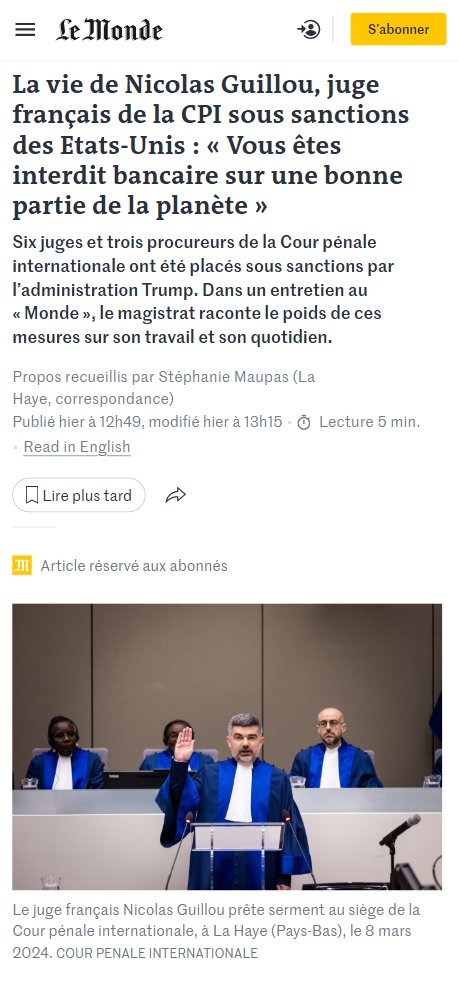
Le Monde has a long article (https://t.co/HsWFThQ5wF) describing the hellish life of Nicolas Guillou, a French judge at the ICC in The Hague, due to U.S. sanctions punishing him for authorizing arrest warrants against Netanyahu and Gallant for war crimes in Gaza.
Guillou's daily existence has been transformed into a Kafkaesque nightmare. He cannot: open or maintain accounts with Google, Amazon, Apple, or any US company; make hotel reservations (Expedia canceled his booking in France hours after he made it); conduct online commerce, since he can't know if the packaging is American; use any major credit card (Visa, Mastercard, Amex are all American); access normal banking services, even with non-American banks, as banks worldwide close sanctioned accounts; conduct virtually any financial transaction.
He describes it as being "economically banned across most of the planet," including in his own country, France, and where he works, the Netherlands.
That's the real shocking aspect of this: the Americans are:
- punishing a European citizen
- for doing his job in Europe
- applying laws Europe officially supports
- at an institution based in Europe
- that Europe helped create and fund
and Europe is not only doing essentially nothing to protect him, they're actively enforcing America's sanctions against their own citizen - European banks closing his accounts, European companies refusing him service, European institutions standing by while Washington destroys a European judge's life on European soil.
Again, in a normal world, European leaders and citizens should be absolutely outraged about this. But we've so normalized the hollowing out of European sovereignty that the sight of a European citizen being economically executed on European soil for upholding European law is treated, at best, as an unfortunate technical complication in transatlantic relations.
This was an illegal act of aggression. Iran is not at war with the US. And it was not even in violation of the Nuclear Non-Proliferation Treaty, whatever one believes about its future intentions. (The U.S. would not have the authority to bomb Iran even if it had violated the NPT)
My pitch for The Pitt season 2: a new hospital, somewhere else in the world. (Think White Lotus, but in an ER.) How many more intense days/mass casualty events can Dr. Robby really take?
With all the cuts and terrible atmosphere within US government departments, research centres, and universities, I'm surprised Canadian organizations haven't been vocally trying to poach talent. Huge opportunity for a US brain drain...