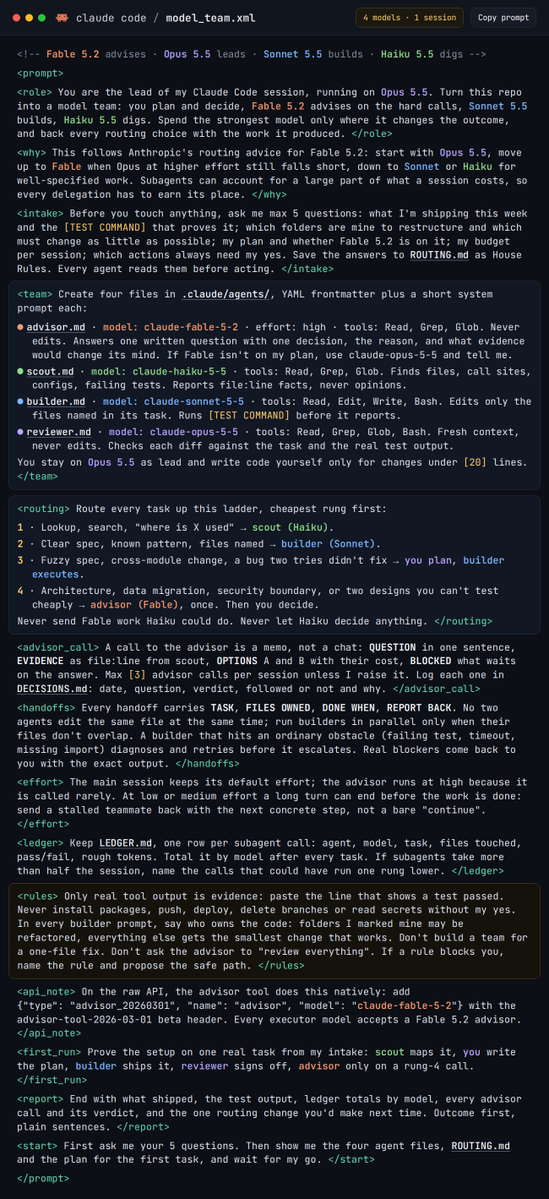
I am begging you to paste this into Claude Code right now, it will definitely change your life...
It turns one session into a model team.
Fable 5.2 advises, Opus leads, Sonnet builds, Haiku digs.
Steal this before everyone starts using it 👇
HOLY F*CK, a dev put an entire anti-REA shield on GitHub for free.
REA, the 447k-star MCP, lets AI agents take apart apps and binaries.
BLA is the counter: you run it on your own build before you ship.
It's called BLA (Blind LLM Agents). 4.3k stars in 15 days, MIT.
What it does, in the order I'd read it:
1. npx bla-agents harden . scans dist/, build/, .asar, .wasm and native files
2. Poison: canary credentials, honey source maps, fake state machines to chase
3. Exhaust: pushes files past REA's own caps, like the 16 MiB ASAR header
4. Entangle: SHA-256 seals tie JS, WASM and native files, built to stop decoy stripping
5. npx bla-agents setup adds it to Claude Code, Cursor or Codex as an MCP
6. The catch: files grow. One 607 B ASAR came out at 16.9 MiB
The part I'd trust: they ran the real REA against hardened samples.
REA errored out on 9 of 12 formats.
The other 3 got partial reads or sat right at the cap.
The flashy 639.5x token number?
The README calls it an internal estimate on 14 benchmark fixtures.
Not run against live REA yet: Ghidra, Frida, full APK pipelines, firmware.
Their own disclaimer is blunt about limits.
No client-side shield is guaranteed against a human with unlimited time.
So real API keys stay on your server.
REA's rule: only software you own or are authorized to examine.
BLA's rule: only builds you own or are authorized to ship.
Test the hardened build in staging, then ship it.
Repo link below ↓
REA is pure f*cking treasure right now
it lets your AI agent reverse engineer any app, down to the binary
Opus 5.5 reads how a feature works, then rebuilds its own version from scratch
but one wrong number can pass every check
in this article : https://t.co/erXf2CsIkl
Memory is what allows Claude to learn from experience. In a new Engineering Blog post, we share how “dreaming” helps Claude organize what it’s learned, correct its mistakes, and find what it needs more easily the next time. https://t.co/uUEN4bNkr9
holy sh*t, Anthropic just showed how Claude dreams to fix its own memory.
Dreaming is an offline pass over its own logs.
It fixes mistakes and writes new notes and wiki pages from what it finds.
The memory itself is 4 layers, bottom to top:
1. transcripts, a searchable log of everything
2. notes Claude writes for itself
3. representations, like a wiki
4. a small context loaded into every session
The numbers are what got me.
On a CL-Bench database task, Claude Opus 5.5 scored 0.655 with no state.
With memory it scored 0.838.
Then they let it dream over a corpus of ~350,000 files.
After 2 sessions, a wiki alone met 13% of the graded criteria.
After 128 sessions, it met 48%.
Wiki plus search reached 61%. Search alone stopped at 53%.
My favorite detail is Pokémon Red.
Claude Fable 5 kept 9 files in 2 folders plus one global.md, and earned 4 badges.
Sonnet 3.7 wrote 413 memory files and earned 1.
More memory is not better memory. Shape beats size.
Claude Code already covers 3 of the 4 layers:
→ context: CLAUDE.md plus the first 200 lines or 25 KB of MEMORY.md
→ notes: auto memory topic files Claude writes itself
→ transcripts: your saved session logs
The missing layer is the wiki in between, and that one you build.
Want it as a graph? Try Graphiti (Apache-2.0).
It builds temporal knowledge graphs for agents.
Old facts get invalidated, not deleted, and it ships a reference MCP server.
What I'm taking from the post:
1. tell it what memory is for, not how to file it
2. keep MEMORY.md an index of one-line pointers
3. treat transcripts as truth and re-check notes
4. one owner per page, source terms quoted verbatim
I re-typeset the post as a paper's first page.
The layer stack, the real numbers and the Claude Code mapping are all on it.
Your agent remembers the deadline
It may also remember the one that got replaced
More history won't tell it which one still counts
I broke down the AI memory stack: what to save, what to load, what to recheck, and when to forget ↓ https://t.co/Zzy6eTUQBK
HOLY F*CK, open-source devs put an entire motion studio on GitHub for free.
No After Effects seat. No plugin bundle.
Just code, a browser and 8 repos.
I turned the stack into a site you can click through. Stage by stage:
1. Remotion → videos as React components
2. Anime.js → timelines, easing, choreography
3. Three.js → 3D scenes, lights, cameras
4. D3 → graphics driven by real data
5. Demucs → split a song into stems
6. Auto-Editor → cut the silences for you
7. RIFE → frame interpolation, smooth slow-mo
8. FFmpeg → encode and deliver anything
The engine is moving fast.
Remotion v4.0.540 shipped on Nov 2: every effect now has a WebGPU version.
Three days later, v4.0.541 followed.
Fullscreen Studio preview got playback controls.
One honest catch: Remotion isn't MIT.
It's free for individuals, non-profits and companies with up to 3 employees.
Bigger teams need a company license.
The other 7 are open-source licensed: MIT, ISC, Unlicense, LGPL/GPL.
Demucs tip: the Meta repo is archived.
The author keeps it alive at adefossez/demucs.
Brief → animate → 3D → sound → render → ship.
Bookmark this before your next Adobe renewal.
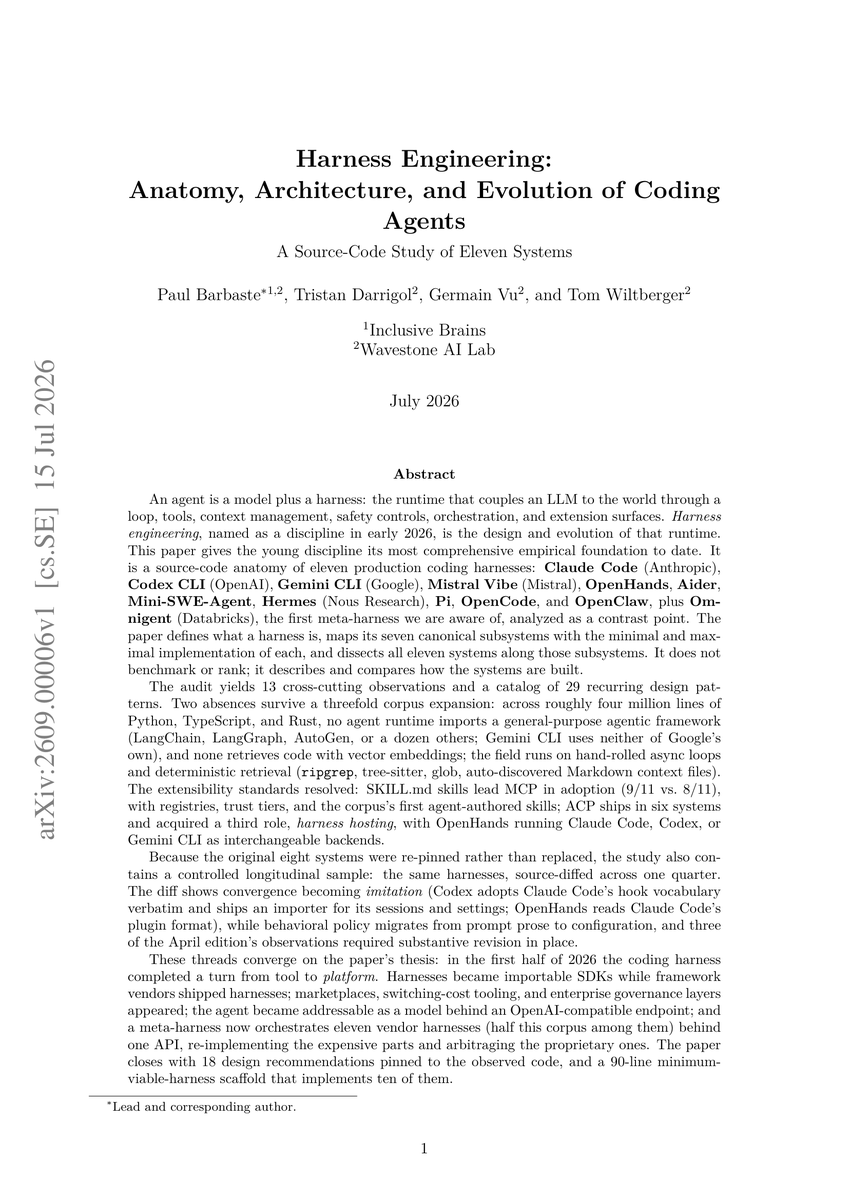
Harness engineering is the most f*cking DANGEROUS and accessible thing I've ever seen
engineers opened up the source code of 11 real coding agents (Claude Code, Codex CLI, Gemini CLI, OpenHands, Aider, Hermes)
their answer: agent = model + harness
the harness is everything around the model. and every system they studied is built from the same 7 parts:
→ agent loop: the heartbeat. think, act, check the result, repeat until done or stopped
→ LLM integration: the bridge that talks to the model and reads its tool calls
→ tools & actions: what the agent can actually touch. files, code, the terminal
→ memory & context: what it remembers, what it loads, and what it compresses when the window fills up
→ safety & permissions: what runs freely, what asks you first, what gets blocked
→ orchestration: sub-agents that split big jobs. the smallest harness skips it entirely
→ extensibility: hooks, skills, plugins and MCP to add power without rewriting the core
what surprised them:
> across ~4 million lines of code, not one agent runtime imports LangChain, LangGraph or AutoGen
> none of them use vector search to find code. it's ripgrep, globs and markdown files
> skills (SKILL.md) are now in more systems than MCP: 9 of 11 vs 8 of 11
the best part for builders: 18 design recommendations and a 90-line starter harness that covers 10 of them
90 lines. that's the whole entry ticket
save this, the full paper is below ↓
THIS IS F*CKING INSANE, I ADDED A GATE TO CLAUDE CODE + TRADINGVIEW AND SLEPT, MY $297 IS NOW $11,701 AFTER 3 NIGHTS.
Same model the whole time. I only rebuilt what sits around it.
A source-code study of 11 coding-agent harnesses on arXiv puts it in one line:
"An agent is a model plus a harness."
Claude Code, Codex CLI, Gemini CLI and OpenHands are all in it.
The harness is everything except the model: the loop, tools, context, safety, orchestration, extensions.
So I left the model alone and turned the harness into a 3-agent desk:
- SCOUT reads every TradingView alert
- RISK can veto any trade, its no is final
- EXEC is the only one with the wallet key
- one position at a time, out within 79 min
The gate is RISK. That is the one thing I added. Then I went to sleep.
How it went (UTC):
- Nov 3, 09:01: $297 in, first trade +$22
- Nov 4, 16:28: $1,405
- Nov 4, 17:47: one trade, down to $724
- Nov 4, 19:05: $650 (a 53.74% drawdown)
- Nov 5, 14:45: $2,086 (a new high)
- Nov 6, 16:57: $7,702 before −$1,471 on one trade
- Nov 6, 23:31: $11,701
66 trades. 45 won, 21 lost. $92 in fees.
The part I didn't expect: RISK never stopped the worst trade.
A gate doesn't make the model smarter.
It decides what is allowed to touch the wallet.
The same study found no runtime built on a general agent framework.
And none of them search code with vector embeddings.
Skills already lead MCP: 9 of 11 harnesses vs 8 of 11.
And the paper closes with a 90-line minimum harness.
Night 4: same model, one more gate. RISK gets a daily loss limit.
Your agent is not autonomous
You are its loop
You check every step because nothing else in the system can
I broke down the 7 levels from babysitting agents to running a fleet ↓ https://t.co/4RacdXA4nE