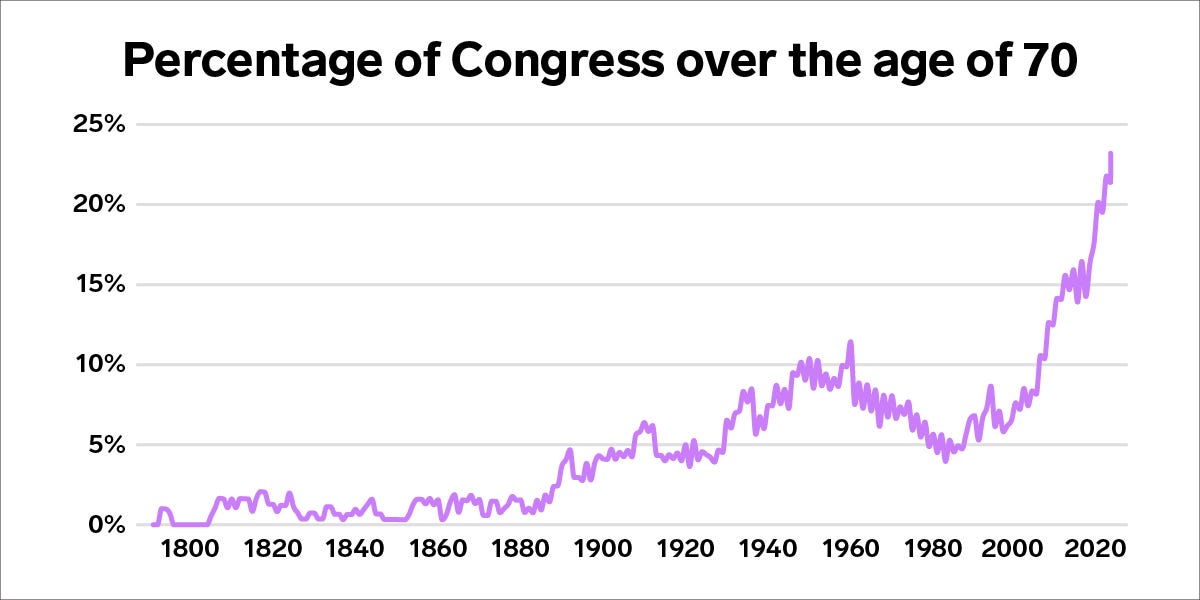
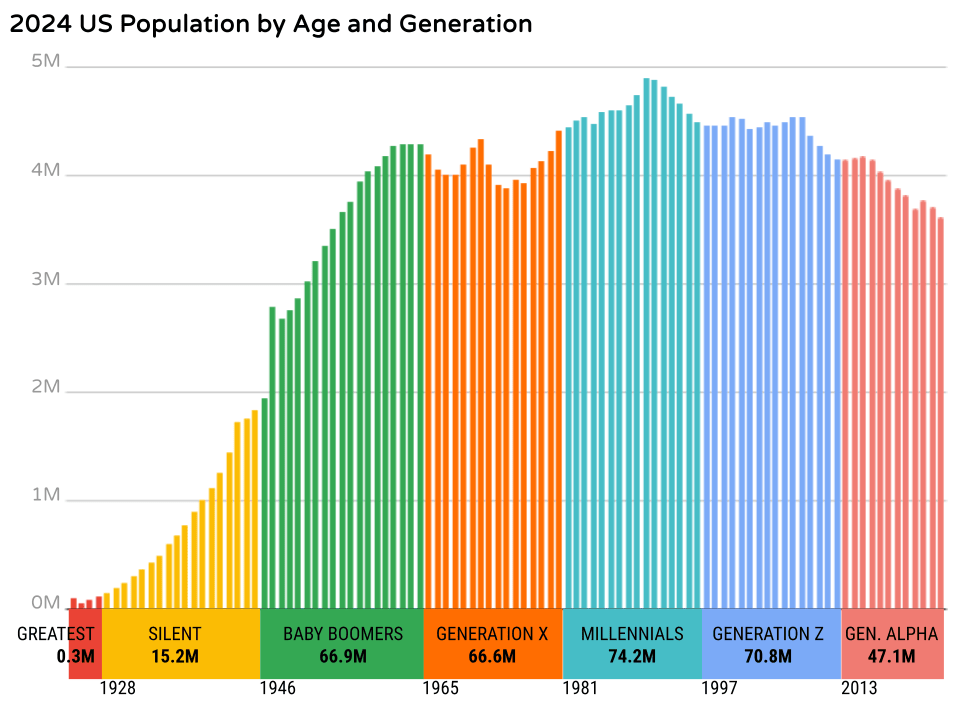
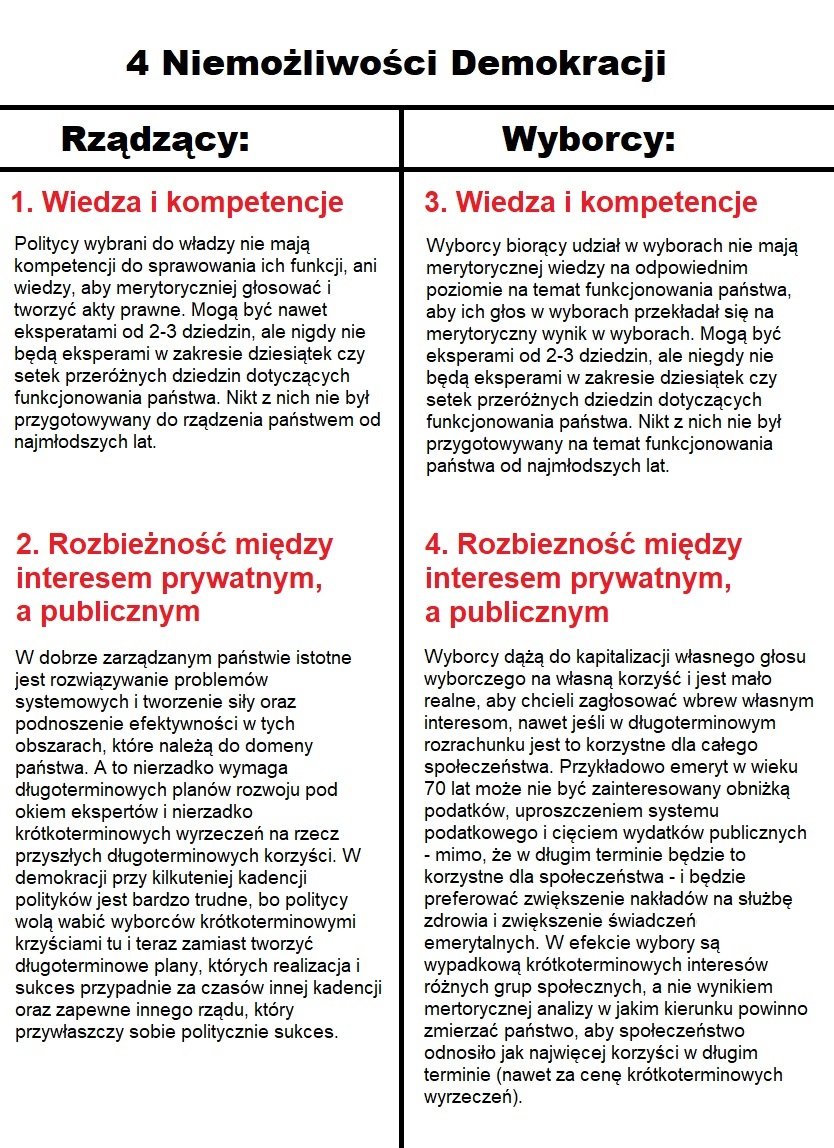
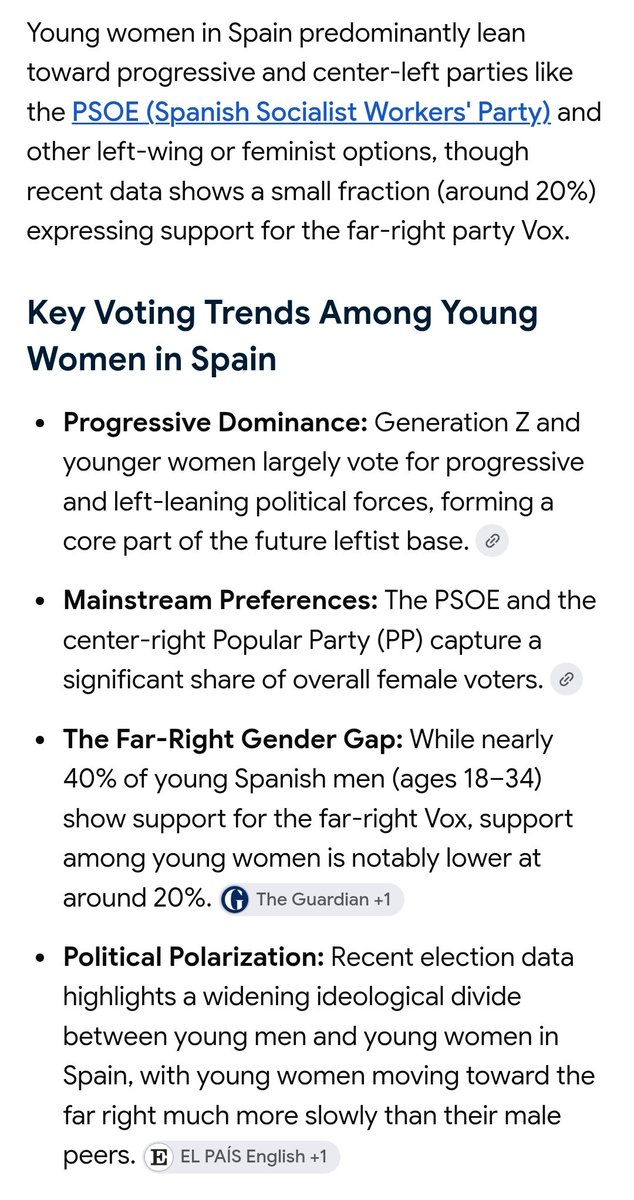
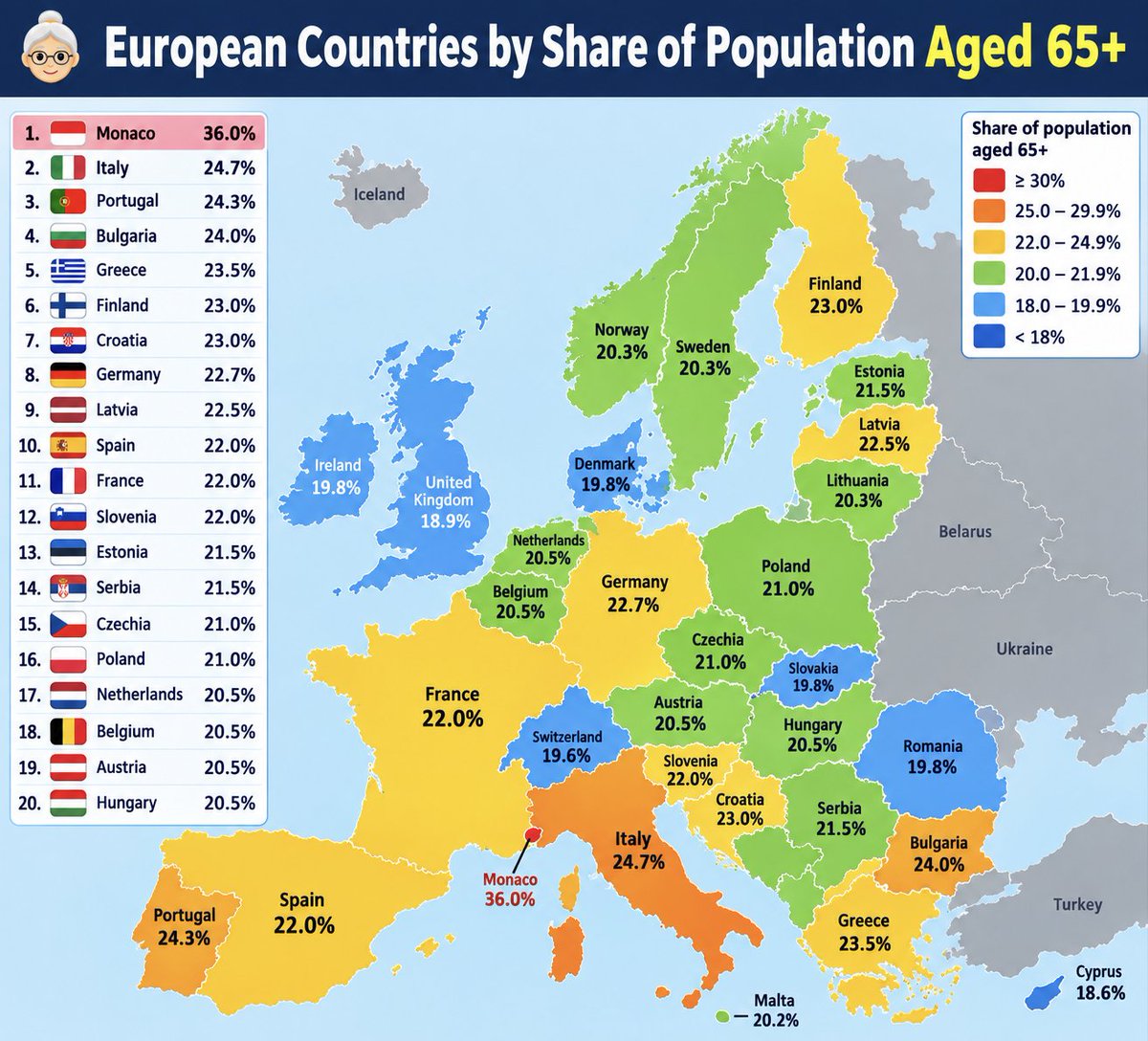
Jeśli skala propagandy medialno-politycznej jest ogromna w stosunku do skali danego zdarzenia, to najprawdopodobniej jest to wrogie działanie wobec obywateli
@PawelDSM Wzorzec głosowania wśród młodych dorosłych jest dość podobny w europejskich państwach, co w długim terminie i tak nie rozwiąże problemów w ramach demokracji
https://t.co/IwKjHiaVqZ
The open doors immigration story seems to be following the same pattern everywhere.
Step 1. Very low levels of immigration. Immigrants are mostly admitted on the basis of filling skills gaps. Little complaint from anyone.
Step 2. Rules change and larger volumes of immigrants start to arrive, with less discrimination. Unrest begins to grow, and anti immigration parties are born.
Step 3. Immigration continues to grow. Anti immigration sentiment and parties continue to expand. People who support them are branded "racist". The Establishment throws its support behind immigrants and pro immigration parties.
Step 4. The downsides of unlimited immigration become clear. It starts to affect even people in affluent areas. Support for anti immigration parties grows further, to its high watermark. The Establishment and its parties and media double down and become increasingly authoritarian.
Step 5. The country becomes balkanised. Flight of the indigenous population accelerates, either abroad or to the countryside. High immigration cities with big populations vote for pro immigration parties. Anti immigration parties are hugely popular amongst the indigenous population but start to decline overall because it's a numbers game and the pro immigration parties have the big numbers in the cities.
Step 6. The Establishment / pro immigration parties start to split along ethnic/racial lines. Islamic parties divorce themselves from the mainstream parties they hitched a ride with. The country people once knew in step 1 is gone. National identity is gone. Unity is gone. People vote along tribal lines. Unrest is the new normal. Even white liberals are fed up, but it's too late.
The UK is at step 4. By the looks of things Sweden might already be at Step 5.
Funnily enough this process is only happening in Western Europe and North America. Not in Africa, or South America, or most of Asia.
It's almost as if we're on somebody's hitlist for total destruction.
Politics is entwined in economics. Strip away the speeches and the ceremony, and every political decision is a decision about who gets resources, who produces them, and who carries the costs.
The state cannot give without first taking. When Congress passed the Inflation Reduction Act, allocating $369 billion toward energy subsidies, that capital did not materialize from goodwill. It came from your purchasing power, diluted through borrowing and monetary expansion. Every subsidy is a transfer. Every regulation is a barrier protecting someone already inside the gate from someone trying to compete.
Politicians understand this perfectly, which is why industries spend billions on lobbying. The American pharmaceutical lobby spent $457 million in 2025 alone. They are buying legislation that raises your drug costs by throttling competition. This is the system operating exactly as incentives predict it will.
The expansion of state power is inherently self-perpetuating. Each intervention creates a distortion, and that distortion produces a crisis, and the crisis generates demand for another intervention. The welfare state, the regulatory state, and the warfare state all feed from the same mechanism.
Separate economics from politics and you get a market. Merge them, and you get a cartel. Respect property, enforce contracts, keep the currency sound, and capital flows toward you. Let politicians price-set, inflate, and redistribute, and watch the capital disappear into politically favored hands instead.
Power selects for a specific personality type, and it is not yours.
F.A. Hayek spelled this out in 1944. In a centrally planned system, the people who rise are not the most competent or the most honest. They are the most willing to exercise force against strangers, the most comfortable with contradiction, and the most skilled at coalition-building through favors rather than merit. Government filters for the bad ones from the start.
The mechanism is straightforward. Political power means controlling resources you did not earn. Capturing that control requires outcompeting rivals who have no ethical constraints. A principled candidate refuses to promise contradictory things to different voter blocs. An unprincipled one does it without blinking. The unprincipled one wins. Repeat this selection pressure across hundreds of electoral cycles and you get the U.S. Congress in 2026: a body where the average member has held office for over a decade, raised millions from interested parties, and delivered almost nothing measurable to the people who voted for them.
Bureaucracy compounds the problem. Once entrenched, state agencies attract people who want authority without accountability. You cannot fire most of them. The FDA, the TSA, the Federal Reserve all function this way, staffed by individuals whose career advancement depends on expanding the agency's reach, never on serving you efficiently.
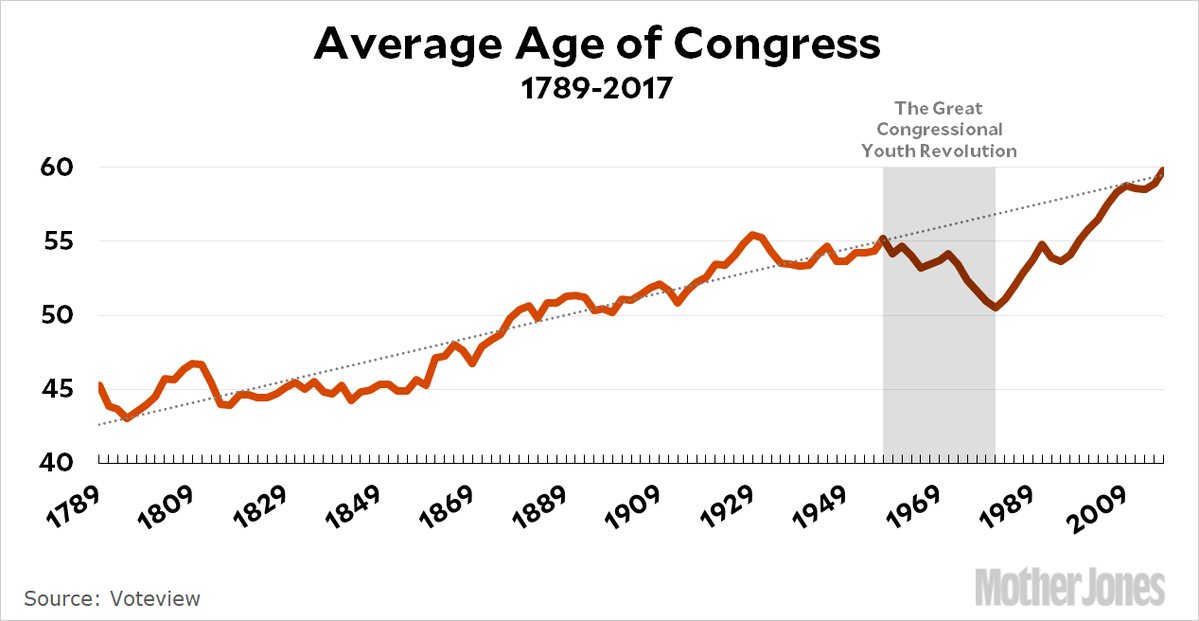
Boomer Hippies spent their youth drinking and getting high and having promiscuous sex and aborting their kids and protesting war. Then they grew up as adults and sent all the factory jobs overseas and loaded up $40 trillion in debt. Then they became grandparents and DEI racially discriminated against the younger versions of themselves for women and foreigners, while voting for endless overseas war they would've draft-dodged. Now they spend their retirement lecturing kids about hard work, sacrifice, and moral character.
They are soft, decadent flower children who see themselves as disciplined, grim, stoic, battle-hardened aristocratic patrician heroic statesmen. And they never grew up.
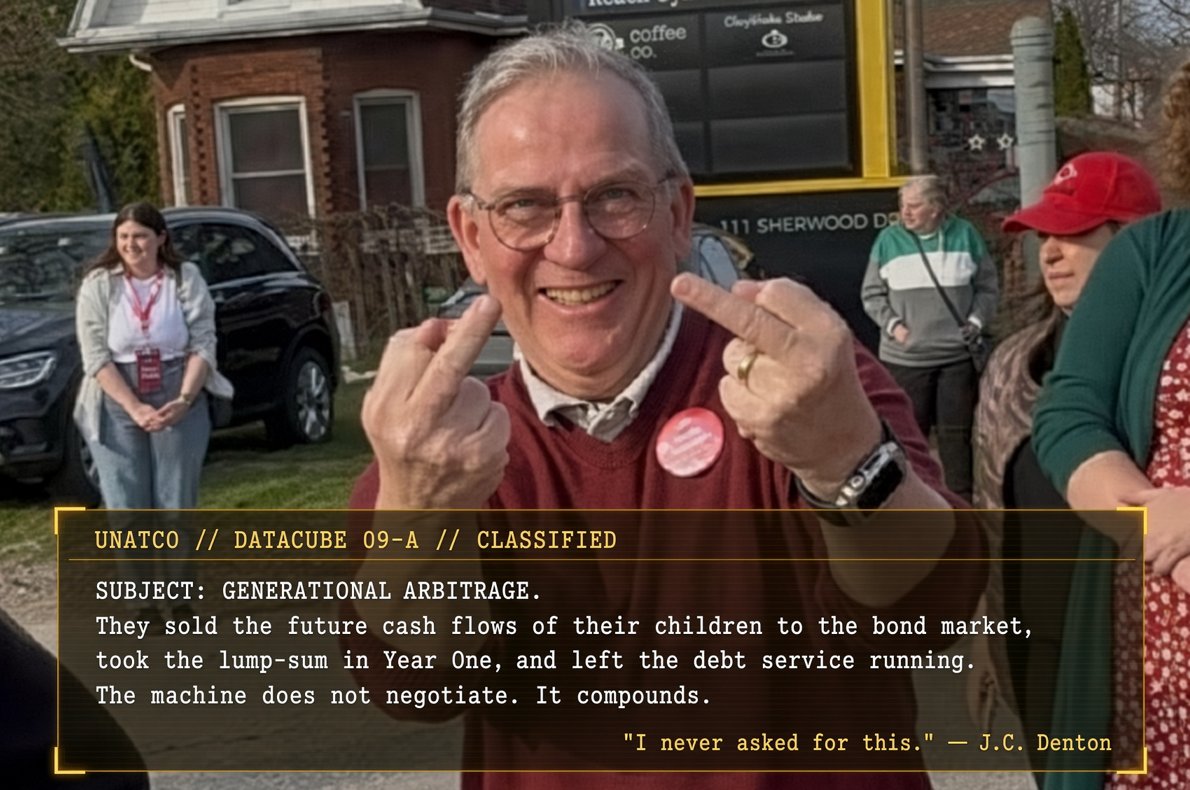
They are prodigal children who sold off the family farm inherited over 300 years and 12 generations. Then they relocated to a mansion and maxxed out the credit cards of their children and sold their children into debt slavery serfdom.
They deindustrialized the American military and turned the Army into a welfare jobs program for black lesbians, sold off the shipyards, and sent the semiconductor factories to Taiwan... a small vulnerable island off the coast of China. They set their children and grandchildren up to fight and die in WW3 with old, rusting ships and low stockpiles of missiles and ammunition.
At home, they imported Mexican drug cartel sicarios and MS-13 Satanic dismemembement to rape and murder their children and grandchildren, as long as the cartel sicarios were willing to mow their lawns as cheap foreign labor global arbitrage.
That's their legacy. And they're proud of it.
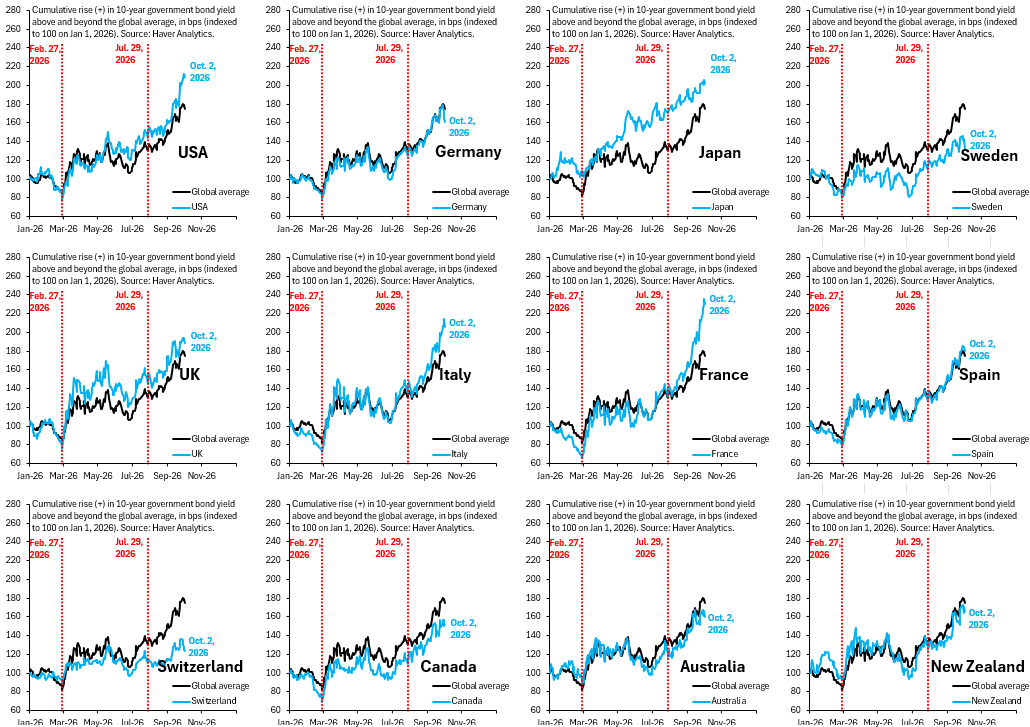
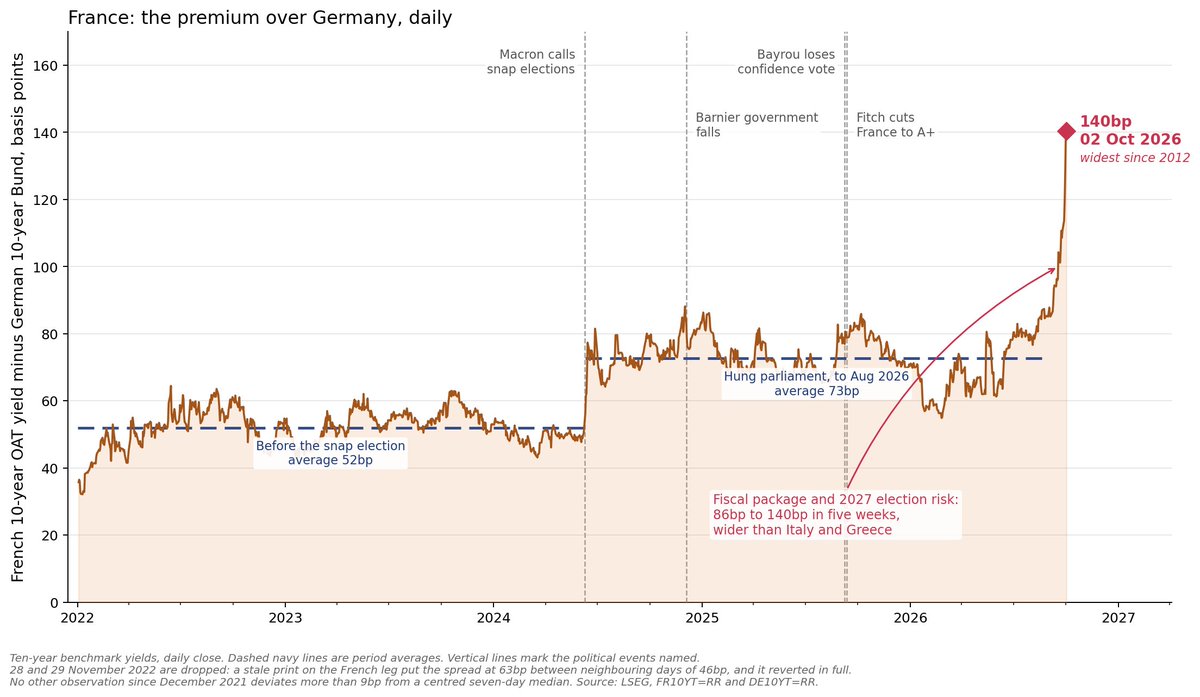
France is in a debt crisis. The problem is that the ECB has a track record of bailing countries out when things get tough. So politicians don't have an incentive to fix stuff, because they know the ECB will be there. Incentives are broken. The ECB is why.
https://t.co/HIlymWsz4u
Why France, why now? Over the last couple of years, the French political class has been signaling to the bond market that its pensioners/boomers are the de facto senior claimants on the French Treasury's revenue. And that's not what bond investors wanted to hear, especially now that they're being asked to absorb a much larger share of issuance than a couple of years ago.
https://t.co/6xMTlWWxt9
The primary scientific contradiction of the global warming campaign lies in the historical precedent.
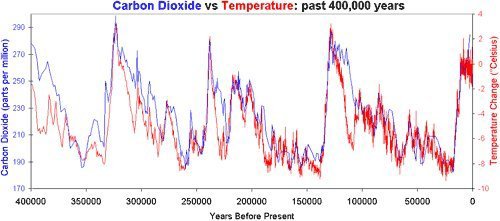
Natural mechanisms—not CO₂ dynamics—controlled every major climatic shift across Pleistocene history, all operating without any human intervention for 2.58 million years.
We currently inhabit an interglacial period that follows these same structural frameworks—and it is, in fact, cooler than peak thermal maxima seen in prior interglacials. Geological history sets the precedent. During the last interglacial period, the Eemian, world temperatures were roughly 2°C warmer and African fauna roamed the Thames Valley, all while atmospheric CO₂ did not change from a baseline of around 285 ppm.
For millions of years throughout the Quaternary Glaciation—spanning the last 2.58 million years—Earth has repeatedly emerged from ice age cycles following a remarkably consistent pattern.
While early Pleistocene cycles occurred roughly every 40,000 years, the Mid-Pleistocene Transition (between 1.2 million and 670,000 years ago) shifted these glaciations into longer 100,000-year cycles, typically featuring a 5–6 °C warming shift.
Antarctic ice-core records (such as EPICA Dome C and Vostok) show that temperature increases routinely precede rising CO₂ levels by several hundred to a thousand years. Recent revisions have sparked scientific debate around the precise resolution of this lag. But the fundamental paleoclimate record indicates that atmospheric CO₂ neither initiates the end of an ice age nor triggers its beginning (Caillon et al. 2003, Pedro et al. 2012, Parrenin et al. 2013).
Deglaciations are consistent with the Milankovitch orbital anomalies, which alter high-latitude insolation and set off ice-sheet retreat, falling surface albedo and shifts in ocean circulation.
Only after the oceans—particularly the Southern Ocean—have warmed for centuries does dissolved carbon dioxide outgas from the deep ocean abyss, slowly elevating atmospheric levels from roughly 180 ppm to 280 ppm across 5,000 to 10,000 years.
As noted in IPCC AR6 WG1 (Ch. 5) and Shakun et al. (2012), CO₂ acts as a secondary feedback mechanism that amplifies orbitally induced warming, rather than driving it. This is the established dynamic of the natural carbon cycle on glacial–interglacial timescales.
By contrast, the UN-led agenda asserts that human activity has added approximately 140 ppm of CO₂ in just 150 years, moving atmospheric concentration from a pre-industrial baseline of 280 ppm to around 420 ppm today. This narrative is based entirely on statistical computer analysis, all controlled by the IPCC. In the same way, production of CO₂ emissions has been allocated on a virtual per capita basis, more suited to a corporate takeover than physical reality.
Paleoclimate records demonstrate that on multi-millennial timescales, temperature leads CO₂ dynamics. The core assumption of IPCC policy framework rests on reversing this historical paradigm. Instead, it asserts that CO₂ will now drive global temperatures on rapid, century-scale timeframes.
This represents a significant departure from established paleoclimate observations. Yet this 'extrapolation' is the foundational justification for multi-trillion-dollar expenditure proposals and the accelerated dismantling of traditional hydrocarbon energy systems, all before reliable alternatives are in place.
Why France, why now? Over the last couple of years, the French political class has been signaling to the bond market that its pensioners/boomers are the de facto senior claimants on the French Treasury's revenue. And that's not what bond investors wanted to hear, especially now that they're being asked to absorb a much larger share of issuance than a couple of years ago.
https://t.co/6xMTlWWxt9
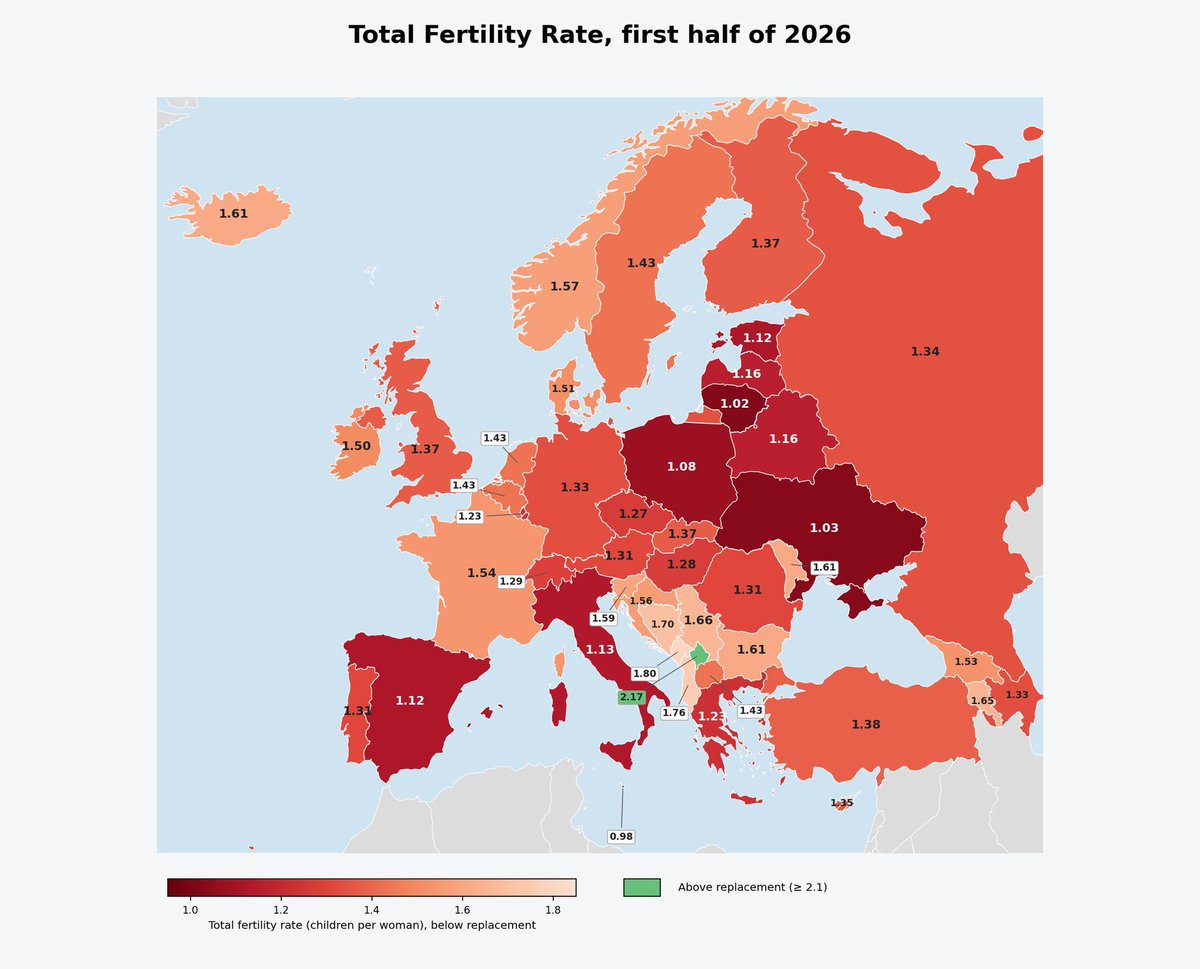
🚨HUGE: KOSOVO IS THE ONLY PLACE IN EUROPE BACK ABOVE 2.1 CHILDREN PER WOMAN — THE SAME MAP PUTS POLAND AT 1.31, UKRAINE AT 1.03 AND BELARUS AT 1.16 🇽🇰🔥🤰
Replacement is 2.1. That is the number of children per woman a country needs if it wants the next generation to be the same size as this one, before migration. A chart of the first half of 2026, posted by the Kosovo account @admirim, marks one green spot on the whole continent. Kosovo, at 2.17. Everything else is below the line.
Read the Slavic row on the same map. Poland 1.31. Czechia 1.28. Slovakia 1.37. Bulgaria 1.31. Russia 1.34. Belarus 1.16. Ukraine 1.03. Serbia, Croatia, Bosnia and North Macedonia sit higher than Warsaw and Kyiv, between roughly 1.56 and 1.70, and still short of replacement. Albania, next door and not Slavic, is at 1.76. Kosovo is the outlier.
Kosovo is a small, disputed territory of about 1.7 million, mostly Albanian and mostly Muslim, north of North Macedonia and west of Serbia. It is not a rich country. It is not in the EU. The usual excuses do not fit. Money did not produce the babies. Brussels did not produce them. The same map shows the richest states in Europe under 1.6, and South Korea, off the chart, near 0.8.
Slavic governments have tried the cheque. Poland’s 500-plus, now 800-plus, paid mothers and did not hold the rate. Hungary taxed the childless and subsidised the third child. Czechia and Slovakia built nurseries. Ukraine has a war on top of a collapse that was already underway. None of them are on the green square.
Absolute births in Kosovo have also fallen hard since the 1990s, so this is not a population boom. It is a rate that, on this half-year count, crossed back over the line while every Slavic capital stayed under it. Family size held where the state was weaker and the household was not.
If a poor Albanian territory can print 2.17 without an EU subsidy, what exactly is stopping Warsaw, Belgrade, Prague and Kyiv?
🚨HUGE: KOSOVO IS THE ONLY PLACE IN EUROPE BACK ABOVE 2.1 CHILDREN PER WOMAN — THE SAME MAP PUTS POLAND AT 1.31, UKRAINE AT 1.03 AND BELARUS AT 1.16 🇽🇰🔥🤰
Replacement is 2.1. That is the number of children per woman a country needs if it wants the next generation to be the same size as this one, before migration. A chart of the first half of 2026, posted by the Kosovo account @admirim, marks one green spot on the whole continent. Kosovo, at 2.17. Everything else is below the line.
Read the Slavic row on the same map. Poland 1.31. Czechia 1.28. Slovakia 1.37. Bulgaria 1.31. Russia 1.34. Belarus 1.16. Ukraine 1.03. Serbia, Croatia, Bosnia and North Macedonia sit higher than Warsaw and Kyiv, between roughly 1.56 and 1.70, and still short of replacement. Albania, next door and not Slavic, is at 1.76. Kosovo is the outlier.
Kosovo is a small, disputed territory of about 1.7 million, mostly Albanian and mostly Muslim, north of North Macedonia and west of Serbia. It is not a rich country. It is not in the EU. The usual excuses do not fit. Money did not produce the babies. Brussels did not produce them. The same map shows the richest states in Europe under 1.6, and South Korea, off the chart, near 0.8.
Slavic governments have tried the cheque. Poland’s 500-plus, now 800-plus, paid mothers and did not hold the rate. Hungary taxed the childless and subsidised the third child. Czechia and Slovakia built nurseries. Ukraine has a war on top of a collapse that was already underway. None of them are on the green square.
Absolute births in Kosovo have also fallen hard since the 1990s, so this is not a population boom. It is a rate that, on this half-year count, crossed back over the line while every Slavic capital stayed under it. Family size held where the state was weaker and the household was not.
If a poor Albanian territory can print 2.17 without an EU subsidy, what exactly is stopping Warsaw, Belgrade, Prague and Kyiv?
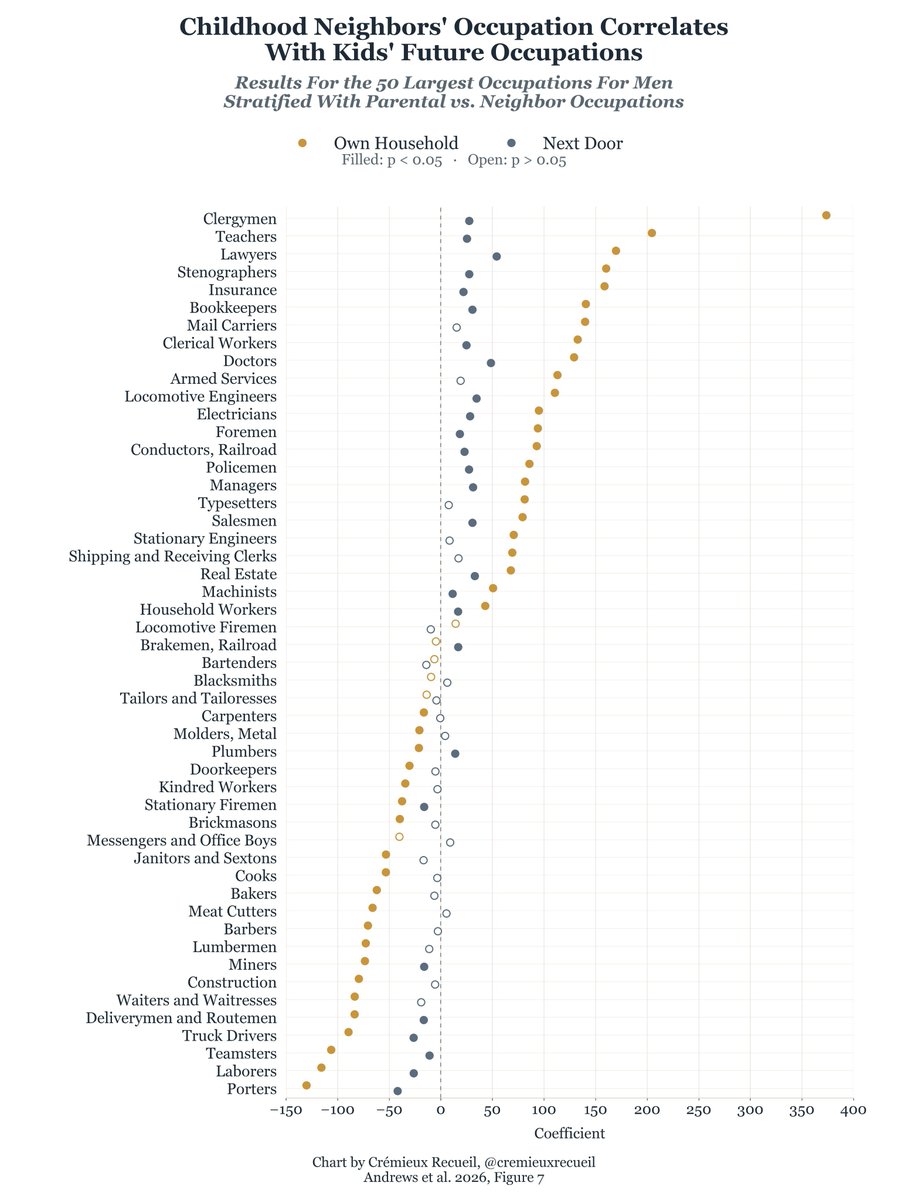
One of the coolest recent papers is this one that found that kids are more likely to go into (some) occupations their neighbors did.
A neighbor being a lawyer greatly increases the odds a kid will become a lawyer. More similar families? More connection? Bigger effects!
The share of US Americans who say they host friends or family at their home at least monthly has declined by 71 percent in the last 50 years. Other activities took a huge hit too. Be crazy this week and invite a friend or two over for dinner. The next day recover from the socialising by reading a book. Source: https://t.co/ghLYS20gSX
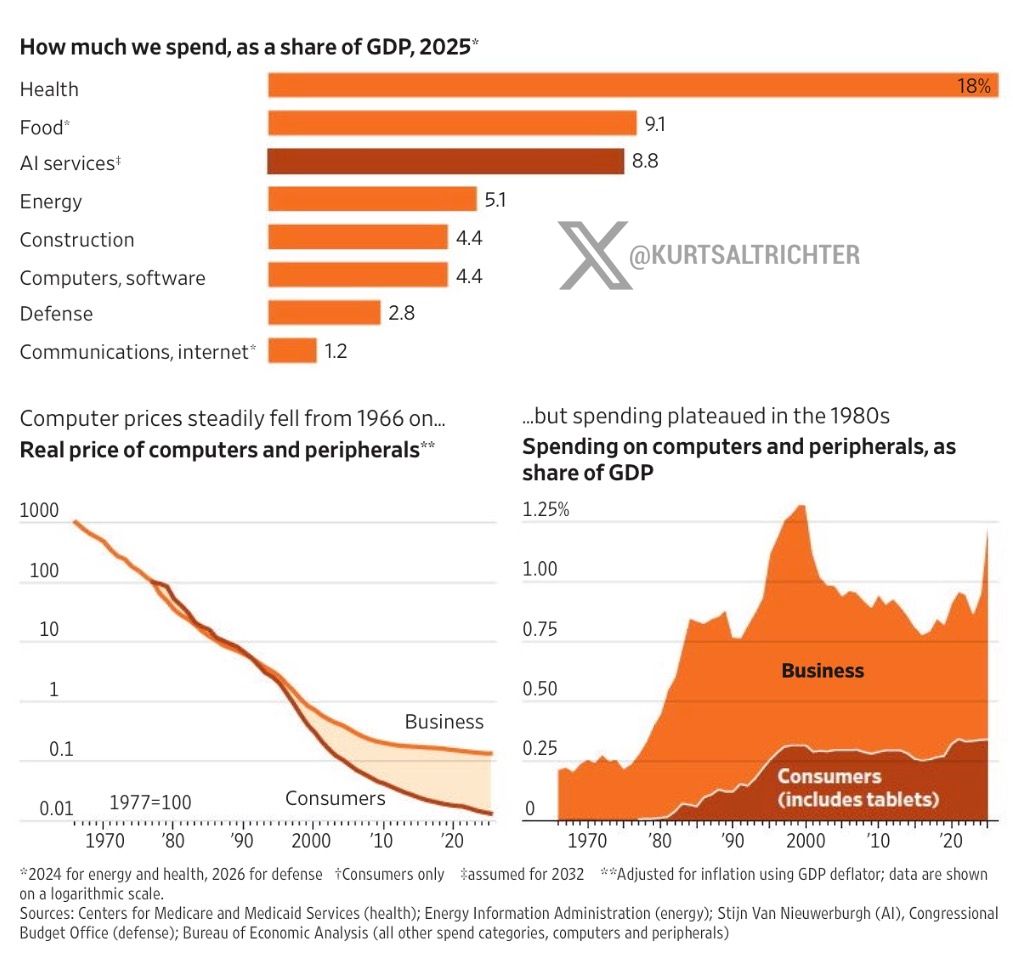
For the AI buildout to pay off, Americans will eventually have to spend about 9% of GDP a year on AI services. Sit with that number.
That is roughly what the entire country spends on food.
A Columbia paper presented at Brookings estimates AI revenue would need to hit $3.5 trillion by 2032, about 8.8% of GDP, to justify what is being committed today. That is bigger than any investment boom in US history, and 7 times what Americans spend on phone, streaming, and internet combined.
Now look at computers. Prices fell for 50 straight years, but business spending on them as a share of GDP plateaued in the 1980s and never climbed again. Cheaper and better did not mean an ever-larger slice of the economy.
AI will almost certainly raise productivity. Whether it delivers the revenue investors are pricing is another matter. That gap is what the buildout is underpricing.