Anthropic just released a 4-hour course to getting a $500k AI engineering job:
00:15 - The right way to prompt Claude
33:21 - What makes Claude act dumber on your code
01:33:39 - How Anthropic use Claude every day
02:50:56 - The fix that makes Claude way smarter
This 4-hour Anthropic free course replaces about 10 paid engineering courses.
Watch it today, then read the step-by-step guide on building loops below.
BREAKING: Ray Dalio just said the AI market is a bubble and it will burst.
"All great technology changes produce bubbles," Dalio told Bloomberg. "The pricking is the converting of wealth into money" right now, every major tech company is pouring hundreds of billions into AI infrastructure and booking it as investment.
The moment investors demand actual returns, companies will have to show that the money spent is generating real profits from real customers. If the revenue is not there, valuations collapse and right now, the revenue is not there.
AI companies are spending $800 billion in capital expenditure this year alone. OpenAI spends $60 billion annually on cloud infrastructure against $25 billion in actual revenue.
Less than 1% of executives globally report meaningful ROI from their AI investments. 95% of enterprise AI pilots have failed to deliver measurable returns according to MIT.
The entire $2 trillion cloud backlog held by Microsoft, Oracle, Google, and Amazon is anchored by two unprofitable companies: OpenAI and Anthropic.
By 2030, the industry needs $2 trillion in annual revenue to justify what is being built today. Bain estimates it will fall $800 billion short.
Dalio is not saying the technology is fake. He is saying the economics do not work yet and every bubble in history has ended the same way when that moment of reckoning arrived.
For now, replace your desire to trade precision and low stop loss executions.
Focus on the meat and take a pound and walk away.
This is all you need and can sustain you and your family.
Overtime, you refine your craft... but learn to eat while doing so.
Elon Musk avait dit un truc qui m'avait marqué sur l'allocation de ressources. En substance : passé un certain niveau de richesse, l'argent n'est plus de la consommation, c'est de l'allocation de capital.
Cette phrase change tout.
L'économie, dans le fond, c'est juste un problème d'allocation. Tu as des ressources finies et des usages infinis. Qui décide où va quoi ?
Imagine une cour de récré. 100 enfants, des paquets de cartes Pokémon distribués au hasard. Tu laisses faire. Très vite, un ordre émerge. Les bons joueurs accumulent les cartes rares, les collectionneurs trient, les négociateurs trouvent des deals. Personne n'a planifié. Et pourtant chaque carte finit dans les mains de celui qui en tire le plus de valeur. Le système maximise le bonheur total de la cour. C'est ça, la main invisible.
Maintenant fais entrer la maîtresse. Elle trouve ça injuste. Léo a 50 cartes, Tom en a 3. Elle confisque, redistribue, impose l'égalité. Trois effets immédiats. Les bons joueurs arrêtent de jouer, à quoi bon. Les mauvais n'ont plus de raison de progresser, ils auront leur part. Les échanges s'effondrent. La cour est égale, et morte. Elle a maximisé l'égalité, elle a détruit le bonheur.
Le problème de la maîtresse, c'est qu'elle ne peut pas avoir l'information que la cour avait collectivement. C'est le problème du calcul économique de Mises, formulé en 1920. L'URSS a essayé de le résoudre pendant 70 ans avec le Gosplan. Résultat : pénuries, queues, effondrement. Pas parce que les Soviétiques étaient bêtes, parce que le problème est mathématiquement insoluble en mode centralisé.
Quand Musk a 200 milliards, il ne les consomme pas, il les alloue. SpaceX, Starlink, Neuralink, xAI. Chaque dollar est un pari sur le futur. Et lui a un track record. PayPal, Tesla, SpaceX. Il a démontré qu'il sait identifier des problèmes immenses et y allouer des ressources avec un rendement spectaculaire.
L'État aussi a un track record. Hôpitaux qui s'effondrent, éducation qui décline, dette qui explose, services publics qui se dégradent malgré des budgets en hausse constante. Le marché identifie les bons allocateurs, la politique identifie les bons communicants.
Le profit n'est pas une finalité, c'est un signal. Il dit : tu as alloué des ressources rares vers un usage que les gens valorisent suffisamment pour payer. Plus le profit est gros, plus la création de valeur est grande. Quand Starlink est rentable, ça veut dire que des millions de gens dans des zones rurales ont enfin internet. Quand un ministère est en déficit, ça veut dire qu'il consomme plus qu'il ne produit. L'un crée, l'autre détruit, et on appelle ça redistribution.
Dans nos sociétés il y a deux catégories d'acteurs. Les entrepreneurs et les bureaucrates. L'entrepreneur prend un risque personnel pour identifier un problème, mobiliser des ressources, créer une solution. S'il se trompe il perd. S'il a raison, ses clients gagnent, ses employés gagnent, ses fournisseurs gagnent, l'État collecte des impôts. Il est la cellule de base du progrès humain.
Le bureaucrate ne prend aucun risque personnel. Son salaire est garanti. Au mieux il maintient une rente existante. Au pire il la détruit par excès de réglementation, mauvaise allocation forcée, incitations perverses qui découragent ceux qui produisent. Mais dans aucun cas il ne crée.
Regarde les 50 dernières années. iPhone, internet civil, SpaceX, Tesla, Google, Amazon, Stripe, mRNA, ChatGPT. Toutes des inventions privées, portées par des entrepreneurs, financées par du capital risque. Pas un seul ministère n'a inventé quoi que ce soit qui ait changé ta vie au quotidien.
La France est devenue le laboratoire mondial de la dérive bureaucratique. 57% du PIB en dépenses publiques, record absolu. Une administration tentaculaire, une fiscalité qui pénalise la création de richesse. Résultat : décrochage face aux États-Unis, à l'Allemagne, à la Suisse. Fuite des cerveaux. Désindustrialisation. Dette qui explose.
Et le pire c'est que la mauvaise allocation s'auto-renforce. Plus l'État prélève, moins les entrepreneurs créent. Moins ils créent, moins il y a de base fiscale. Plus l'État s'endette et taxe. Boucle de rétroaction négative parfaite. La maîtresse pense qu'elle aide, et chaque année la cour produit moins.
Dans nos sociétés, ce sont les entrepreneurs, toujours, qui font avancer la civilisation. Les bureaucrates au mieux maintiennent une rente, au pire la détruisent. Aucune société n'a jamais progressé en taxant ses créateurs pour subventionner ses gestionnaires.
La question n'est jamais qui a combien. C'est qui alloue le mieux la prochaine unité de ressource pour maximiser le futur de l'humanité. La réponse depuis 200 ans n'a jamais changé. Ce ne sont pas les fonctionnaires.
Sooner or later, you are going to come to your senses and see that I was telling you the truth, all along.
Everything is rigged. They give you the illusion of choice. The fallacy of voting. The myth of free markets. Healthcare that actually is sickcare... keeping you ill, paying for life with illness, versus real healing.
They want you to hate your neighbor. They want you so angry with this broken system that you take matters into your own hands.
Then the trap is closed... the real lock down. Don't fall for it. Love your neighbor.
You can't say what you want for fear of consequence from your governments. They force you to endure mass migration of people who don't wish to live civilized but would rape and trample over your culture, beliefs and sanctity and peace; while leaching off the taxpayer's back.
They engineer wars to thin the herd and profit on the blood and lives of your children... and you think your gimmicks overlaid on charts has any sway over price movement or predicts it.
You sipped their tea for far too long. Sober up.
The real stuff is about to commence... ready or not.
The trillion dollar question:
How will we generate enough energy to power all of these AI deals?
The US Department of Energy says US data centers will use 325,000–580,000 GWh of power per year by 2028.
That’s equivalent to the power used by ~40 million homes, all on JUST data centers.
Currently, nuclear power is viewed as the only solution to the impending power shortage.
The average nuclear produces power plant can produce 8,000 GWh per year.
In other words, we would need ~73 plants new to power 580,000 GWh data centers.
However, here is the problem:
The US has added 2 nuclear reactors since 1995 and it takes over 10 years to build one.
Reaching the required energy output by 2028 seems close to impossible at our current rate.
Something must change.
Russia just accused the US of using crypto to wipe out its $35T debt.
Putin’s adviser Kobyakov says Washington will shove debt into stablecoins, devalue it, and reset the system.
I lost $85k over 4 years before finally becoming profitable.
If I knew what I know now, I could’ve done it in 6 months with under $1k
Here’s the shortcut I wish someone had given me on day one:
🧵
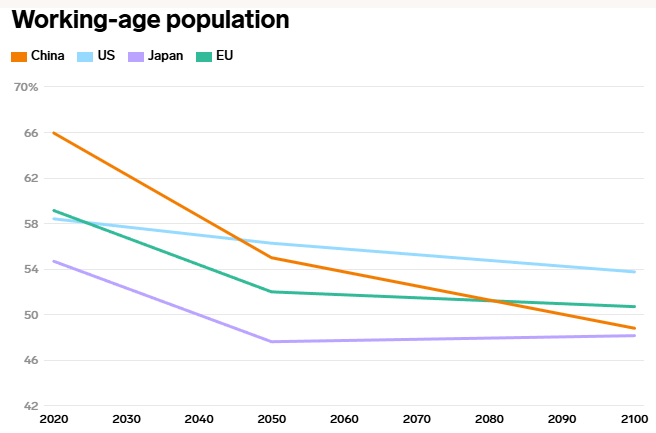
🚨 THE WORLD IS RUNNING OUT OF PEOPLE—AND IT'S WORSE THAN YOU THINK
Forget robots taking your job—soon there won’t be enough humans left to do them anyway.
Birth rates are crashing in rich countries like the US, Japan, and South Korea.
In 40 years, the global population will start shrinking, not growing.
That’s bad news for jobs, the economy, and anyone hoping to retire before age 90.
By 2100, the world could lose up to 2 billion people, with countries like Italy and China watching their workforces vanish.
Fewer babies means fewer workers, and fewer workers means less money, slower growth, and a whole lot of panic.
The “Great People Shortage” has already started.
From pilots to preschool teachers, companies can’t find enough staff. And when old people outnumber workers?
Good luck keeping the lights on.
Source: Business Insider
JUSTIN:
🇷🇺 Russian Spokeswoman, Maria Zakharova regarding the "cocain" video of Macron, Starmer and Merz:
"In the video: the President of France, the Prime Minister of Britain, and the Chancellor of Germany.
Having pushed Zelensky into yet another hellish intrigue to sabotage a settlement and continue the bloodshed in Europe, like in the joke, the Frenchman, the Englishman, and the German got on a train and... took a hit.
Apparently, they did it so thoroughly that they forgot to hide their paraphernalia (a little baggie and a spoon) before the journalists arrived.
The fate of Europe is being decided by dependent and temporary figures—in every sense of the word.
Incredible footage. It's as if the Almighty Himself is pulling back the curtain on this foul gathering, so that 'those with eyes may see.'
In 2022, I asked a Western ambassador: 'How can you supply weapons to the unbalanced drug addict Zelensky? He’s been on cocaine for years!'
And I got the reply: 'For the EU, that’s normal — many Western leaders use.'"
🚨DEVELOPING: Macron, Starmer, and Merz caught on video on their return from Kiev. A bag of white powder on the table. Macron quickly pockets it, Merz hides the spoon. No explanation given. Zelensky, known cocaine enthusiast, had just hosted them. Connect the dots.
I contacted @tradingview about the @CMEGroup data being slow compared to other platforms.
It seems like there's a latency cap or something similar. On Topstep, with the setting adjusted to 50ms, we can see every single tick. But right now on TradingView CME, we can’t see anything clearly—just candles bouncing all over the place. It’s been like this for at least 5–6 months, and I’m tired of it.
Is it just me?
Has anyone else noticed a major difference in data quality on TV?
I’m paying for the CME data on TradingView, but the latency appears to be capped at 250ms. That’s way too slow. I’d like the option to reduce it to 50ms.
Let’s see how they respond.
Noticed that too? @I_Am_The_ICT