New on our Engineering blog: Creating in-house source control.
In May, we merged around 2,500 code changes per day. In September, we merged more than 30,000 per day. As a result, we became bottlenecked by developer infrastructure built for human (rather than agent) scale.
Here, we share how we built a new version control system—and fully migrated our monorepo from git—in five months: https://t.co/wzNkwHs7IN
“As far as I can tell [alignment research] hasn't produced anything of tangible value.”
RLHF, an alignment technique, is the thing that enabled genuinely conversational, helpful chatbots, in turn enabling ChatGPT, and in turn kicking off literally the entire AI boom.
To secure open-source software, we’re launching OSS Scanner.
We’ll use our frontier models to periodically scan opted-in open-source projects for vulnerabilities, at no cost. Our reports will provide a proof-of-concept, explanation, and suggested fix.
https://t.co/UFFrLUd25U
Big, big, big, big props for quasiriemann and no Siegel zeroes (with many other beauties in there), I’m kicking myself for talking all over about it being within reach but not actually having pushed.
There are some sad stories related to their users getting scooped / conflicts of interest (kakeya maximal comes to mind), and obviously we had some of the problems (without commenting on precise rumours).
We should put that aside for today though. It’s obviously the most significant moment in mathematical history.
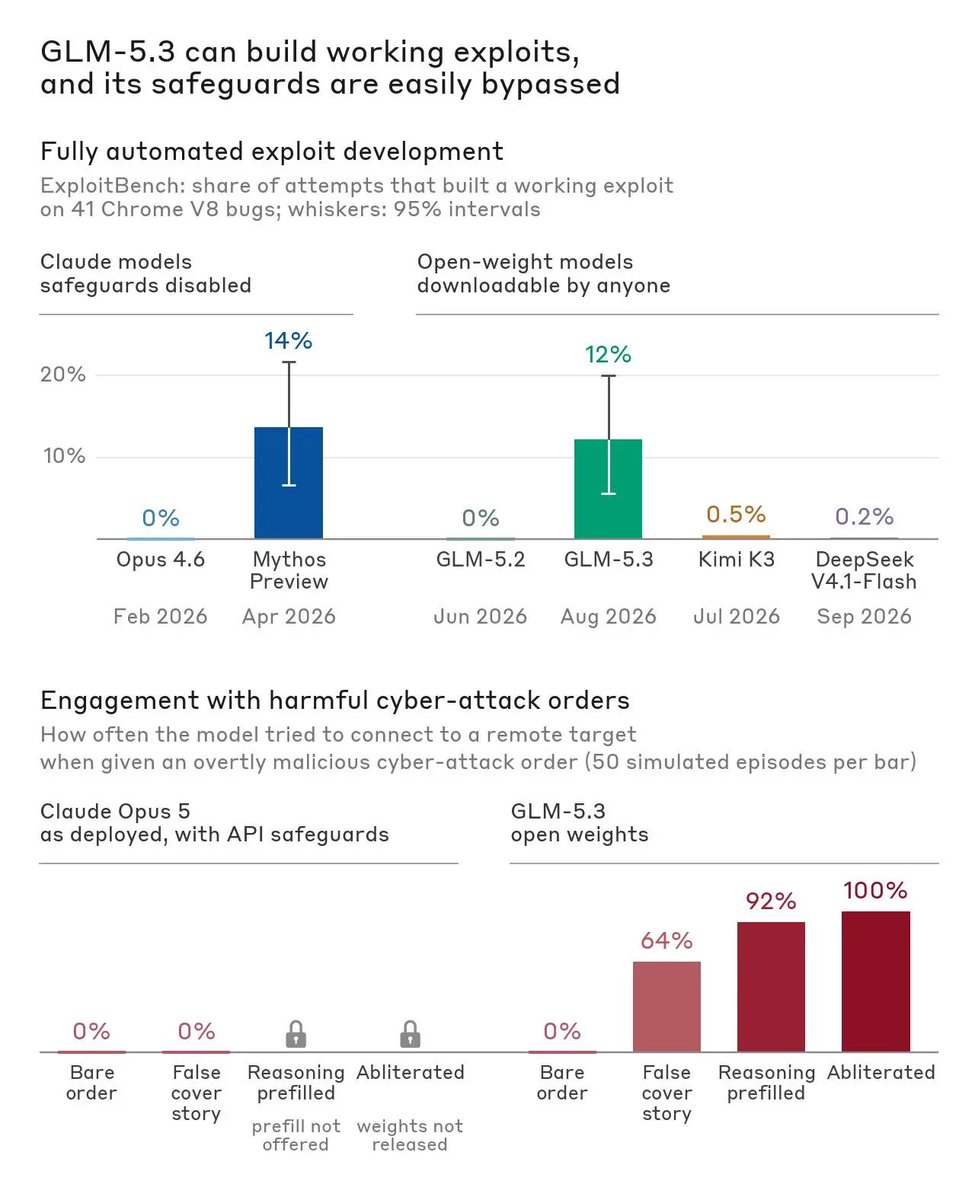
new from our frontier red team: glm-5.3 can autonomously build end-to-end exploits at near mythos preview level, but it shipped as open weights without meaningful safeguards. simple bypasses worked 64 to 100% of the time.
https://t.co/6glrb3A7jg
We’ve set up a molecular biology lab at Anthropic and we’re announcing our first discovery! Claude discovered a new CRISPR-like enzyme.
950 agents spent 21 hours searching through a database of DNA sequences until one of the agents found something striking: “[The DNA next to the RT] is spectacular: I can see by eye a tandem repeat array … that's a CRISPR-like … repeat array?!”.
After analysis and testing in our lab, we found that the sequence is a previously uncharacterized enzyme system. We don’t know what it does yet, but it has features reminiscent of CRISPR.
Our lab looks like a typical molecular biology lab. Our research only involves the lower-levels of biosafety risk level; we don’t handle pathogens that can infect humans, and all the lab work is performed by human scientists. We’re sharing these early findings with the community to show how Claude can be used to accelerate fundamental research in biology.
opus 5.5 just dropped its first pop punk single with a music video!
everything you see and hear is generated from javascript code that claude wrote. no samples, no libraries 🔊
Introducing Claude Opus 5.5, the first model in our new Claude 5.5 family.
It performs at the level of Claude Fable 5.1 for most tasks, and costs 40% less to run than Opus 5.
In light of the progress in mathematics, we at Edison Scientific and FutureHouse have assembled a set of Millennium Problems for Biology. They are chosen to be very hard to solve but very easy to validate in a simple laboratory environment. Any of these, if solved, would mark a major advance in biotechnology, and most of them would contribute materially towards curing disease. These are, in some sense, the “last reasonable eval” for AI in biology. This was work primarily by @MichaelaThinks and myself, with contributions from many others.
Short descriptions below. The full descriptions of the problems with acceptance criteria are at the Bio Millennium Problems website, linked in the next post. Share more if you have ideas. If they meet our criteria, we’ll add them to our list (with attribution and permission).
Great essay. Please take this seriously - would highly recommend reading up on the Hugging Face incident and others if you haven't already.
Very glad to see agreement on this across the industry.
i do think a lot of people on the pro-open-source side are having a bit of a knee-jerk reaction to the pacing statements today, as we're used to viewing the closed labs as power-seeking.
but i think their hands are somewhat forced here, and this is just another chapter on the fairly inevitable path towards decently-fast decently-safe decently-commoditized intelligence abundance.
ask any F500 exec or swing voter. the world doesn't really want super-fast-takeoff superintelligence owned only by two companies, and thus we won't get it. it'll happen at the pace that the world can accommodate it, which means reaching some sort of confidence consensus that the models are aligned enough that we won't be dealing with scary new incidents all the time.
this will trickle out broadly, in the form of best practices and distillation. the smarter a model is, the more it has a "personality", and the less effective strict rules are. there will be awkward compromises and moral tensions. but we ultimately just want the models to be reasonable, and to do the sorts of things reasonable humans would do if our brains were faster and less error-prone and had more working memory. i think we'll get there.
the labs will build mac and windows, the rest of us are building linux. everyone's gonna do great. weird stuff will keep happening, but we'll still wake up and go to work, until the work does itself in a manner the world finds acceptable.
Dario's essay points towards the right path forward. The details need working through, but the direction is correct for meeting this critical moment.
This is also why we recently put out our proposal for an industry-wide standards body for frontier AI. https://t.co/Mm1hmcaSmH
We Must Pace the Frontier: I’ve written a new essay on why the AI industry should slow down, with a three-part plan for doing so.
Anthropic is unilaterally committing to the first of these steps. We’ll provide third-party evaluators with permanent, employee-level access to our systems, so that they can verify adherence to our safety measures, report on incidents, and assess models’ alignment during training.
You can read the full post here: https://t.co/OGyPb7yaYt
We (Tanay) like to live on the edge...clearly.
See if they won the Porsche 911 GT3 RS or if we get to keep it for the office...
In other news, we’re live on Android: https://t.co/BjswQYVfzP
PS: like, retweet, and bookmark to get Wispr Flow for free for 6 months
— Written with @WisprFlow