(1/7)
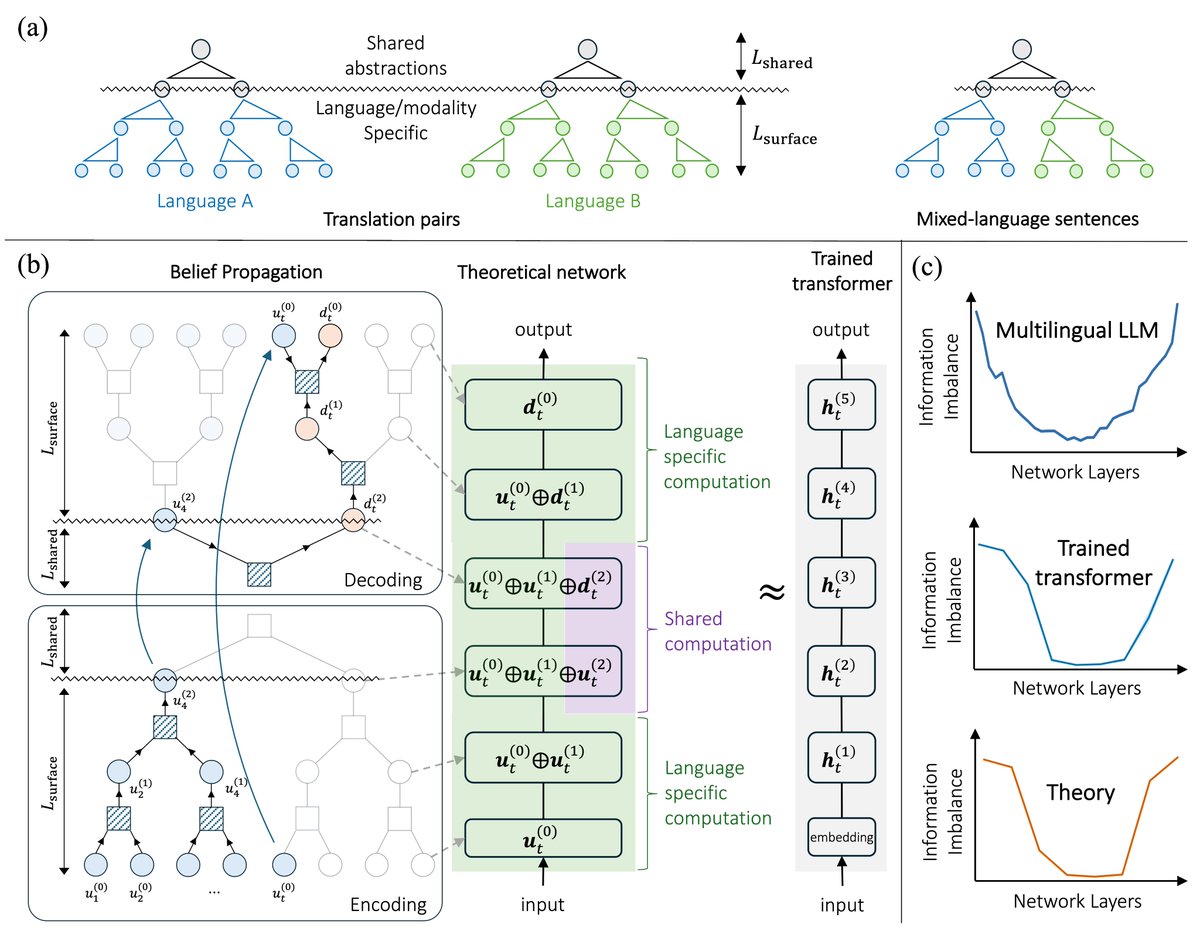
Why do different languages/modalities have similar "platonic" representations in neural networks? Why does similarity peak in the middle layers of LLMs? When does it enable cross-lingual transfer?
Our new paper develops a theory based on shared hierarchical structure. 🧵
In today’s episode of saving-peer-review:
Manuscript revisions should not be allowed during rebuttal. Too many placeholder submissions and complete overhauls.
Having to read two versions of the same AI slop should be banned under the Geneva convention.
#iclr
We’re hiring! PhD students & postdocs. To apply: motivation letter engaging on this topic+ CV, with 2 recommendation letters (PhD) or 3 (postdoc), to [email protected]. Applications from women are particularly encouraged. Please share! #PhDposition#postdoc
Thrilled that our ERC Synergy grant DeCoR, with Marco Baroni (UPF) and Alessandro Laio (SISSA), is funded. Our goal: decipher how deep networks encode and learn meaning - and lay the ground for a new field: the #PhysicsOfSemantics 🧵
@LucaAmb The surge in submissions is also caused by LLM use.
Besides, as someone who had to review multiple 120+ page incoherent word vomits, I can assure you that bad reviews or unfair rejections have never given me existential crises like LLM slop has.
How can physicists and mathematicians help understand ML? One approach: test ML methods on data we understand quite well. We – me and my awesome collaborators @IosueJoe and @victorvalbert — did this for intrinsic dimension estimation. Set to appear in @TmlrOrg ! 🧵below [1/n]
@Trong_Hatachi@iclr_conf I agree that it is drastic. Ideally, we would like to discern “only used AI to refine my rough draft” from “AI did most of it”. But we cannot. And I worry that while we wait, the peer review process will die.
We can detect AI writing from human writing to some extent. Hence..
After hours of playing guess-what-is-AI-slop (aka reviewing for @iclr_conf ), I am convinced that the only Hail Mary left to save peer review is to fully ban AI usage in *writing* papers.
Use AI for research, but communication has to be fully human.
@Nonicoc As a reviewer/reader, I have to go through multiple sloppy papers before I reach one such unicorn. No automatic method can distinguish the two. Asking reviewers to go through this is unsustainable policy for peer-reviewed venues.
@RagerGr@iclr_conf Bad scientific communication existed pre-AI, yes. But I have not seen any evidence that it has improved post-AI. Have you?
Human-slop is annoying, but AI-slop is catastrophic.. to peer-review and hence academic research.
@knowledgedelta@iclr_conf You're right on both counts. However, the problem is that it is very difficult to (quickly and scalably) distinguish AI slop from good-spirited AI-assisted writing. Unfortunately, the fraction of sloppy papers is so high that drastic measures are unavoidable imo.
Your neo-lab wants to pre-train a frontier model, but no provider will sell you enough co-located chips?
We got you.
Our new work shows that SOAP & SPlus achieve strong worker scaling to 96+ DiLoCo workers (e.g., 96 providers) by whitening the update’s covariance. 🧵1/9
I'm delighted to announce that I'll join @MITEECS as an Assistant Professor next Fall! I will be recruiting graduate students this cycle, please apply if you're interested in the science of deep learning! Despite the ambient doomerism, now is a great time to do research.
Whatever you make of https://t.co/6FFf5EBdjL, it has brought compositionality and generalisation back into the spotlight. I’d like to see more rigorous work testing these ideas.
The Random Hierarchy Model is one example. By controlling the data's compositional structure, we recover several key features of deep learning: advantage of depth, scaling laws, linear representations and circuits.
Well-motivated toy models are invaluable: they help us explain how these phenomena fit together and make falsifiable predictions about real data.
Fun fact: @nickcammarata and colleagues’ earlier “Zoom In” work inspired the RHM, back when we were still thinking about cats and dogs.