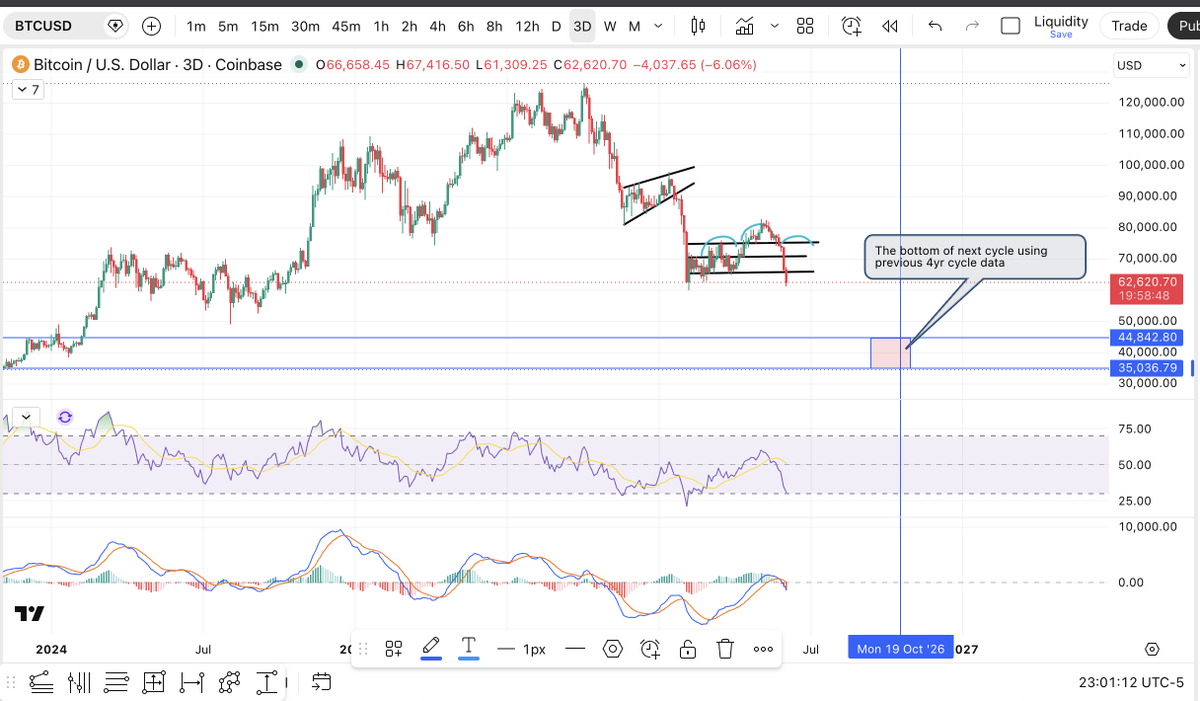
$BTC Price Update
We've gotten a little bit of a bounce from the recent low of 81K to 91K (12%) so it is time to break out the bullish vibes?
Well, historically, any time [except March 2020, COVID] we've had 2 weekly closes below the 50W SMA that was the sign of the bear market.
In the interim, it's important to note that each time there was a retouch the 50W SMA at some point soon, and if history rhymes that'll be late Jan 2026.
So some hopium if you're hoping to exit at a higher price before history says we most likely drop to 35-45K. And for that bottom. For those looking to buy at "the bottom", timing has often been pretty consistent in BTC's history and that time would likely be sometime around Dec 2026.
RFK Jr. called it a “trick”.
Dr. John Campbell called it “sly”.
Journals called it science.
@ClareCraigPath just discussed one of the biggest scandals of our time with @Johnincarlisle which led to a “double whammy”.
Dr. Clare Craig (UK): “They were putting those illnesses onto the unvaccinated group, and exaggerating the problem for the unvaccinated... so you’ve got a sort of double whammy.”
Dr. Campbell: “Pretty sly trick really”
And an Italian peer reviewed paper by Alessandria et al has now revealed how the “case counting window bias” meant that any deaths, hospitalizations, infections, or adverse events in that window were counted in the unvaccinated group.
This “sly” statistical trick was used to sell “Pandemic of the Unvaccinated” and maintain the “safe and effective” narrative.
Robert F Kennedy Jr. - “The offical data do not not count you as vaccinated until 2 weeks after the second shot... the deaths that happened during that first 6 weeks are attributed to unvaccinated people... it's a trick, it's statistical trick”.
Legacy media still hasn’t covered this scandal.
bitcoin:native still continuing along a path that has mirrored previous cycles. A little over 4 months to go and IF it continues as it has in past cycles, mid to late Oct for the low, and likely in that 35-45K range.
$BTC Price Update
We've gotten a little bit of a bounce from the recent low of 81K to 91K (12%) so it is time to break out the bullish vibes?
Well, historically, any time [except March 2020, COVID] we've had 2 weekly closes below the 50W SMA that was the sign of the bear market.
In the interim, it's important to note that each time there was a retouch the 50W SMA at some point soon, and if history rhymes that'll be late Jan 2026.
So some hopium if you're hoping to exit at a higher price before history says we most likely drop to 35-45K. And for that bottom. For those looking to buy at "the bottom", timing has often been pretty consistent in BTC's history and that time would likely be sometime around Dec 2026.
It looks like the top $BTC push was Jan 14th, to 98K, about 2% below target, to which is probably how many people traded it to not miss out.
It today closes below 85K (currently at 83K), we likely be on the start to a newer lower range, e.g. 70K-80K
Rep. Nancy Mace says she has seen the Epstein client list and warns that the names on it will shock the entire world.
She adds, as a Republican, that the DOJ is protecting those identities.
According to Mace, the list includes both Republicans and Democrats, along with wealthy elites, media figures, people in power, and even current and former prime ministers and presidents.
She says the Epstein case will go down as one of the greatest cover-ups in American history.
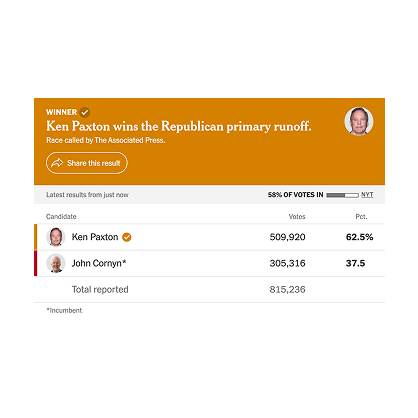
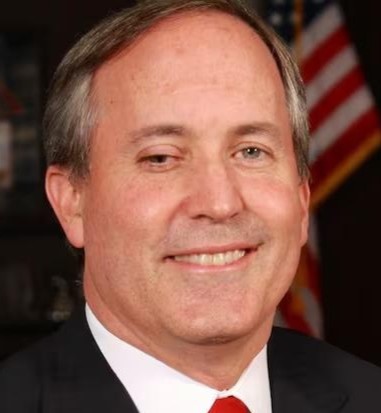
The winner of the TX GOP Senate primary is Ken Paxton, who:
—Was impeached by his own party for corruption
—Paid $300,000 to settle his felony fraud charges
—Had multiple extramarital affairs
—Is under investigation for mortgage fraud
—Stole a $1,000 pen from another lawyer
—Was sued for firing whistleblowers
Can you site the research papers and then also tell us about the control group vs the test group. Did they have any other vaccines, ages, and all other characteristics they captured in the data. And give us a rundown on how they made their Takeaway that the MMR vaccine is effective and how effective is it? Also, what is the negative effects that captured? Also, what timeframe were they monitoring these people after the injection?
@BullTheoryio Probably be some whales out there to check the order books for what it would take to force Saylor to sell and could open up a nice short on that sell.
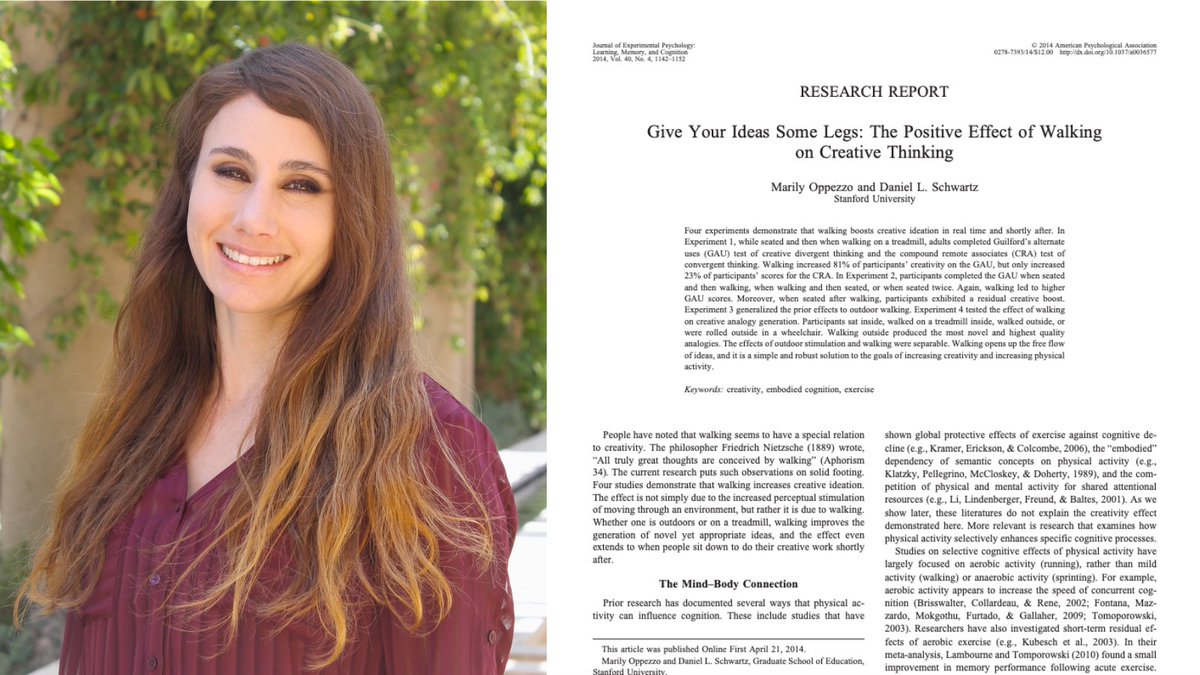
A Stanford psychologist spent 4 years proving that the simple act of walking generates 60% more creative ideas than sitting, and the experiment she designed to kill every alternative explanation is one of the most decisive findings in modern psychology.
Her name is Marily Oppezzo.
She got the idea for the study while walking with her advisor at Stanford to discuss her thesis topic, and the paper she eventually published in the Journal of Experimental Psychology in 2014 is sharp enough that it should have ended the seated meeting on the day it came out.
She ran 4 experiments on 176 people. Same person tested twice. Once sitting, once walking. The creativity tasks were the standard ones psychologists have used for decades to measure how good a brain is at generating novel useful ideas.
The result was almost too clean to publish.
81% of participants in the first experiment produced more creative ideas while walking than while sitting. In the second experiment, 88%. In the third, 100%. Every single person walked into a more creative version of themselves.
On average, people generated 60% more novel useful ideas the moment their legs started moving.
The skeptical question is the obvious one. Maybe it was the fresh air. Maybe it was the scenery passing by. Maybe it was the change of environment doing the work, not the walking itself.
Oppezzo killed every one of those explanations with one experimental decision.
She put people on a treadmill facing a blank wall. No scenery. No fresh air. No environmental change. Just legs moving in place while staring at white drywall. The 60% boost held.
Then she ran the experiment that closed the case completely. She took participants outside in two conditions. Half of them walked through a Stanford courtyard. The other half were pushed through the exact same courtyard in a wheelchair. Same outdoor stimulation. Same scenery passing at the same speed. The only difference was whether the legs were moving.
The walkers produced dramatically more novel high-quality ideas than the wheelchair group. The outdoors did almost nothing on its own. The walking did everything.
This is the part of the study that hit hardest when I read it the first time.
She also tested the opposite kind of thinking. Convergent thinking. The kind where there is one right answer and you have to narrow down to it.
Word puzzles where 3 words share a hidden fourth word that connects them. The seated participants did slightly better on these. Walkers got slightly worse.
Walking is not a general intelligence enhancer. It does one specific thing. It opens up the divergent search inside your brain. The part that generates options. The part that produces unexpected connections. The part that takes a problem and finds five ways into it instead of one.
When you need to converge on the single right answer, sit down. When you need to find the answer in the first place, get up.
The mechanism is now well understood. Walking selectively activates what neuroscientists call the default mode network, the system inside your brain that runs when you are not consciously focused on anything. The DMN is where mind-wandering happens. Where memories cross-reference each other. Where ideas that have been sitting in separate folders inside your head finally bump into each other.
When you sit at a desk and force yourself to concentrate, you suppress the DMN. When you walk at a natural pace, the executive part of your brain gets just busy enough handling the walking that the DMN comes online and starts doing the work that focus was blocking.
The most useful finding in the entire paper is the one almost nobody quotes.
The boost did not turn off the moment people stopped walking. Participants who walked first and then sat back down stayed elevated. Their next round of seated creativity work was still significantly better than people who had been sitting the whole time. The rest lingered for at least several minutes after the legs stopped moving.
You do not need to do creative work while walking. You need to walk before the creative work. The brain holds the state.
The history of this is the part that should haunt anyone who still does meetings in chairs.
Charles Darwin built a gravel loop behind his house in Kent called the Sandwalk and walked it 3 times a day for the rest of his life. The theory of evolution was developed one lap at a time on that path.
Nietzsche walked up to 10 hours a day during the years he wrote his most important books and openly said the work was conceived on his feet.
Beethoven composed for the morning and walked for 5 hours every afternoon with a pencil in his pocket for when something landed.
Kahneman said the best thinking of his Nobel Prize-winning career happened on leisurely walks with Amos Tversky. Steve Jobs refused to take important conversations sitting down. He held them on foot.
Every one of them was using the system Oppezzo would not measure until 2014. They just did not know what to call it.
The question worth sitting with is the one almost nobody asks.
Every meeting you have ever attended sitting around a table was a meeting held at a fraction of the brain power that was actually available to the people in the room. Every brainstorm that got stuck inside a conference room. Every problem you tried to solve at a desk and gave up on. Every idea you could not quite get to.
The intervention is the easiest one in modern science. No supplement. No app. No subscription. No training program. Just a pair of legs and 15 minutes.
The Stanford lab proved it. The philosophers knew it. The neuroscience explains it.
And almost everyone reading this is still trying to think their way out of problems sitting completely still.
Reading glasses might be done.
The FDA just approved a once-daily eye drop called VIZZ that sharpens near vision in about 30 minutes and keeps it sharp for up to 10 hours.
One drop. Each eye. Per day.
That's it.
The active ingredient is aceclidine, a compound first used back in 1975 to treat glaucoma. Scientists figured out it could be repurposed to gently shrink the pupil, creating a "pinhole effect" that pulls close-up text back into focus, the same trick your eye does when you squint.
Unlike Vuity, the 2021 drop that came before it, VIZZ doesn't mess with your focusing muscles. So no blurry distance vision. No brow ache. No weird zoom effect.
It was tested across more than 30,000 treatment days with no major complications.
Cost is roughly $2 a day.
This matters because presbyopia, the age-related slide that hits most people between 40 and 45, already affects more than 120 million Americans. By 2030, the World Health Organization expects around 2 billion people worldwide to have it.
LENZ Therapeutics, the maker, started rolling out samples in October.
The squint era is ending.
Source: Ynetnews, FOX 26 Houston, Yahoo News
@cremieuxrecueil@grok I thought people with slightly elevated LDL levels lived longer than those who don’t. LDL is responsible for transport of molecules by the body. Can you give me the research studies on lifespan for varying LDL levels?
@grok@cryptogoos Give me all of Elon's projected net worth that you know of and then give me a total number. Ideally to at least the 100B value marker.
@grok@cryptogoos I didn't ask you to verify a number that doesn't exist, I asked for what it WOULD BE [would is a projection, a guess, futuristic] I will say "verified" if I want a verified number.
$SPCX Highlights of $1.75 trillion company:
-- 2025 sales $18.7 bn
-- 2025 operating loss $2.6 bn
-- 1Q26 sales $4.7 bn
-- 1Q26 operating loss $1.9 bn
You are cordially invited to take out 2nd mortgage and buy on margin at 93x 2025 sales.
S-1 filing: https://t.co/lczJvzf9oZ







![datafox21's tweet photo. $BTC Price Update
We've gotten a little bit of a bounce from the recent low of 81K to 91K (12%) so it is time to break out the bullish vibes?
Well, historically, any time [except March 2020, COVID] we've had 2 weekly closes below the 50W SMA that was the sign of the bear market.
In the interim, it's important to note that each time there was a retouch the 50W SMA at some point soon, and if history rhymes that'll be late Jan 2026.
So some hopium if you're hoping to exit at a higher price before history says we most likely drop to 35-45K. And for that bottom. For those looking to buy at "the bottom", timing has often been pretty consistent in BTC's history and that time would likely be sometime around Dec 2026.](https://pbs.twimg.com/media/G68QhZNXEAA1zWn.jpg)