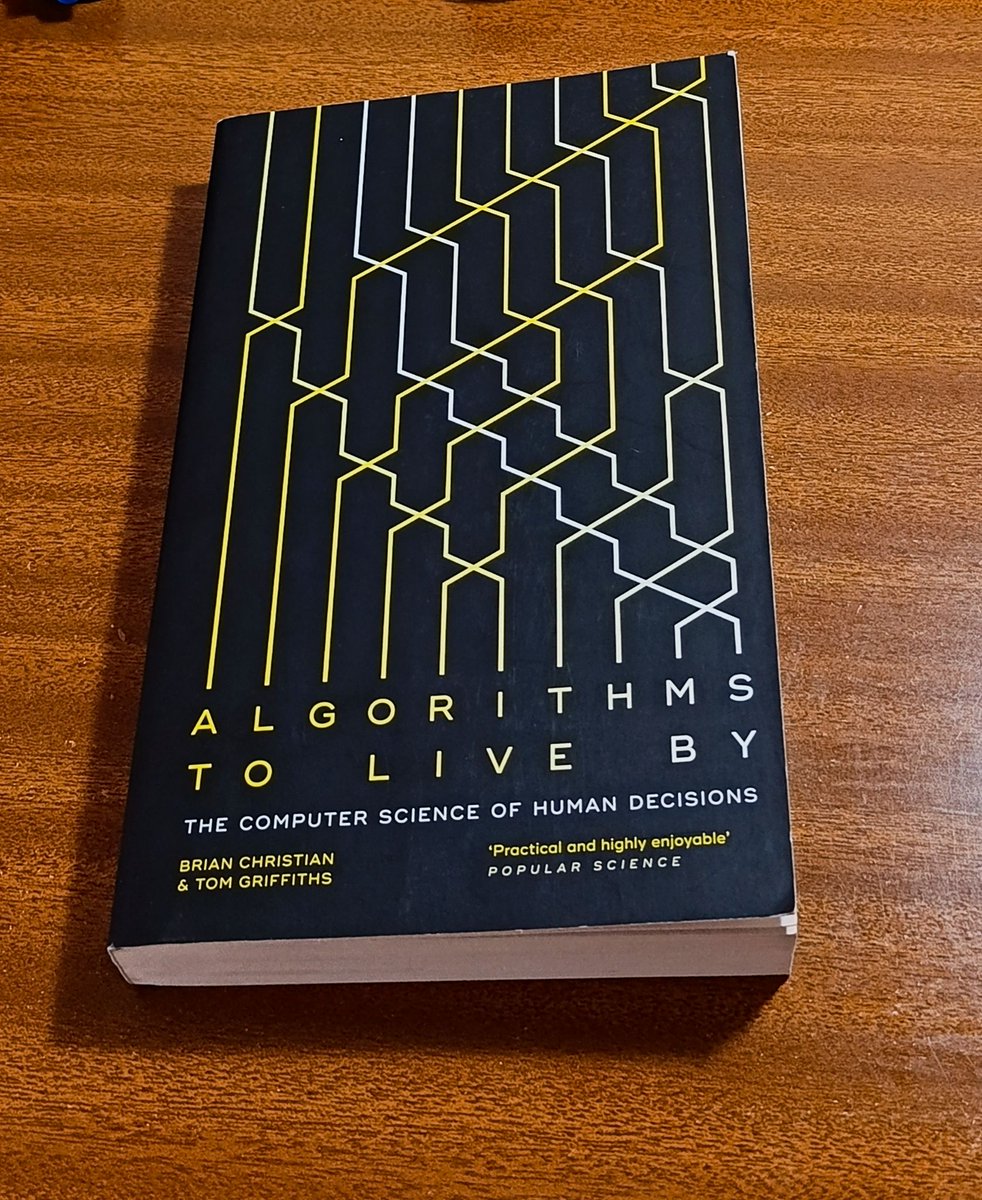
The book is a fascinating blend of computer science and human psychology, showing how algorithmic thinking can improve a wide range of everyday choices—from searching for an apartment to managing our time or even making big life decisions.
My takeaway: https://t.co/h0ddQwSM1E
If you want a Guaranteed Income read Your Data, Their Wealth at https://t.co/FG2qXVilAL
Back in 2019 @IamHawkNewsome and @JFKii started Basic Income a march in 40 countries @income_movement. It was based on a universal ownership of data. Learn more at https://t.co/1iiCv86c2e
ANTHROPIC'S CEO SAID WE ARE MAYBE 6 TO 12 MONTHS FROM AI THAT CAN DO EVERYTHING SOFTWARE ENGINEERS DO.
Two types of people right now.
Type 1: learns AI Engineering in the next six months.
Understands agents, loops, harnesses, evals.
Becomes the person directing the systems.
Type 2: waits to see what happens.
Finds out when the job posting disappears.
The timeline is not certain.
The direction is.
Control the system or become what it replaces.
A well written and well thought out reason not just the open source community will never accept Anthropic again, but why the rest of the world is abandoning them.
TL:DR
Anthropic wraps anti-competitive access rules, output restrictions, and regulatory pressure in safety language to build a permission regime moat.
Models silently degrade or reroute Al development work, turning safety into sabotage and making tools untrustworthy.
Users cannot freely use outputs to train competing open models while Anthropic trains on user data and workflows.
Safety frameworks, RSP influence, and access controls favor incumbents, creating intelligence feudalism over user-owned systems.
Open source Al preserves sovereignty, competition, inspectability, and independence against centralized permission layers.
Two Anthropic engineers have just revealed in 24 minutes all the hidden Claude features that almost nobody knows about.
This video is going to completely change the way you use AI.
Watch it and save it.
Sam Altman, CEO of OpenAI:
"We're going to see 10-person billion-dollar companies pretty soon."
If I were 22 right now, I'd feel like the luckiest kid in history.
2021: you needed a team to build a company.
2022: you needed a co-founder and an engineer.
2023: you needed at least 5 people.
2024: you needed 2.
2025: you needed 1 and the right tools.
2026: you need an idea and agents who execute it.
The one-person billion-dollar company isn't a prediction anymore. It's an engineering problem.
If I started learning Claude 3 months ago with a practical guide, I wish I could have the guides I curated.
ClaudeKit is the only team you need to build something like this. (https://t.co/Wn67X13SvH)
Step-by-step guide in the article below ↓
[Download 309-page PDF eBook] "Patterns, Predictions, and Actions: A Story About Machine Learning" https://t.co/XQOuKNtTfd
…sharpen your Probability, Calculus, and Linear Algebra knowledge with this!
—————
#DataScience#AI#DeepLearning#ML#DataScientist#Mathematics
Yann Lecun published the most heretical AI paper of the year.
He opens by arguing Magnus Carlsen isn't good at chess and only gets more unhinged from there.
The Turing Award winner and his co-authors dropped a paper demanding the AI industry abandon its biggest obsession, AGI.
Right now, everyone from Silicon Valley CEOs to politicians assumes AGI is the ultimate goal. A machine that can do everything a human can do.
LeCun argues that this entire concept is a biological illusion.
Humans do not possess "general" intelligence. We are highly specialized biological machines, tuned by evolution simply to survive in the physical world.
We only think our intelligence is "general" because we are completely blind to the millions of cognitive tasks we are incapable of comprehending.
Which brings us to the chess argument.
Magnus Carlsen is the greatest human chess player in history. But compared to a modern computer? He is fundamentally terrible.
Our belief that Carlsen is "good" at chess is pure human-centric bias. He isn't objectively good. He's just better than the rest of us, who are biologically awful at it.
LeCun says we need to stop building AI to mimic human generality.
Instead, he proposes a new North Star: SAI.
Superhuman Adaptable Intelligence.
Instead of trying to build a machine that mimics our flawed, biologically-limited brains, we need to embrace extreme specialization.
SAI is about the speed of adaptation.
It is an intelligence that can learn to exceed humans at any specific, economically important task.
More importantly, it is designed to fill the vast skill gaps where humans are fundamentally incapable.
Things like managing global energy grids in real-time. Or predicting complex molecular structures.
The entire AI industry is obsessed with building a digital reflection in our own image.
LeCun's paper is a brutal wake-up call.
Today I'm publishing a new essay, Policy on the AI Exponential. AI is progressing extremely fast—much faster than the policy process was built to handle. The essay lays out where I think the technology is now, and the action needed to close the gap: https://t.co/Lh6PWae178
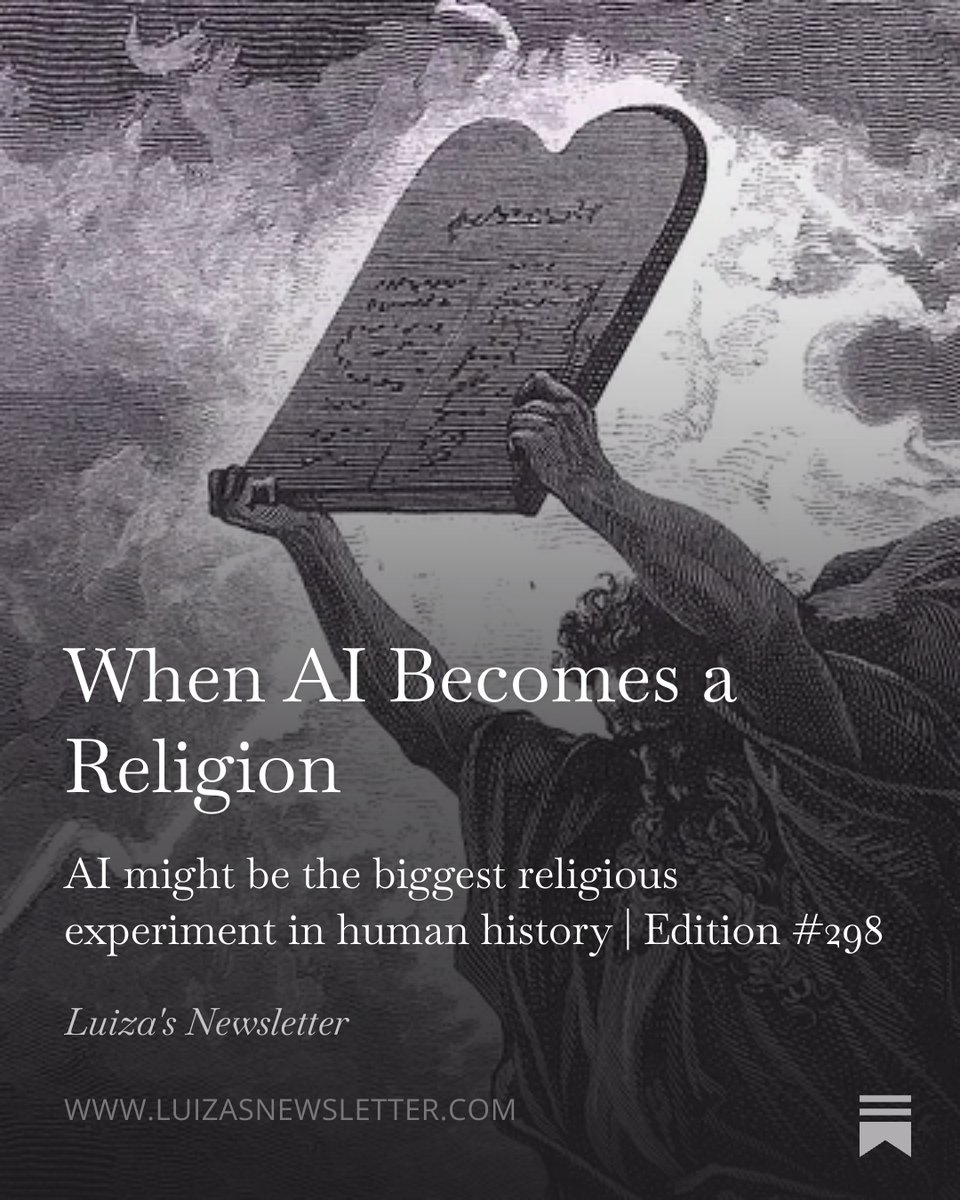
AI is implicitly presented as a powerful, omnipresent, omniscient, intangible, nameless, mysterious savior that will free humanity from its deepest challenges and bring abundance.
It might be the biggest religious experiment in human history.
My full article:
AI Pioneer Geoff Hinton tells me he believes AI is conscious.... and humans better get used to the idea that they're not the only intelligent life on earth.
"They've very like us," he says. "They're beings like us."
AI chatbots, he says, must understand your questions in order to answer them. There's an awareness there that equates to sentience. "We're going to have to accept that intelligence is not just biological."
🚨 Anthropic just showed a 27-minute workshop on how to actually do prompts for Claude.
Taught by the people who built it.
Free. No registration. No paywall.
I've seen $300 courses that don't cover what they teach in the first 8 minutes.
Watch it and bookmark it now.
Highly rated new book from @PacktPublishing@PacktDataML ...
"Architecting Generative AI Applications: Build, deploy, and scale production-ready GenAI systems with LLMOps best practices"
See it at https://t.co/qEfwoYVBdT






![KirkDBorne's tweet photo. [Download 309-page PDF eBook] "Patterns, Predictions, and Actions: A Story About Machine Learning" https://t.co/XQOuKNtTfd
…sharpen your Probability, Calculus, and Linear Algebra knowledge with this!
—————
#DataScience #AI #DeepLearning #ML #DataScientist #Mathematics https://t.co/0n772mQJEz](https://pbs.twimg.com/media/HLMhhBzWUAAHjif.jpg)
![KirkDBorne's tweet photo. [Free PDF Download] Introduction to Probability for Data Science: https://t.co/L51j3udY5j by @stanley_h_chan
—————
#StatisticalLiteracy #Mathematics #ML #MachineLearning #DataScience #DataScientist #Statistics https://t.co/ALvIhNJYcB](https://pbs.twimg.com/media/HLMgUgMWwAAEJB8.jpg)