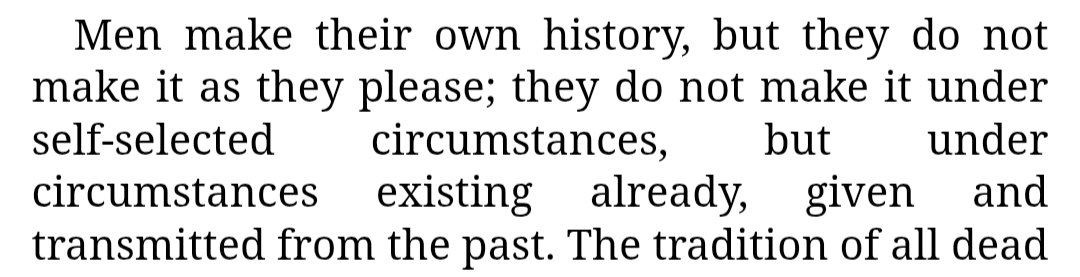
@Biyombonesaw@NiaFrome Marx considered himself a Jew pre Holocaust. But he understood identity as a historical construct that one does not fashion ex nihilo or simply as one pleases. Embracing that identity/Zionism post Holocaust is something else. Plenty of Jews didn't. There was a big shift post 1967
@DraperOr@AaronBastani You don't know what you are talking about. Amazon Prime (for film), YouTube, and other platforms have targeted ads. Even educational apps/platforms that are sometimes mandatory in schools in the US subject children to advertising
@DraperOr@AaronBastani What are you talking about? Children shouldn't be exposed to cinema? My son and I watched Seven Samurai together when he was eight. Also, there is a great deal of educational content available on YouTube, for example, and sometimes viewing such content is required for homework.
@DraperOr@AaronBastani You do heavy lifting in order to miss the point. Your initial comment was that it's on parents for allowing their kids to use social media, but targeted advertising is unavoidable if you use virtually any media/streaming platform. Knee-jerk anti-statism is cognitively imparing
@DraperOr@AaronBastani Inane response that completely misses the point. One need not engage social media to have one's behavior datamined. One need not even actively use a smartphone, since smart devices actively pursue ambient data.
@_CLancellotti What about if it were a source of significant, well-documented capital accumulation whose beneficiary insistutions still exist & have yet to recompense the descents of those whose unfree labor helped build these powerful institutions? Is that not worthy of history's scrutiny?
@cyberholstein@_CLancellotti The term "chattel slavery" was used widely by Christian abolitionists in the 1850s-60s to contrast what they regarded as the qualitatively different form slavery took in the USA from those forms deemed permissable in the Bible. But who is making claims for a "radical" difference?
@olivebranchud@_CLancellotti Do we have evidence of free (former) Roman slaves being re-enslaved because they were deemed slaves-by-nature irrespective of their having been granted the status of Roman citizen?
@olivebranchud@_CLancellotti Perhaps not singular, but the constellation of historical circumstances was unique: the slave as a commodity, production for (international) market, modern property law, simultaneous development of "scientific" racism and race-based legal status, etc
@olivebranchud@_CLancellotti It was a heavily debated legal concept that led to the American Civil War, so I'm not sure what you're referring to. E.g. if a slave is brought to a free state in which human bondage is illegal is the slave thereby free from bondage? That's a debate over the limits of property
@ianbremmer@ggreenwald Since when does "the key point" of whether something is in accordance with the law depend upon its political motivation? That's a peculiar notion of legality.
@olivebranchud@_CLancellotti More generally, it's a question of hermeneutic charity. In one sense, "chattel slavery" may be pleonastic, but in fact the expression was used widely in the 1850s-60s by Christian abolitionists to contrast unjust slavery w/slavery as deemed permissable in the Bible.
@olivebranchud@_CLancellotti Not at all. The status you speak of a social nature & slavery in antiquity was rather different in form. Manumission was virtually unheard of in the Americas & sometimes legally prohibited, because slavehood was regarded as a permanent condition. This was not typical of antiquity