AI isn’t just changing how work gets done.
It’s changing how GTM systems and teams need to operate.
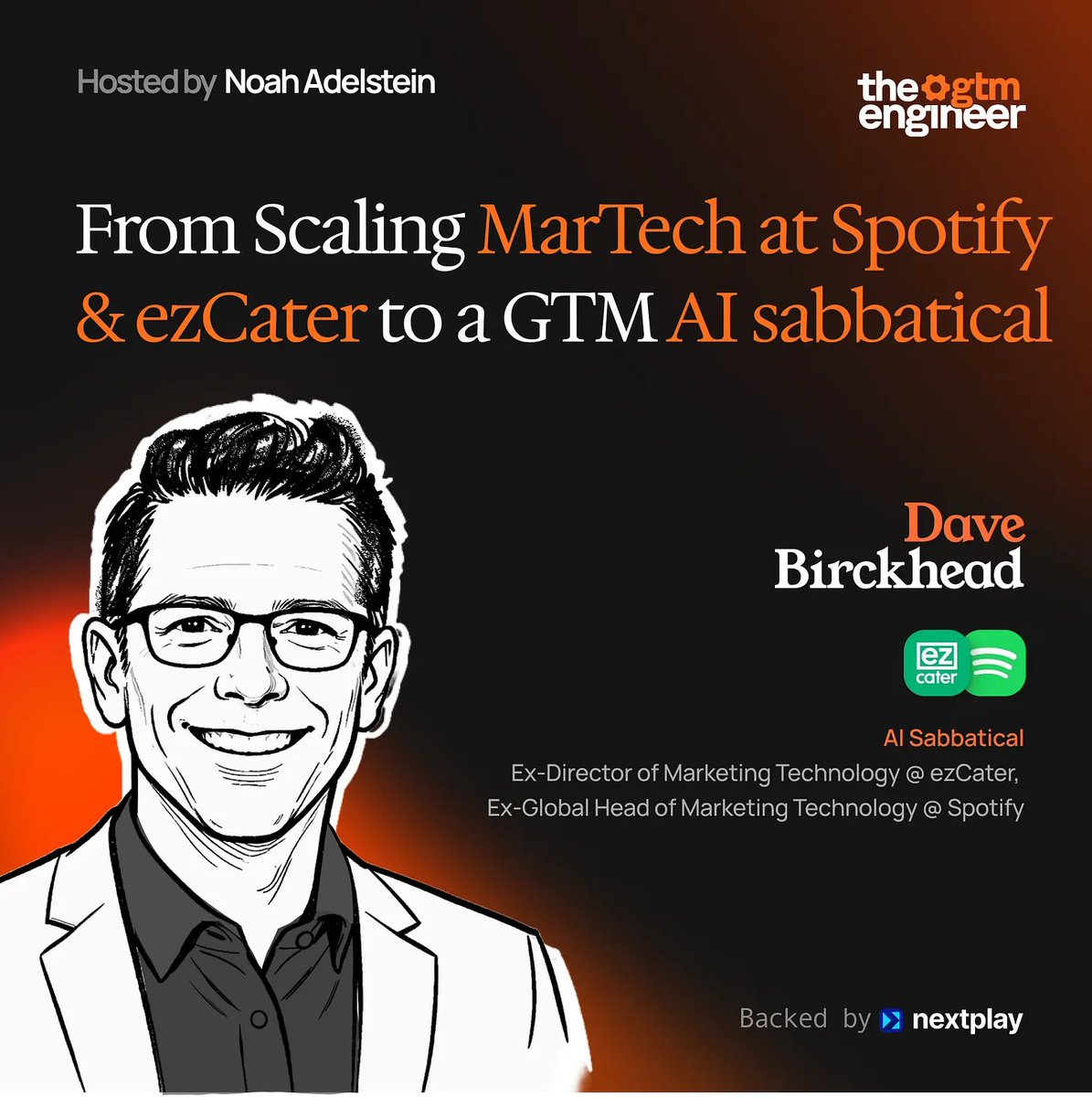
Great conversation with Noah Adelstein on:
• why leaders must become beginners again
• applied AI in GTM
https://t.co/stcqyeewoG
"Systems thinking" has now come up on the last five podcast interviews I've done.
As teams move faster and products get more complex, the ability to think about the big picture, build platforms and building blocks, and think about 2nd and 3rd order effects of your changes becomes more and more valuable.
So stoked to see people love this video.
This came about after @ajambrosino and @guinnesschen asked for some help to make an internal post.
That weekend Guinness came to my house and with the help of our phone cameras and iMovie and codex we made an internal video.
Then Zach our head of creative helped us make it real. They gave us a great team and even let us act in one you see here.
Working at OpenAI is so fucking fun. Everyone has a voice and these amazing moments get to exist!
I’ve never met Fidji & yet she’s had a profound impact on the path I’m on today.
her HEC Paris commencement speech helped me think differently about the role of creators in the age of AI.
more than that, she modeled something powerful: be unapologetically yourself. your background, your accent, your style, your differences. they’re not liabilities. be so good they become part of your advantage.
she also showed the power of imagining the future you want in vivid detail, then leading yourself and others toward it with intention & focus. this is now part of my daily practice.
thank you, Fidji!
wishing you all the best in what’s next!
Today, I shared with the OpenAI team that I have decided to leave my full-time role at OpenAI and transition to being a part-time advisor.
Three months ago, I had to go on medical leave after a severe exacerbation of a chronic illness I’ve lived with for seven years. During that time, it became clear that the road to recovery would be much longer and more complex than I had anticipated—and that I needed to focus on it fully.
When I went on leave, many people told me I was courageous for prioritizing my health. The truth is that I am only making this decision now because I failed to make it many times before.
Over the years, doctors, friends, colleagues, and loved ones encouraged me to slow down. Two years after I got sick, Facebook offered me the opportunity to take a full year of medical leave. I didn’t even pause to consider it. I immediately said no. At the time, Zuck told me I should play the long game. I wish I had listened.
Looking back, I realize that a lot of what made me successful also made this decision incredibly difficult.
I grew up believing that opportunities were precious and that when they appeared, you grabbed them with both hands. That mindset carried me from a small town in southern France to opportunities I never could have imagined. By the time I turned 40, I had already gotten to do more than I’d ever dreamed possible as a kid growing up in Sète.
I love building. My work has always given me a deep sense of purpose. OpenAI in particular felt like a role that my entire career had been building toward, which made this decision even harder.
But what I’m learning now is that grit and endurance are not the only skills required to have impact over decades. Sometimes the harder thing is to stop, listen, and trust that taking care of yourself today makes it possible to contribute for much longer tomorrow.
This experience has also strengthened my conviction about why this work matters.
It has been a jarring experience to spend my days helping build the future while simultaneously navigating a disabling disease that still has no cure.
Over the last seven years, I’ve spent countless hours in doctors’ offices, dealing with symptoms, treatments, insurance, uncertainty, and all the invisible work that comes with being a patient. Like millions of others living with chronic illness, I’ve experienced firsthand how difficult healthcare can be to navigate, even when you have every possible advantage.
More than ever, I believe that some of the most important opportunities for AI lie in helping people solve real problems in their daily lives: their health, their finances, their time and the everyday burdens that shape human experience.
In particular, curing disease is the most important thing AI could accomplish. I’m excited to continue working towards cures through OpenAI but also through my work with @ChronicleBioAI and @CODA_research.
I’m deeply grateful to @sama, @gdb and the OpenAI board for their support during this time and for offering a way for me to continue contributing to the mission without sacrificing my chances of recovery. I’m also so thankful to my team and the many extraordinary colleagues I’ve had the privilege to build alongside.
For now, my focus is recovery. But my belief in the potential of technology to solve deeply human problems has never been stronger.
Introducing ChatGPT Work, a new agent in ChatGPT powered by Codex and GPT-5.6.
It can take action across your apps and files, stay with a project for hours if needed, and turn a goal into finished work.
It’s a whole new way to get work done.
Introducing GPT-Live, a new generation of voice models for natural human-AI interaction.
Rolling out in ChatGPT starting today.
You’ll want to turn the sound on for this one.
My biggest takeaways from OpenAI's Codex lead @ajambrosino:
1. Product work has inverted. The old product process was built around the assumption that building things is expensive, so de-risk everything up front with specs, research, and prototypes. That assumption is gone. The hard work has shifted from “Should we build this?” to “Of all the prototyped attempts at this idea, what's the best idea, what should we fold together, and what do we go all-in on?”
2. Your role is now defined by the average of what you spend time on. Deginers write code, engineers do design, PMs ship. So what are you? You're now defined not by your title but by how you spend your time. If you averaged out everything you do in a week, where do most of those dots land? That’s your role.
3. Codex PMs use a "zone defense" strategy to stay on top of everything. With ideas flying at them from every direction, top-down annual planning doesn't work, so they spread their team out to cover the whole company. If two product people are working too closely, without any gaps, that's a bad sign. They space out PMs across the org for full coverage, and backfill gaps with product-minded engineers.
4. What is AI so bad at design? For two reasons: one practical, and one structural. Practically, design is harder to grade than code, and labs prioritize coding because it accelerates AI research. Structurally, good design requires novelty and culture—a model that outputs the @Linear website every time isn’t showing taste—and there’s a visual-to-code abstraction layer models can’t yet bridge. The practical reasons will likely be solved; some deeper challenges around novelty, culture, and abstraction may persist.
5. The original Codex Web release was “too AGI-pilled for the moment.” The first public Codex release was built on too ambitious a premise: give the model a task, and it comes back with the task finished. The problem was that the models at the time weren’t good enough to deliver on that promise reliably. Claude Code launched locally, asked questions, and sat with the user—a much better fit for where model capability actually was. Andrew thinks about that this constantly: are we building for where the models are, or for where we wish they were?
6. Andrew is confident that the Codex app launched in February 2026 would have failed if it had shipped in November 2025. The product was identical—the models were not. The lesson he learned was to keep prototypes that aren’t ready yet, and revisit them with each new model generation. Resist the temptation to kill a feature just because the experience isn't perfect. “It might not be ready yet” is very different from “it’s a bad feature.”
7. Taste isn’t just about aesthetics—it’s deciding what to build when you can build anything. Andrew points to a tweet arguing that people overemphasize taste’s aesthetic side (the example: Paul Graham has great taste and wears cargo shorts). Real taste blends aesthetics with systems thinking: knowing the direction, the theme, and how to present an idea. Ask “If we can build anything, what should this be?”—which he says is now the most important decision to make, in every field.
8. The design process isn’t dead. Yes, the formal design process as taught in design schools is finished. What remains is the meta-awareness of where in the product development process you actually are. The danger Andrew sees is the fully polished prototype that looks production-ready before anyone has done the research, and a roomful of people who assume it’s further along than it is. “That’s the design process now,” he says, “multiplayer exploration that looks like a finished product.”
9. “PRDs are dead” is also completely wrong. Because implementation has become cheap across every format, it’s tempting for non-engineers to jump straight to prototypes and for engineers to write long documents—when neither is the right tool. Andrew’s rule: if you’re trying to establish product clarity around a vague area, it’s probably a document; if you’re stress-testing an interaction pattern, it’s a prototype. The medium used to carry an implicit signal about where you were in the process, and now it doesn’t.
10. Most careers are longer than any one moment of failure. Andrew’s current success at OpenAI is, in his telling, 10 to 15 years of accumulation: skill set, passion, and market timing finally lining up at once.
Work at OpenAI is being transformed by agents, in every department.
Across our entire company, people are using Codex to do work that is more complex, longer-running, and increasingly cross-functional.
Our internal usage offers an early look at how agentic tools may reshape work as they become more capable and broadly available.
I thought I was learning a new tool.
Instead, I found myself questioning the role of the software itself.
Some thoughts on Codex, organizational memory & why I think the primary work surface for marketers is about to change.
The Magical Mystery Tour: https://t.co/HiM0TY10UM
Steve Jobs wanted us dead:
“In their internal meetings they literally said: We’re going to kill you.”
“Imagine that you're a small startup and then the most respected product company in the world —and the person you look up to the most— Steve Jobs says that he's coming after you.”
“But not only that, later they go and buy Beats Music and bring in Dr. Dre and Jimmy Iovine!”
“We're going to kill you. That's what they literally said in their internal meetings. They gave us six months to live.”
Not long ago, I stepped into uncertainty.
I took a sabbatical to go deeper into applied AI: building, experimenting, learning.
Today, I’m incredibly excited to share that I’m joining @OpenAI to lead Marketing Technology.
Grateful to all who helped me take the leap.
Onward.
codex is the best AI coding product and we want to make it easy to try.
for the next 30 days, we are giving companies that want to try switching over two months of free codex usage.
The deeper I go into AI, the more convinced I am that we need practices that help us to slow down.
Reading Homer and Emily Dickinson aloud with family has reminded me that things like imagination & inner power may matter now more than ever.
https://t.co/ikGI3DxUrt
As coding agents have become the standard for developing software, we've transformed Sierra's engineering interview process to be AI-native. We've documented our lessons here, and very curious how others in the industry are navigating https://t.co/xbqM5bzvUg
hot take :) The biggest and most productive people in the AI era are the folks who are already good at their jobs. AI as a multiplier, not an equalizer/democratizer
Union Square Ventures' @mignano says that when he was at Spotify, @GustavS had a famous saying: "Talk is cheap, so you should talk a lot."
"And what he means by that is the cost of getting something wrong is actually way more expensive than the time it takes to talk, align, and earn the right to go invest, spend, or bet on something."
"And what I've always loved about @USV is that they have a similar philosophy — they talk a lot. It's a small team, but they spend a lot of time together forming their point of view on the world. And I think that's what's given them the edge."
the 10x engineer is now a 1000x engineer
Turns out AI dev skillset is not evenly distributed. The best developers know how to use the tools and direct agents better than the average developer, and the gap is only growing!