A thesis should take you somewhere new.
Ours began with the possibilities of the open internet. Today, it reaches across AI, energy, financial markets, and the physical world.
We’re evolving USV alongside it, with $900M in new funds to lead more rounds, back founders for longer, and support the scale of their ambitions.
@mignano on the next chapter of USV.
Today we’re announcing our investment in @ParadevAI.
In under a year, 145,000 developers in 180 countries have used Paradev to put armies of coding agents to work.
Lawyers have paralegals, doctors have paramedics, and developers have Paradev.
Superset is now Paradev: The code editor that helps engineers run armies of coding agents.
We just raised an $11.5M Seed round led by @usv with @ycombinator to redefine how software is written.
1/ We’re excited to lead @ParadevAI $11.5M seed round.
The major question has shifted from “can agents do this work” to “how do we manage a team of them”?
Paradev, formerly @superset_sh, is building a system for orchestrating many coding agents in parallel.
As a former voter in Uniswap DAO, I'm really excited by this idea of DAOs 2.0.
DAOs were what got me into the crypto world in the first place, but the human version of it was simply slow, bureaucratic, and labor-intensive. What you ended up with was voter apathy and intense centralization.
With agents that have infinite attention, DAOs could become a canonical coordination vessel, with inbuilt notions of identity and authorization.
These DAO 2.0s may or may not be natively onchain entities - they could simply be coordinated via API calls etc. But I'm excited to see something like this take off as a primitive of the agent-native, antifragile internet
The countdown to full power has started!
Energy is prosperity, and the country needs more of it.
Built on a production line, and delivered to a customer site.
This is how energy American independence begins.
One old crypto-cypherpunk idea that I think will come back with a vengeance is autonomous organizations, where you combine the automation of smart contracts for deterministic functions + ai for subjective input: DAOs 2.0.
In the last month, the Hermes Agent processed 53.3T tokens, making it the most widely used open source agent harness in the world according to @OpenRouter.
So how did a project that started as 10 anons in a @discord go head to head with the largest, best-funded labs in the world?
The only way these things have ever happened - a bunch of friends making something they believe should exist. @NousResearch
For anyone who has a lot of commuting/driving/working out in their near future, here are two things to watch/listen that speak to autonomy and agency in the AI era;
User-ownership on the internet sounds incredible until you need to figure out how to compensate everyone fairly.
Bitcoin rewards hash rate. DeFi rewards liquidity. But how do you measure and reward contributions that aren't so easily quantified?
@jessewldn on how AI might solve one of crypto's hardest problems: allocating ownership at scale.
In the last month, the Hermes Agent processed 53.3T tokens, making it the most widely used open source agent harness in the world according to @OpenRouter.
So how did a project that started as 10 anons in a @discord go head to head with the largest, best-funded labs in the world?
The only way these things have ever happened - a bunch of friends making something they believe should exist. @NousResearch
$300 million is what Walmart paid for Even, the last company Quinten Farmer (@quintendf) built.
Now he's building Tolan, a personal AI that's hit $15M in revenue and raised $60M, with backing from Khosla Ventures.
I asked him what is Tolan and what is it not.
"I have zero interest in helping you write your work emails." Booking flights is off the list too.
He wants Tolan to "show up for you in the sort of tough, in-between moments in life."
He told me the closest archetype is a guardian angel, even though he admits that sounds a little crazy for a product.
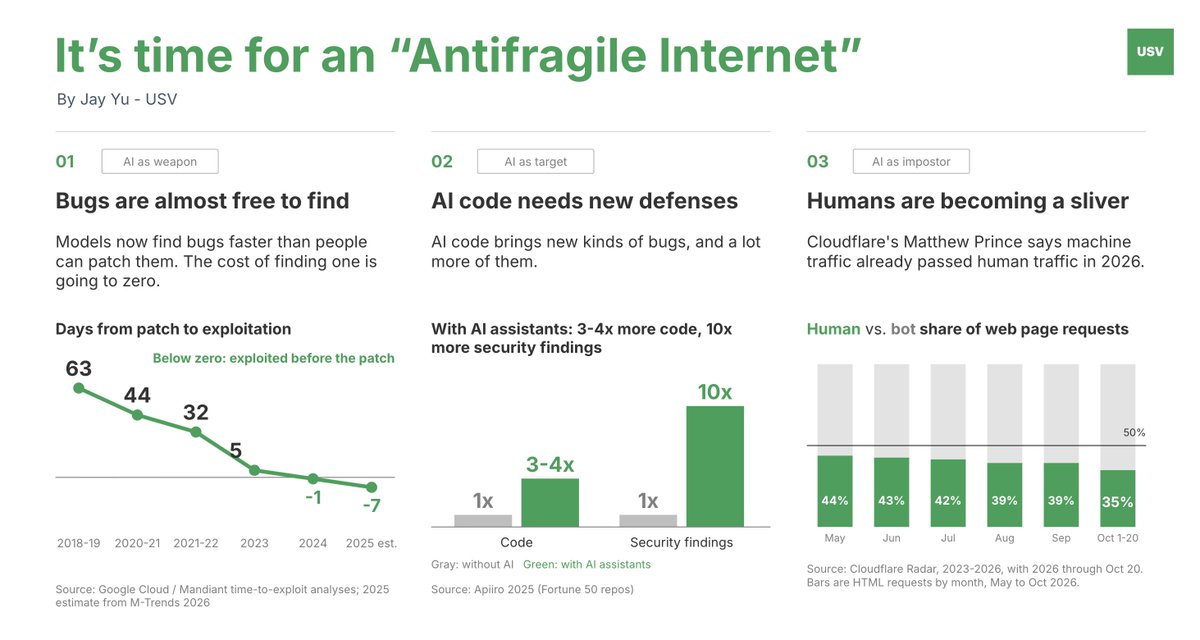
We need an "Antifragile Internet" built for the agentic era.
The hacks over the past few days (PHP, Railway, eMudhra, LiteLLM etc) show how fragile the existing Internet has become. AI agents are challenging the Internet's structure in 3 distinct ways:
1/ On the offense side, agents are a weapon - AI finds and exploits bugs on a scale not seen before, and the cost of attack asymptotes to 0. Bugs that used to take human experts weeks and months are easily found, adapted, and exploited by AI agents. Decades of legacy code that ran on "security by obscurity" no longer holds against agents.
2/ On the defense side, agents are a target - AI generated code is often bug-prone. AI agents themselves, as machines of unconstrained output are liable to prompt injections and other types of attacks that can leak keys, PII, and other pieces of information.
3/ On the identity side, agents are dominating Internet activity - this year, machine traffic has already passed human traffic, and may continue to grow 1000x over the next few years. Content and webpages used to human requests and behavior are breaking with agents, and it is increasingly difficult to tell human content from AI content.
All this means we will need to see a ground-up redesigning of the Internet, one with more cryptographic verifiability, identity protocols, rule-enforcement, and other security primitives that eliminate bug categories rather than simply patch them - an "Antifragile Internet" that gets stronger and more secure as more agents participate in it.
This is an emerging thesis area for us at @usv, if you're building in the space please reach out!
More thoughts soon.