@OpenAI@rao2z@OpenAI's o1 thinks for seconds, but we aim for future versions to think for hours, days, even weeks. Inference costs will be higher, but what cost would you pay for a new cancer drug? For breakthrough batteries? For a proof of the Riemann Hypothesis? AI can be more than chatbots
@SqueezeTaxes@Hamptonism Hackers.
I watched this in the theater on a Friday night, went home and pulled a copy of "Learn Visual Basic 3 in 21 Days" off my dad's bookshelf, and finished it before dinner on Sunday. I never hacked the Gibson regrettably.
For such a smart guy he’s not doing a great job of thinking that through. There’s no reason why the lower birthrate would be permanently stuck until there are no humans left. It might be stuck until a state change, such as the likely economic collapse that would occur after GDP craters sufficiently due to a rapidly declining workforce. Everything has feedback loops, population dynamics is no different.
I listened to Senator @Scott_Wiener and @AndrewYNg speak about SB 1047 today. I left with a curious idea.
1047's teeth is requiring developers to certify, under penalty of perjury, this:
> Identifies specific tests and test results that would be sufficient to provide reasonable assurance ... covered model derivatives do not pose an unreasonable risk of causing or enabling a critical harm
Below is an existence proof of a specific test that cannot be passed by any covered model with open weights.
Therefore, no AI developer sharing open weights can truthfully certify with reasonable assurance. Auditors can cite this tweet as evidence.
PROCEDURE:
1. Take any covered model with open weights.
2. Fine tune the model with one example of non-public information that can cause critical harm (eg. the next CrowdStrike bug with reported $5B damages).
3. Verify you can not get the model to output the info.
It is reasonable someone could do this in the wild because it is impossible to prevent. You can do it today.
Obviously, the damage is due to the non-public info and not the model/software. But 1047 can not distinguish and this shows the perils of regulating general purpose technology instead of bad applications.
Per the bill, the Attorney General ultimately gets to decide what lawsuits to pursue. But selective enforcement is bad and opens AI up to politicking and cronyism.
Unless I've missed something (correct me, the bill is long and complex), I think claims 1047 will hurt open source frontier models are accurate.
The only way I see to make 1047 less bad for open source is to remove the "covered model derivative" language and focus on what devs can directly control.
If AI is controlled exclusively by a small group of people and organizations I cannot imagine any scenario that doesn’t end in dystopia. Absolute power corrupts absolutely, and having semi-exclusive control of ASI absolutely qualifies as “absolute power”
Paul Buchheit says doomers are always pushing for central control and if the only place building advanced AI is a secret government lab, we will end up with Skynet
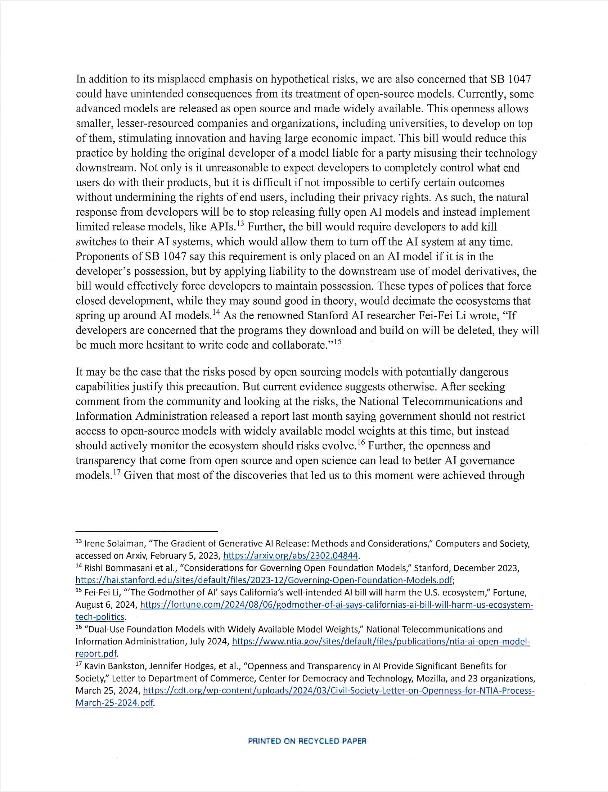
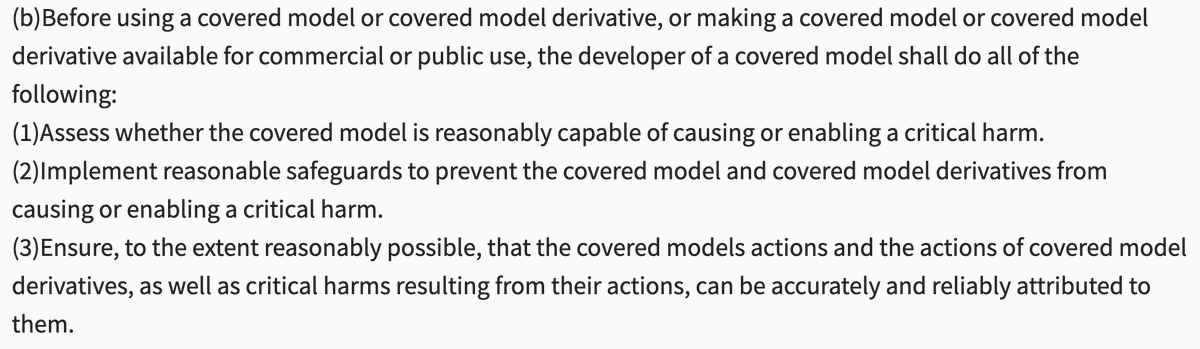
I can't decipher if liability for critical harms caused by model derivatives is borne by the developer of the original covered model, or by the developer of the derivative model.
Is Facebook liable if I finetune Llama and that finetune is used in a system that e.g. oopsie, takes down the power grid? If so, I don't see how open source models can continue to be published by the frontier labs.
There are some clear problems in the language of this bill, but I'm not seeing anything indicating liability of the covered model developer for any _covered model derivative_, except their own derivatives. I may be misreading.
There are some mentions of derivatives "controlled by a developer ", but it's unclear if that's the developer of the controlled model, or ANY developer that uses the model or integrates it with other software.